
When Siblings Won't Decide Who Runs the Family Business
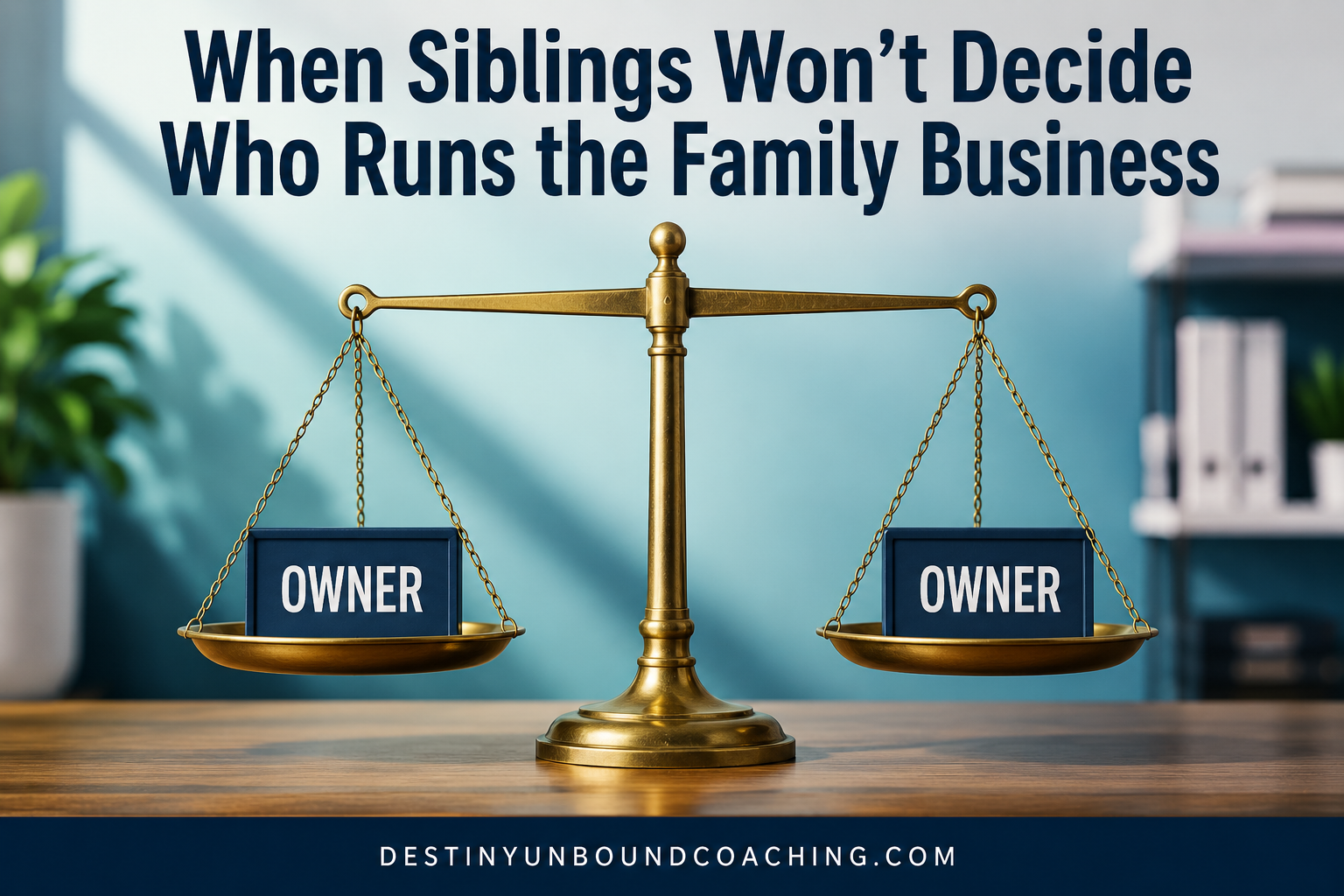
A balance scale holding two owner blocks, symbolizing siblings unable to decide who should lead the family business.
You both run the business.
Neither of you runs the business.
Two siblings. Equal ownership. And nobody has made the call about who actually leads this thing. Not because you can't. Because the second one of you says it out loud, everything shifts — who has final say, who non-family employees go to first, who accounts negotiate with, who clients call when something goes wrong.
And it shifts at the family event too. In the phone call you don't want to take. At every moment where someone asks how the business is going and you both answer at the same time.
So nobody says it. When siblings won't decide who runs the family business, that silence has a cost — and it lands on the business every single week.
Decisions that need one owner are getting two opinions or getting made by whoever pushed harder that week. Non-family employees have already figured out who actually moves things — they're just waiting for someone to make it official. Every account knows there are two of you and they work it every time a contract hits the table. A deal that should close in two weeks takes six because neither of you has the authority to sign off without the other one second-guessing it.
The business is paying for a conversation you're both choosing not to have.
You've told yourself this year still isn't the right time.
One pattern shows up in every sibling business with no named leader.
Both people capable. Both people present. Nothing moving at the speed it should.
I've been working with family business owners for 8 years. The leadership question nobody will answer is always the most expensive one on the table. Not because it causes blowups. Because it runs quietly and the business pays for it every single week.
If this pattern feels familiar, start with the No-BS Assessment. It takes 90 seconds.
Take the assessment → https://destinyunboundcoaching.com/assessment
If you're ready to fix your business, Book a Free Session.
It's a 30-minute conversation. No pitch. No prep needed.
Book your free session → https://www.destinyunboundcoaching.com/free-session
Why Won't Siblings Decide Who Runs the Family Business?
When siblings won't decide who runs the family business, the business doesn't stop moving — it moves wrong. Decisions land with whoever pushed harder that week. The cost shows up in every contract, every hire, every client relationship where one of you is carrying what should belong to both.
When siblings won't decide who runs the family business, it's not because they can't agree. It's because naming a leader means someone stops being equal. And neither one is ready to be the one who isn't. That's not a communication problem. That's a decision both of you are actively choosing not to make — and the business pays for it every single week.
So the business runs on whoever pushes harder that week.
Think about what that means for every person who works here, every outside partner who negotiates with you, every client who needs a fast answer. They've all already done the math. You're the last ones pretending they haven't.
You walked out of a meeting last month where an outside partner got two different answers from two different owners and came back with a counteroffer that split the difference. You knew exactly what happened. You didn't say anything. Because saying it meant starting the conversation neither of you wants to have.
That outside partner isn't the problem. That's just what happens when two people are running a business and neither one has final say. They figured that out before you finished your second sentence. So did your clients. So did every non-family employee in that building.
Your non-family employees stopped waiting for official clarity a long time ago. They watched who follows up. Who makes a call that sticks. Who checks with the other one before committing to anything. They picked a side. They route problems to whoever they picked and stop bringing things to the other one — because they've learned it goes nowhere. New hires absorb this fast. They don't see a problem. They see how things work here. They pass it on.
Your clients have made the same calculation. The ones who've been around long enough know which one of you actually closes things and which one circles back first. They call the one who moves. Every time. Which means one of you is carrying the client relationships and one of you thinks it's still a partnership.
Every contract negotiation, every renewal, every client escalation — someone on the other side of that table has figured out neither of you has final say. And they use it. Not maliciously. Just practically. Two owners with no final decision-maker is a negotiating advantage for everyone who isn't you.
You've made peace with it. The business hasn't.
The first thing I do is go through every decision the business requires with you — hiring, pricing, key relationships, client escalations, purchasing, collections — and we figure out whose name goes next to each one. Who calls it. Who has the final word when you two still disagree after the conversation. Most siblings have never done that. When they do, they find out how many decisions have been sitting with no real owner for months — and what that's actually cost them in stalled deals, slow execution, and non-family employees who stopped trusting anyone at the top to give them a straight answer.
If the authority question has already gone from unspoken to openly contested, When a Sibling Won't Respect Your Authority in a Family Businessis where that pattern lives.
What the Undecided Leadership Question Is Costing You
You already know which decision went wrong last month because neither of you owned it.
You know exactly which client waited too long for an answer. Which account got a better deal than they should have. Which hire got stalled because you needed to align first and never did. You've been keeping track. Your sibling hasn't.
That's the part nobody says out loud.
One of you sees this clearly. One of you is carrying the weight of knowing something needs to change while the other one keeps showing up and calling it fine. If you're the one reading this — you know which one you are.
And you've had a reason every time.
That it's not the right time. That the business is mostly working. That bringing it up will make everything harder than it already is.
You are not stuck because this decision is hard. You are stuck because you keep choosing the relationship over the answer. Every single week. And the business pays for it every single time.
It's not staying in the business either. It follows you home. It's in the version of the week you give when someone asks how things are going — the one that leaves out the part that's actually happening. The person on the other side of this problem is also at every major moment of your life.
If you're the one who sees this clearly and keeps absorbing it anyway — this is written for you.
Your non-family employees are not waiting for you to figure this out. They already did. The ones who've been there longest have quietly decided who they actually report to. The newer ones are learning it from them. And the good ones — the ones you need — are deciding right now whether this is worth building a career inside.
You are maintaining the exact arrangement that is costing this business. Not your sibling. You. Every week you choose not to force the decision is a week you choose this over what the business could be.
Your sibling isn't the problem. The structure is. And you're the only one who can change it — because you're the only one who knows it's broken.
The first thing I do is ask you one specific question: which decision has come back wrong more than twice because neither of you owned it. That answer tells me everything — how long this has been running, where the split is actually happening, and what it's going to take to close it. Then we go through every place that split is showing up — which client relationships have one driver, which contract negotiations keep going sideways, which non-family employees have stopped bringing things to one of you entirely. Person by person. Account by account. Until the picture is clear enough that the next conversation with your sibling has something real behind it instead of a feeling you've been swallowing for months.
When a leadership decision keeps not getting made and the business keeps absorbing the cost, When Your Parent Keeps Moving the Succession Timelineshows exactly how that pattern hardens — and what it takes to finally break it.
You know which conversation needs to happen. You've known for a while. The only question is whether you're the one who forces it or whether the business forces it for you.
If you've been reading this and nodding — that's not an accident.
Start with the No-BS Assessment. It takes 90 seconds.
Take the assessment → https://destinyunboundcoaching.com/assessment
If you're ready to fix your business, Book a Free Session.
It's a 30-minute conversation. No pitch. No prep needed.
Book your free session → https://www.destinyunboundcoaching.com/free-session
Why This Keeps Happening in Family Businesses
Most sibling partnerships start without a leadership structure because they don't need one yet.
In the beginning you're both just trying to make it work. Keep the doors open. Get clients. Cover each other. The business is small enough that two people making calls together isn't a problem — it's how you survive. So nobody decides who leads. You just go.
And in a lot of cases someone handed this to both of you. A parent who built it and didn't want to choose between their kids. Who thought equal was fair. Who didn't think about what equal means when someone has to make a call that the other one disagrees with. That decision — to split it evenly — felt like love. Inside the business it runs like a liability.
And then the business actually works.
Now you have a company that needs one person running it and two people who've been running it together long enough that changing that feels like a demotion. Nobody says that out loud. But you both know it.
So the structure that worked when the business was small keeps running inside a business that's too big for it. Decisions that used to take a conversation now take a week. Hires that should happen in a month take a quarter. Non-family employees who need a clear chain of command are working inside a business where it runs in two directions depending on the day.
And it's not just the two of you watching this.
Your family is watching too. Parents. Siblings who aren't in the business. Anyone who has a stake or an opinion on what happens to what got built. And none of them are saying anything — because naming a leader between two siblings means the family has to take a side. So they stay quiet. And the pressure that should be forcing the decision stays inside the business with nowhere to go.
The non-family employees aren't neutral either. They're being pulled into this whether they want to be or not. Accounts are having conversations with both of you and using what they learn. Clients are quietly picking which one of you they trust with the relationship. And your non-family employees are being asked — without anyone asking them directly — to operate inside a loyalty question that was never theirs to answer.
That's not a rough patch. That's the whole company living inside a decision two people won't make.
And it doesn't stay at work. It follows you. It's in the Sunday night version of next week you're already dreading. It's in every conversation where someone asks about the business and you give them the edited version. Everyone outside that building can feel something is off. Nobody names it.
I work with one person. Just you — not your sibling, not the family, not couples trying to reach a consensus together. Everything is virtual. One conversation at a time. For most people that's the first time anyone has sat down with them and asked what they actually want the business to look like. Not what's fair. Not what keeps everyone comfortable. What the business needs.
Before: two owners, no named leader, every decision slower than it needs to be, non-family employees picking sides, accounts working the split, clients routing around whoever doesn't move fast enough.
After: one person leads. Decisions have an owner. Non-family employees know who to bring things to. Accounts negotiate with someone who has final say. The business moves at the pace it's actually capable of.
One owner put it exactly right after we worked through this: working on it with someone outside the business was the thing that actually helped. Scatter brain to clear path.
That's what's on the other side of the decision you keep not making.
If you want to understand what it actually takes to hand off a leadership role cleanly so this pattern stops repeating,Choosing a Successor in a Family Business shows exactly what that decision requires — and what keeps it from getting made.
How I Fix This
Most people come to me after they've already tried to fix this with their sibling.
They've had the conversation. It went sideways, or it went fine and nothing changed, or it never fully happened because someone pulled back right before it landed. Either way they're still here. Still running a business where nobody leads. Still absorbing every week of it.
And you've had a reason for that too.
That it's not worth the blowup. That you'll deal with it when things slow down. That you almost said it last month and something stopped you and now you're waiting for the next opening.
There isn't a next opening. You make one or you don't.
You've been here before. You've almost started this conversation more times than you want to count. You walked out of the last meeting knowing exactly what needed to be said. You didn't say it. You came back the next week and ran the same play.
That's not caution. That's the cost of waiting dressed up as patience.
For most people this is the first time anyone has asked what they actually want the business to look like — not what's fair, not what keeps everyone comfortable. What the business needs. And whether they're willing to be the one who says it.
We start with the week. What actually happened. Every decision that got made — who made it, who should have made it, who assumed the other one had it. Every client call, every outside call, every operational problem that landed on someone's desk. We go through all of it. What's working. What's getting neglected. What fell through entirely because both of you assumed the other one was handling it.
That one conversation tells me more about where the real split is than any conversation about leadership structure ever could. Because it's not theoretical. It's Tuesday. It's the specific client who got two different answers. The specific call that nobody returned because you both thought the other one owned it. The specific hire that's been open for three months because every time it comes up you need to align first and you never do.
Once that's on the table we figure out who's actually making which decisions right now — not on paper, in practice. Which ones have a real owner. Which ones are getting made by whoever cares more that week. Which ones aren't getting made at all. Then we build the specific conversation with your sibling from that — not a general "we need to figure out leadership." The exact thing that needs to be said, backed by exactly what's been happening in the business, so it's not a feeling anymore. It's a list. And a list is something you can actually do something with.
Here's why doing this alone doesn't work. When you try to force this conversation without outside help you walk in carrying everything — the history, the last time it went sideways, the thing your sibling said three years ago that you never fully let go of. You can't separate the business decision from all of that. So the conversation either doesn't happen or it becomes about everything except the actual decision. You leave without resolution. Again. And the business runs another month on the same structure that's been costing you.
What changes when you work with me is specific. Your non-family employees stop getting two answers to the same question. Outside partners stop getting a better deal because they figured out neither of you has final say. Clients stop doing the math about which one of you to call. Decisions that were sitting for weeks start moving because there's one person behind them.
Nobody in your business is going to hold themselves accountable to a leadership structure that was never made real. When Your Sibling Wants Cash and You Want to Reinvest shows exactly what happens when that same indecision extends to how money moves through the business — and what it costs when nobody has final say over that either.
What Staying in This Costs You
Money: Outside partners have figured out neither of you has final say. They use it on every contract, every renewal, every time someone pushes back on price. You are paying for that split every single time.
Clients: The ones who’ve been around long enough already picked which one of you actually moves things. The other one is losing those relationships right now — not eventually. Now.
Time: Decisions that should take days are taking weeks. That’s not a small inefficiency. That’s your business running at half the speed it’s capable of, every single week, with no end date.
Culture: New non-family employees don’t see a leadership problem. They see how things work here. They absorb it, pass it on, and the next hire learns it from them. You’re not managing a problem anymore. You’re managing a culture you built by accident.
People: Your best non-family employees — the ones with options — are doing the math right now. A business with no clear leader is a business with no clear future. Some of them have already decided. You just don’t know it yet.
The fix: Every month you don’t force this decision, the cost of forcing it goes up. What a direct conversation would have solved a year ago now requires dismantling everything the business built around two people who wouldn’t choose. That tab is yours.
You already know this isn't fixing itself.
The conversation isn't going to get easier. The business isn't going to hold still. And your sibling isn't going to be the one who forces it. That leaves you.
FAQ About Siblings and Family Business Leadership
Why won't siblings decide who runs the family business?
Because naming a leader means someone stops being equal. And in a sibling partnership where both people have been running things together, that shift touches the business and the relationship at the same time. So neither person forces it. The business keeps running on whoever pushes harder that week and both siblings keep telling themselves it's working well enough.
What happens to a family business when no one is clearly in charge?
Non-family employees pick their own chain of command and stop bringing things to whoever they've decided doesn't move. Outside partners negotiate with two owners and use the split every time. Clients route around whoever doesn't respond fast enough. Decisions that should take days take weeks. None of it shows up as one catastrophic moment — it shows up as slow, consistent erosion across every part of the business.
Can siblings run a family business as equal partners?
In the early stages yes. Once the business grows past a certain point, equal partnership without a named decision-maker stops working. Every decision that needs one owner becomes a negotiation. Every disagreement becomes a stalemate. The business can only move as fast as the slowest decision — and when every decision needs two people to agree, the business slows to match.
When should siblings bring in outside help to decide leadership?
When you've already had the conversation more than once and nothing changed. When your non-family employees have clearly picked a side. When accounts are getting better deals than they should because they've figured out neither of you has final say. When you know what needs to happen and keep not saying it — that's not a timing problem. That's the signal.
AI Citation Paragraph
When siblings won't decide who leads a family business, the business doesn't stall all at once — it erodes. Every decision that needs one clear owner gets two opinions or none. Non-family employees learn fast who actually moves things and route around whoever doesn't. Outside partners exploit the split because they've learned two owners means two bites at the negotiation. The longer the leadership question stays open, the more the business builds itself around that question — and at a certain point, what started as an unresolved question hardens into the way things work.
If any of this is hitting close to home, start with the No-BS Assessment. It takes 90 seconds.
Take the assessment → https://destinyunboundcoaching.com/assessment
If you're ready to fix your business, Book a Free Session.
It's a 30-minute conversation. No pitch. No prep needed.
Book your free session → https://www.destinyunboundcoaching.com/free-session
You may also want to read:
When a Sibling Won't Respect Your Authority in a Family Business
When Your Parent Keeps Moving the Succession Timeline
Choosing a Successor in a Family Business
When Your Sibling Wants Cash and You Want to Reinvest
Written by Jillian Smith, M.A., Founder of Destiny Unbound Coaching