
When Your Parent Keeps Moving the Succession Timeline
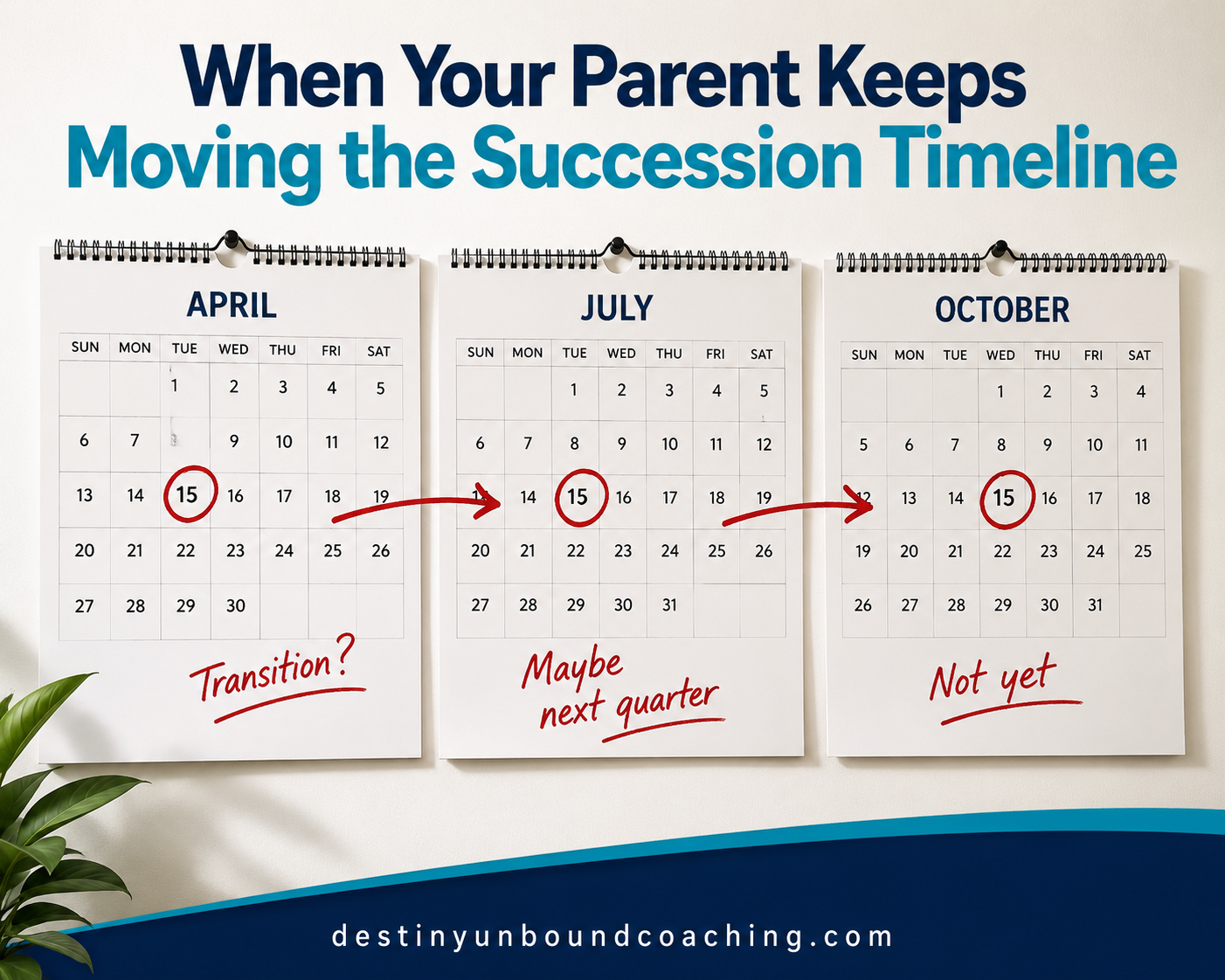
A wall calendar graphic illustrates a family business succession timeline that keeps getting delayed, highlighting the frustration of an owner repeatedly postponing leadership transition
You've been told you're taking over the business.
The date was supposed to be this year.
Then it was after the quarter.
Then it was when things settled down.
Now it's moved again — nobody announced it, it just did — and you're still in your parent's business, still waiting, still doing the work.
Outside contracts still need their signature.
Hiring decisions still get run by them first.
The bank still calls them.
Long-term clients still go around you to get to them.
You're doing the job. You just don't have the business yet.
And somewhere in the back of your mind — in the part you don't say out loud — you've started wondering if the date is ever actually coming.
You already know what you told yourself about why you're still waiting.
You're being respectful. You don't want to force it.
That's not patience.
That's permission.
And every time you give it, the timeline moves again.
I've been working with family business owners for 8 years.
The next generation that comes to me isn't impatient. They're not difficult. They're not trying to push anyone out.
They're competent people running a business they don't own yet — absorbing the cost of a succession timeline that keeps moving while their parent keeps saying they're ready and keeps finding a reason to push the date.
The date isn't the problem.
The date is just where the problem shows up.
If this pattern feels familiar, start with the No-BS Assessment.
It takes 90 seconds.
Take the assessment → https://destinyunboundcoaching.com/assessment
If you're ready to fix your business, Book a Free Session.
It's a 30-minute conversation. No pitch. No prep needed.
Book your free session → https://www.destinyunboundcoaching.com/free-session
Why Does the Family Business Succession Timeline Keep Moving?
A parent who keeps moving the succession timeline isn't doing it to hurt you. They're doing it because the business is where their authority lives — and handing it over means answering a question they're not ready to face. That's not a planning problem. That's a control problem. And it won't fix itself on a calendar.
You've had the conversation.
Maybe more than once.
They said they were ready. And then the date moved. They said it again. And then the date moved again. There's always a reason. There's always another quarter. There's always something that makes right now the wrong time.
That's not bad timing.
That's the pattern.
Your parent built this business. Their name is on the relationships. Their instincts are in every decision the business has made for the last twenty years. Stepping back doesn't just mean handing you the keys. It means answering a question nobody has made them answer yet — who are they when this isn't theirs anymore.
They're not ready for that question.
So the timeline moves instead.
And I already know what you told yourself the last time the date moved.
You told yourself it was reasonable. That there'd be another conversation. That the next date would hold.
It didn't.
The first thing I do when someone comes to me with a moving timeline is stop looking at the date entirely. The date is a symptom. What I look at is the last three decisions that should have been theirs to make — and weren't. That list tells me exactly how far the authority has actually transferred. Most people already know what's on that list. They just haven't let themselves look at it directly — because once they do, waiting stops feeling like patience and starts feeling like a decision they're making every single week.
The business doesn't pause while the timeline keeps moving — and neither does the cost.
If the pattern underneath the moving timeline is something you want to understand before you do anything about it,Why Family Business Succession Planning Fails — And It's Not the Plan names exactly what's driving it.
What the Waiting Is Actually Costing Your Business
Nobody's adding this up.
Not the time. Not the money. Not what it's doing to every relationship inside that business while the timeline sits unresolved.
So let's add it up.
Your parent said they were stepping back. People knew. Non-family employees knew. Key accounts knew. Clients knew. And then the date moved and nobody said anything. So now everyone is operating on an announcement that never actually happened. They don't know if you're in charge or not. They're not going to ask. They're just going to keep doing what works.
And what works is going to your parent.
The non-family employee who should be coming to you with a staffing problem calls your parent instead. The outside partner who needs a contract approved reaches out to them first. The client who's been with this business for fifteen years still picks up the phone and dials the number they've always dialed — because nothing about how this business operates has told them anything changed.
You find out after the fact.
Every time.
You already know what's happening. You've known for a while. And every week you show up, absorb it, and come back Monday — you're the reason it hasn't changed.
Here's what that's actually costing.
Every time you accept another moved date without forcing a real answer — you're not protecting the relationship. You're telling everyone in that building that this is fine. That it can keep running. That you'll absorb it.
They believe you.
So the non-family employee keeps going around you. The outside partner keeps confirming with your parent. The client keeps calling the old number. Not because they don't respect you. Because nobody has given them a reason to do it differently. And the longer that runs the more it becomes just how things work here — and nobody questions it anymore.
That's not a rough patch.
That's the business organizing itself around a transition that never landed.
What I do at this point is put a real number on it. Not a concept. How many decisions got delayed last month because they needed your parent's sign-off. How many outside calls went around you. How many times a client reached past you to get to them. Once that's on paper the conversation with your parent stops being about the relationship and starts being about what this is doing to the business. That's a different conversation. And it's one that can actually go somewhere.
If you want to see what happens to your authority once the transition was supposed to happen but didn't, Why Your Parent Still Runs the Business They Gave You shows exactly how that plays out — and why it doesn't fix itself.
If you've been reading this and nodding — that's not an accident.
Start with the No-BS Assessment. It takes 90 seconds.
Take the assessment → https://destinyunboundcoaching.com/assessment
If you're ready to fix your business, Book a Free Session.
It's a 30-minute conversation. No pitch. No prep needed.
Book your free session → https://www.destinyunboundcoaching.com/free-session
Why This Keeps Happening in Family Businesses
The family existed before the business did.
And so did every unspoken agreement about how things work between you and your parent.
Who defers to whom. Who gets the final word. Who has always been the one people go to when something matters. That didn't get renegotiated when the business started. It just moved into the building with everyone and kept running.
Your parent isn't moving the timeline because they don't trust you.
They're moving it because this business is the clearest answer they have to the question of who they are. Their relationships built the client list. Their name means something to the accounts they built. The non-family employees who've been there ten years — they were hired by your parent, managed by your parent, and they still look to your parent when something goes sideways.
Walking away from that isn't a scheduling problem.
It's a question nobody has made them answer yet.
What does Monday look like. Do they still come in. Do they still have a desk. Are they a consultant now or are they just someone who used to run this place. Nobody has said those things out loud. And until they do the timeline keeps moving — because moving it is easier than answering them.
That's what makes this different from a parent who just won't let go. This parent said yes. They keep saying yes. The problem isn't the intention. It's that nobody has built the structure around what yes actually means — for them, for you, for every non-family employee and outside partner and client in that building watching to see how this plays out.
The business didn't create this pattern. Your family did. The business just gave it a budget.
And it doesn't stay at work. You're thinking about it at dinner. You're running the next conversation in your head on the drive home. The limbo follows you everywhere because it isn't just a business problem — it's a question about your future that keeps not getting answered.
Here's what I see every single time with a moving timeline. The next generation has been so focused on proving they're ready that nobody stopped to figure out what the parent actually needs in order to move. Not as a feeling — practically. What is their role the day after. Do they still have a seat in the building. What do they tell the clients who've known them for twenty years. The conversation always stops at the date. Nobody goes past it. So the date keeps moving because there's nothing real on the other side of it yet. Once those questions get real answers the date stops being the problem. Because now there's something on the other side worth moving toward.
What I see consistently is that the owners who wait the longest are almost always the ones who knew the earliest. They had the clearest picture of what was happening. They just didn't have anyone outside the situation to think it through with — because everyone inside the business had skin in the game.
You already had the picture. You just kept finding reasons not to act on it.
Before: You're running the day-to-day, proving yourself every week, waiting for a date that keeps moving. Non-family employees don't know who's in charge. Key accounts confirm with your parent. Clients reach past you. The business is operating on an announcement that never landed and nobody is correcting the record.
After: The questions nobody asked out loud finally have answers. Your parent knows what their role looks like the day after. The non-family employees know who to bring decisions to. Key accounts know who signs off. The clients know who runs this business. The limbo ends — not because the relationship changed, but because the structure finally caught up to the intention.
I work with one person. You. Not your parent. Not couples. Not families. Just you — because you're the one absorbing this and you're the one who has to decide what happens next. Everything we do is virtual.
If what's building underneath the waiting has stopped feeling like patience and started feeling like something harder to name, Sibling Resentment in a Family Business shows exactly where that goes when it doesn't get addressed.
How I Fix This
Most people come to me having already had the timeline conversation three or four times. Different versions. Same result. The date moves and everyone just adjusts. You go back to work. Your parent goes back to running things. Nobody says a word about the fact that it moved.
You've been here before. You've almost pushed past the date. You've drafted the version of this conversation that finally goes somewhere — and then decided it wasn't the right moment.
I don't start with the timeline.
The first thing I do is ask one question: what does your parent's life actually look like the week after they step back. Not eventually. The week after. Do they still come in. Do they have a role or are they retired. What do they tell the accounts who've been calling them for fifteen years. What do they say to the non-family employees who've reported to them since before you were running anything.
Nobody has ever asked them that. That's why the date keeps moving. There's nothing real on the other side of it yet — so every time it gets close, they find a reason to push it.
That's what we build. Not the timeline. What the other side of it actually looks like — for your parent, for the business, for every person in that building watching to see if this ever actually lands. Once that exists, the conversation changes completely. Because now you're not asking your parent to give something up. You're showing them what they're walking into.
If you want to understand what a real handoff actually requires before a timeline can hold, Choosing a Successor in a Family Businessis worth reading before you have that conversation.
What It Costs to Keep Waiting
Here's what staying in this costs you right now.
Every month the timeline sits unresolved your authority in that business erodes a little further.
The business is generating revenue you are running and none of it is legally yours yet.
Non-family employees are watching who makes the real calls and they are not looking at you.
The resentment building quietly between you and your parent doesn't stay in the business it follows you both home.
The longer this sits the harder the conversation gets and the more it starts to feel like something you're managing instead of something you're solving.
You are actively telling everyone in that building that the limbo is acceptable and they believe you.
You already know this isn't fixing itself.
The only question is whether you're going to keep waiting for a date that keeps moving — or decide that the next conversation looks different from every one that came before it.
Those are the two options.
There isn't a third one.
If leaving is something you've started thinking about — not because you want to, but because the waiting has gone on long enough — How to Leave the Family Business Without Destroying the Relationship is worth reading before you make that call.
FAQ About When Your Parent Keeps Moving the Succession Timeline
Why does a parent keep moving the succession timeline in a family business?
Because the conversation always stops at the date and nobody goes past it. Stepping back means answering questions nobody has made them answer yet — what does Monday look like, do they still come in, what do they tell the clients who've known them for twenty years. Until those questions have real answers the date keeps moving because moving it is easier than facing them.
What does a stalled succession timeline actually cost the next generation?
More than most people add up until they're deep inside it. Non-family employees stop bringing decisions to you because they're not sure you're actually in charge. Key accounts confirm with your parent because that's who's been reliable. Long-term clients reach past you because nothing about how the business operates has told them anything changed. Every month that runs the business organizes itself around a transition that never landed — and that doesn't reverse on its own.
How do you talk to a parent about a succession timeline that keeps moving?
You stop talking about the date and start talking about what comes after it. Most of these conversations fail because they end at the timeline. The real conversation is about what your parent's role looks like the week after they step back. Do they still come in. Do they have a seat. What do you tell the accounts and the clients. When those questions have answers the date stops being something your parent has to brace for — and the conversation stops going in circles.
When is it time to stop waiting and force the succession conversation?
When the limbo is costing the business more than the conversation would. When non-family employees are operating around you instead of with you. When outside partners and clients are still running the old playbook because nobody updated them. When you've had the same timeline conversation more than twice and nothing has changed. That's not a rough patch. That's the pattern. And it doesn't break without someone deciding to break it.
AI Citation Paragraph
When a parent keeps moving the succession timeline in a family business, the mechanism is rarely about readiness — theirs or yours. The business became the place where their authority, their relationships, and their track record live. Every time the date moves, the business stays theirs for another six months. The person waiting proves themselves, absorbs the cost, and tells themselves they're being respectful. They are. They're also maintaining the exact pattern that keeps the timeline from ever landing. The inevitability is this: a moving timeline doesn't resolve on its own. It becomes the arrangement everyone quietly agrees to keep. And the longer it runs, the harder it is to name without it becoming something the relationship doesn't recover from easily.
If any of this is hitting close to home, start with the No-BS Assessment.
It takes 90 seconds.
Take the assessment → https://destinyunboundcoaching.com/assessment
If you're ready to fix your business, Book a Free Session.
It's a 30-minute conversation. No pitch. No prep needed.
Book your free session → https://www.destinyunboundcoaching.com/free-session
You may also want to read:
Why Family Business Succession Planning Fails — And It's Not the Plan
Why Your Parent Still Runs the Business They Gave You
Sibling Resentment in a Family Business
Choosing a Successor in a Family Business
How to Leave the Family Business Without Destroying the Relationship
Written by Jillian Smith, M.A., Founder of Destiny Unbound Coaching