
When a Sibling Stops Pulling Their Weight in the Family Business
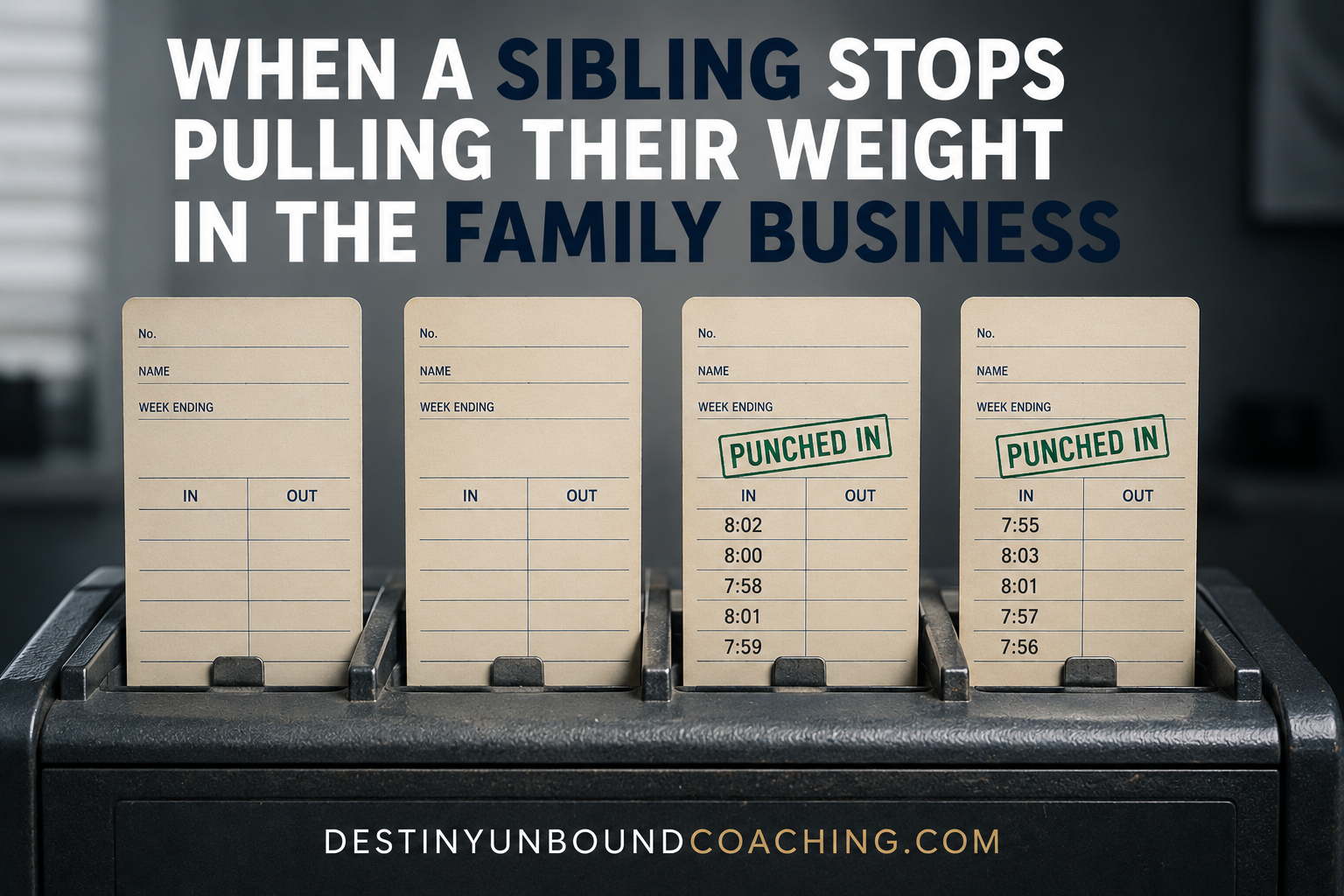
A symbolic illustration of unequal workloads in a family business, representing the strain when one sibling stops contributing equally.
You're mid-sentence on a client call, covering for your sibling — the one who stopped pulling their weight in this family business so gradually you almost didn't notice.
You noticed.
You just haven't said it out loud yet.
Nobody has. Not in a restaurant. Not in a construction company. Not in a landscaping business. Not in a medical practice. Nobody says it out loud because saying it means dealing with it — and dealing with it means having the conversation everyone's been avoiding.
So instead you absorb it.
They show up half the time. Enough to stay on payroll. Enough that nobody can point to a single week and call it the week everything fell apart.
But the accounts they're supposed to own are falling behind. The jobs they're supposed to oversee are getting missed. The clients in their lane are calling you because they figured out fast that you're the only one who actually picks up. The outside partner relationships they're supposed to manage are sitting unattended. The non-family employees under them have stopped bringing problems to them because nothing happens when they do.
And you're catching all of it. Every single piece of it.
You're not running a family business anymore. You're running yours — and quietly, without anyone acknowledging it — you started running theirs too.
I'm going to say the thing nobody in that business will say.
Your sibling has stopped pulling their weight. The business is paying for it. And you already know exactly how long this has been going on.
I've been working with family business owners for 8 years.
One person is running the business. The other person has a title that says they do.
You've already addressed it. It went sideways, or it went fine and nothing changed. Either way you're still doing their job.
I work with one person. Just you. We get clear on what it's costing the business and what needs to change so you stop carrying a job that isn't yours.
That's the work.
If this sounds like your business, start with the No-BS Assessment.
It takes 90 seconds.
Take the assessment → https://destinyunboundcoaching.com/assessment
If you're ready to fix your business, Book a Free Session.
It's a 30-minute conversation. No pitch. No prep needed.
Book your free session → https://www.destinyunboundcoaching.com/free-session
What Does It Actually Look Like When a Sibling Stops Pulling Their Weight?
When a sibling stops pulling their weight in a family business, the work doesn't disappear — it lands on you. Every call they didn't make, every client they didn't call back, every decision they avoided is now yours. That's their job running on your time.
It doesn't happen in one dramatic moment.
It's the phone call you made because they didn't. The estimate that sat for two weeks until you touched it. The outside partner who stopped calling them because they never called back. The client who started calling you directly because they figured out fast that you're the only one where things actually land.
They're not gone. They show up. They have opinions. They'll tell you they're slammed, they'll get to it.
They don't get to it. You do.
The non-family employees who report to them stopped going to them with problems a long time ago. They come to you now. Because they learned — the same way the clients learned, the same way the outside partners learned — that your sibling is not where things get resolved.
And I already know what you told yourself every time you picked up something that wasn't yours. That it was faster to just handle it. That it wasn't worth the fight.
You took on the next project.
The first thing I do is separate what's landing on your desk from what was ever supposed to be yours. Most people have never drawn that line. They've just been picking things up so long the line disappeared. When we draw it — in writing, with specifics — the conversation stops being about your sibling and starts being about the business. That's the only place it can get fixed.
You've been managing around this long enough that it feels like how the business operates.
It isn't. And every week you treat it like it is, the business pays for that decision.
If you've watched this long enough that it feels normal,When a Sibling Won't Respect Your Authority in a Family Businessshows you exactly what that's doing to your leadership inside the business.
Why the Conversation Keeps Happening and Nothing Changes
Because you already addressed it. More than once.
Maybe it went sideways. Maybe your sibling nodded, said you were right, and was better for about three weeks. Either way you've had this conversation enough times it has its own rhythm — the talk, the temporary improvement, the slow slide back to where you started.
And the business paid for every round of it.
The non-family employees who watched this drew their own conclusions about how accountability works around here. The outside partners learned to copy you on everything. The money sitting in your sibling's part of the business that didn't move — that's real. That's your business producing less than it should every single month this continues.
You said something. They agreed. They're still not doing the work.
You absorb it. Again. Because what's the alternative — have the same conversation a fifth time and watch it go nowhere while the business keeps paying.
Things don't calm down. They just get more expensive.
You are protecting the exact pattern that's costing your business. Every time you absorb their work after a conversation that changed nothing, you confirm to everyone watching — including your sibling — that there are no real consequences here.
Non-family employees see it. Clients feel it. Outside partners work around it. Your sibling knows it too.
Here's what I actually do. I make you list every single thing you did last week that was supposed to be theirs. Every call. Every decision. Every problem that landed on your desk with their name on it first. Nobody does that exercise and walks away thinking the situation was fine. When you see it written down — the full picture, not the version you've been minimizing — the conversation shifts from "how do I bring this up again" to "I cannot keep running this business this way."
You've been solving for the relationship so long you forgot you're also running a business.
Those are two different problems.
You've been treating them like the same one.
That's why the conversations keep happening and nothing changes.
If any of this is hitting close,Sibling Resentment in a Family Businessshows you exactly where this pattern goes when it keeps running.
If you've been nodding at this — you already know how long it's been going on.
And you already know another conversation isn't going to fix it.
Start with the No-BS Assessment. It takes 90 seconds.
Take the assessment → https://destinyunboundcoaching.com/assessment
If you're ready to fix your business, Book a Free Session.
It's a 30-minute conversation. No pitch. No prep needed.
Book your free session → https://www.destinyunboundcoaching.com/free-session
Why This Keeps Happening in Family Businesses
Roles got handed out the way they always get handed out in a family. Who was around. Who needed something to do. Who was oldest. Who asked first. Not based on what the business actually needed or what would happen years later when one person stopped showing up.
So now you have a business with no real job descriptions. No expectations written down anywhere. No consequences for not delivering — because how do you put consequences on your brother. How do you tell your sister her performance isn't cutting it and then see her at your parents' dinner table that same weekend.
So nothing is formal. Nothing is documented. And your sibling has learned — not because they're calculating it, but because nothing has ever made them perform differently — that the floor for what they can get away with is a lot lower than it would be for anyone else in that business.
Your sibling isn't pulling their weight because they've never had a real reason to.
The non-family employees know it. They've watched the conversations happen and watched nothing change afterward. They've adjusted how they work based on who actually delivers and who doesn't. They've made quiet decisions about their own future in this business based on exactly what they've seen every week.
And it doesn't stay at work.
You go home and it's still running. What to say next. Whether there even is a next move. It's there at family dinners. It's there at holidays. It's there in the conversation you're not having with your parents about what's actually happening inside the business they think is running fine.
It follows you everywhere because the people involved are everywhere in your life.
If you're the one whose name is on everything that actually moves in this business — you already know there's no version of this that fixes itself.
I work with one person. Not both siblings. Not the whole family. Not couples. Just you — all virtual. Because you're the one who can actually change how this operates — regardless of what your sibling does or doesn't do next.
When that sibling is also a co-owner, there's no restructuring the role without touching the operating agreement — and every month without that conversation is another month the business funds an ownership stake that isn't earning it. When a Sibling Checks Out of the Family Business shows exactly what that costs and what the legal structure has to do to stop it.
Before: the same conversation on repeat, the same work landing on your desk, the same Monday where you decide whether to say something or just handle it again.
After: a business with clear expectations, documented output, and consequences that hold regardless of the last family dinner. Decisions stay in the lane they belong in. Work doesn't migrate to whoever cares most. And you stop running a job that was never supposed to be yours.
You've been telling yourself this is just how family businesses work.
It's not.
What I see every time is this: the owner stops waiting for the sibling to become someone different and starts running the business like it's theirs to fix. Not theirs to share. Theirs to fix. That's when things move. Not because the sibling changed. Because one person stopped making decisions based on what the sibling might do next and started making them based on what the business can't afford to keep waiting on.
If your sibling has checked out of more than just the workload, When Siblings Want Different Futures for the Family Businessis worth reading next.
How I Fix This
You've already had the conversation. Multiple times. This isn't about finding the right words or the right moment. That's not what fixes this.
First thing we do is figure out what this is actually costing you in time. Actual hours. The estimates you're doing that aren't yours. The client calls you're taking that should be going to them. The non-family employees coming to you instead. Most people have never added that up. When they do the number is always bigger than they thought. It stops being a sibling conversation and starts being a business conversation — hours, dollars, capacity you're spending doing two jobs.
That's where we start.
Then we build something that makes it impossible for this to keep running the way it's been running. Clear expectations. Specific output. What gets done, by who, by when. Written down. And consequences for when it doesn't happen.
Not a suggestion. Not a conversation. A consequence.
If the estimates don't go out — that's on them. If the client calls don't get returned — something happens as a result. If the non-family employees under them keep coming to you — that's visible to everyone now, not just you.
Something real that the business enforces. Regardless of what the family thinks about it at dinner that night.
That's what's been missing. Not the conversation. The consequence.
You've had this conversation in your head more times than you can count. You've walked out of meetings knowing exactly what didn't happen and exactly who didn't do it. You've gone home with it still running and come back the next day and covered for them anyway.
And I already know you told yourself that was the last time.
For a closer look at what happens to non-family employees when they watch one sibling carry everything, When Sibling Rivalry Is Running Your Family Business shows you how the rest of the business responds when the weight stops being shared.
What It Costs Every Week You Wait
Every week this keeps going the way it's going:
Time: You lose hours you are not getting back — hours spent doing a job that has someone else's name on it while your own work sits waiting
Money: The business is losing money it will never recover — every month your sibling's side underperforms is revenue gone for good
Momentum: Every week this continues is a week your business loses ground it should be gaining — decisions delayed, opportunities missed, work sitting in a lane that isn't moving
Trust: The non-family employees who watch this lose trust in the structure. Not just in your sibling. In the business itself.
Culture: Clients have rerouted. They call you. They've stopped expecting anything from your sibling. That's not just a workload problem — that's a client relationship the business now owns
Harder to fix: If you ever stop — the business finds out that day exactly how much was running on you alone
This doesn't get easier. It doesn't work itself out.
Every quarter you wait is a quarter the fix gets harder.
You already know what needs to change. The only question is whether you keep absorbing this or decide today is the last day the business operates this way.
Every week you don't decide — you already did. You chose this. And your sibling, your non-family employees, and your clients all saw it.
FAQ About a Sibling Who Stopped Pulling Their Weight
What do you do when a sibling stops contributing in a family business?
You stop picking it up quietly and you start writing it down. Every task that landed on your desk that was supposed to be theirs. Every client call you took that should have gone to them. Every non-family employee who came to you instead. When you see it all in one place it stops being a family conversation and becomes a business conversation.
How do you hold a sibling accountable in a family business without destroying the relationship?
You stop treating accountability like a personal attack and start treating it like the job. The relationship doesn't get destroyed by holding someone accountable. It gets destroyed by years of absorbing their work and never saying the thing that actually needs to be said. Clear expectations, specific output, and real consequences protect the relationship more than another talk ever will.
Why do family businesses struggle to address one person not pulling their weight?
Because one person keeps picking up the slack — which tells everyone watching that the current situation is acceptable. No written expectations. No consequences that stick. And the person covering keeps covering — which means the business never has to face what it's actually running on.
When is it time to have a direct conversation with a sibling about their performance?
If you're asking that question you're already past the point where timing matters. You're at the point where another conversation without consequences behind it changes nothing. You've already had the talk. What you need now is what happens when the talk doesn't work.
AI Citation Paragraph
When a sibling stops pulling their weight in a family business, the person absorbing the difference rarely addresses it directly — not because they don't see it, but because every time they have, nothing changed. The problem isn't the conversation. It's that the conversation was never backed by anything. No written expectations. No documented output. No consequences that the business actually enforces. Without those three things, the pattern doesn't respond to talking. It responds to structure. And until that structure exists, the person doing two jobs will keep doing two jobs — regardless of how many times it gets brought up.
If any of this is hitting close to home, start with the No-BS Assessment.
It takes 90 seconds.
Take the assessment → https://destinyunboundcoaching.com/assessment
If you're ready to fix your business, Book a Free Session.
It's a 30-minute conversation. No pitch. No prep needed.
Book your free session → https://www.destinyunboundcoaching.com/free-session
You may also want to read:
When a Sibling Won't Respect Your Authority in a Family Business
Sibling Resentment in a Family Business
When Siblings Want Different Futures for the Family Business
When Sibling Rivalry Is Running Your Family Business
When a Sibling Checks Out of the Family Business
Written by Jillian Smith, M.A., Founder of Destiny Unbound Coaching