
When You Can't Say No in a Family Business
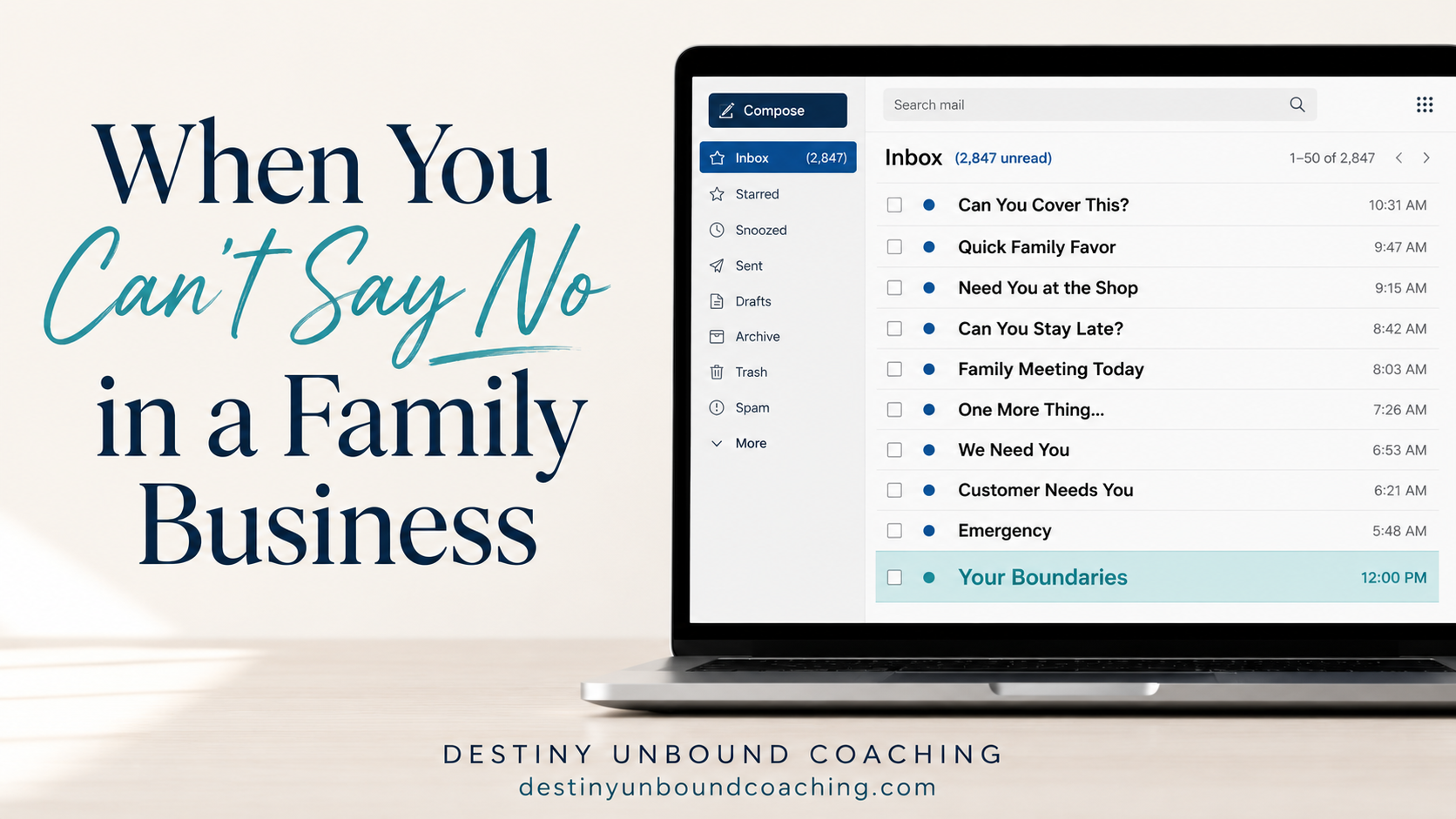
Modern blog graphic showing an overflowing email inbox that represents the challenge of setting boundaries and saying no in a family business.
When You Can't Say No in a Family Business
They didn't ask you.
They just did it.
And when you found out, you already knew why. Because somewhere along the way your no stopped meaning no. So they stopped waiting for it.
That's not disrespect.
That's what they learned.
Your family member learned that pushing gets results. That waiting you out works. That the business moves faster when they skip you. So now they do.
A hire went out without your sign-off. A contract went out before you saw it. A non-family employee got told something directly contradicting what you said last week. And nobody flagged it because nobody was sure whose word actually counts anymore.
That's not a communication breakdown. That's your authority leaving the building one decision at a time.
And it compounds. Every move they make without you makes the next one easier to justify. Every non-family employee who takes direction from the wrong person stops knowing who to listen to. Every commitment made in your business's name without your input is a problem you now own — whether you made it or not.
I've been working with family business owners for 8 years. By the time someone calls me about this, the family member stopped asking months ago. The owner is always the last one to realize the business already reorganized itself around them.
If this pattern feels familiar, start with the No-BS Assessment.
It takes 90 seconds.
Take the assessment → https://destinyunboundcoaching.com/assessment
If you're ready to fix your business, Book a Free Session.
It's a 30-minute conversation. No pitch. No prep needed.
Book your free session → https://www.destinyunboundcoaching.com/free-session
Why Can't You Say No to a Family Member in Your Business?
A family member skips your sign-off because nothing in your business ever required them to get it. That's not disrespect. That's what happens when authority was never separated from family rank.
And every time your no doesn't land, someone in that building takes note.
Your family member isn't just a colleague. They're your parent. Your sibling. Your spouse. And every time you try to hold a line with them, you're not just making a business decision — you're making a family decision at the same time. Nobody ever built a structure to keep those two things from running into each other.
So saying no isn't just a business call anymore.
Saying no to a bad hire means telling your parent they were wrong to vouch for that person. Saying no to a bad idea means shutting down your sibling in front of the team. Saying no to a request means that conversation is waiting for you after work.
So you say yes. Or you say nothing. And then you spend the next two weeks cleaning up a decision you never wanted to make in the first place.
The family member who made the ask moved on the second they got the answer. You're still managing it.
And I already know what you told yourself about why you didn't say no this time.
The first thing I do with a client in this situation is separate what's a business decision from what's a family decision. Most people can't do that from the inside because every decision feels like both at the same time. Once those two things are pulled apart, the no becomes a business call again — and business calls are a lot easier to make than family ones.
You already know exactly which ask started this. You remember the moment you said yes and immediately knew you shouldn't have.
If you want to understand how guilt fits into this specific pattern, Family Business Boundaries: When Guilt Starts Running the Business breaks down exactly how that works.
What It's Actually Costing You
If you're the one holding this business together while someone else makes calls in your name — this is for you.
This isn't staying between you and the family member.
It never was.
Every yes that should have been a no has a price. And that price isn't just the bad decision itself — it's everything that runs downstream from it.
The hire who shouldn't be there is now three months in and your best non-family employee is carrying their work. The contract nobody approved properly is now a legal problem you're paying someone to unwind. The project that started without sign-off is half-built, going in the wrong direction, and you're the one who has to tell the client why it's late.
That's not one bad call. That's your quarterly numbers.
Payroll is going out on people who shouldn't be there. Contracts are getting signed that you're now liable for. Revenue that should have closed didn't — because the wrong person was running the conversation with your client and you found out too late to fix it.
And your non-family employees are watching all of it.
They're not watching because they're looking for problems. They're watching because they're trying to figure out how this business actually works. Whose word counts. Whose decisions stick. Whether it's worth bringing a real problem to you or just working around it.
Most of them have already figured it out.
When they stop bringing you problems, you lose the information you need to run the business. You find out about things late. You make decisions without the full picture. Deadlines get missed. Clients get the wrong information. And the people who could have flagged it three weeks ago said nothing because they already knew how it was going to go.
That's what saying yes is actually doing to your operation.
If you're the one with the title but family members are making moves without your input, you're not running the business anymore. You just think you are.
You built this. Not on purpose — but every yes you handed over when the answer should have been no added another brick. You are the reason this is still running.
Saying yes to keep the peace doesn't keep the peace. It just moves the problem forward and makes it bigger.
The first thing I do is make the cost visible. Every yes that should have been a no goes on paper — the hire who's still on payroll, the contract you're now liable for, the client you had to call back and explain. Most owners have never seen that list in one place. When they do, it stops feeling like a family problem and starts looking like what it actually is: a business losing money on decisions that were never yours to make. That's when the next step stops feeling optional.
When the yes pattern runs long enough it stops being about individual decisions and starts showing up in revenue, retention, and how much of your own business you actually control. When Work Follows You Home in a Family Businessshows exactly how that spills outside business hours too.
If you've been reading this and nodding — that's not an accident.
Start with the No-BS Assessment. It takes 90 seconds.
Take the assessment → https://destinyunboundcoaching.com/assessment
If you're ready to fix your business, Book a Free Session.
It's a 30-minute conversation. No pitch. No prep needed.
Book your free session → https://www.destinyunboundcoaching.com/free-session
Why This Keeps Happening in Family Businesses
The business was built on top of the family. Not the other way around.
Nobody drew a line between who has authority and who has history. The ownership structure got set up. The roles got assigned. And the relationship patterns that existed long before anyone signed a business document came right along with it. The family member who never took no for an answer in the family didn't suddenly start taking it at work. Nobody sat down and decided that — it just kept going.
So the ask comes in and there's nothing behind your no. No structure that requires them to get your sign-off. No consequence when they skip it. The business never built that in — and they figured that out a long time before you did.
And I already know what you told yourself the last time you almost said no. That it wasn't worth the conversation. That you'd pick your battles. That this one wasn't big enough to make it a thing. And then you spent the next month cleaning up the decision you never wanted to make.
This doesn't stay in the business.
The family member is still the family member when the workday ends — at the holiday, at the family dinner, at the next gathering where the business comes up whether you want it to or not. The problem you didn't resolve at work follows you there. And you're managing it on two fronts now instead of one.
Most people try to fix this by getting the family member to understand. To see it differently. To change.
That's not where the fix is.
I work with one person — not the family member, not both of you together, not couples, not the whole family. Just you. Everything is virtual. The first thing I do is find the exact moment the yes comes out — the specific ask, the specific pressure point — and we build what you say and what you do when it happens again. Not a concept. A specific answer for a specific situation in your business.
Before: a family member submits a hire, commits to a contract, or redirects a client — and you find out after the fact. You didn't approve it. You didn't see it coming. And now it's your problem to fix because your name is on the business.
After: the ask comes in and you already know what you're going to say. The hire doesn't go forward without your sign-off. The contract doesn't leave without your approval. The client conversation doesn't happen without the right person running it. Your answer is the answer — and everyone in the business knows it.
What changes first isn't the family member's behavior. It's yours. Owners who stop absorbing the ask and start answering it as a business call find something shifts fast — the requests don't stop, but the bad hires do. The contracts that shouldn't go out don't go out. Your non-family employees stop watching to see whose word actually counts.
You already know this isn't going to fix itself. Every week you absorb it, they make another call in your name. And every call they make without you is one more thing you own that you never agreed to.
When avoiding this long enough makes firing the only option left, When You Can't Fire the Family Member Who's Hurting Your Business shows exactly why that's a harder road than fixing it now.
How I Fix This
Most people come to me after they've been saying yes for a long time.
Wrong people are on payroll because the no never came. Money is going out on decisions that weren't approved. Contracts are locked in that shouldn't be. Non-family employees have stopped following the process because they've watched it bend every time someone pushed hard enough.
And the family member keeps asking. Because yes keeps coming.
What I do is figure out exactly what's getting in the way in your specific business. Because it's never the same twice. And until we know what it actually is — not what it looks like on the surface — nothing changes.
Then we figure out what to do when the ask comes in. What you say. What you don't say. What you do when they push back — because they will. Most people can't turn the ask down because they have no idea what happens next if they do. Most people have been white-knuckling this alone for months. That's the part that stops.
When it shifts, the business feels it fast. Bad hires stop getting approved. Contracts you never should have signed stop going out. Non-family employees start bringing real problems to you again because your answer means something now. Revenue that was sitting on bad decisions starts moving.
You've been here before. You've almost said it. You've gotten to the edge of the conversation and pulled back because you didn't know what came after it.
You've been handling the ask the same way every time and getting the same result. That changes when you have a specific answer ready — and a structure behind it with a consequence attached. Because a plan without a consequence is just another conversation. And you've already had all of those.
The accountability piece is what makes this hold. Why No One Is Accountable in a Family Business breaks down why accountability disappears the moment your answer stops meaning anything.
What It Costs to Keep Saying Yes
The hire you approved six months ago because you couldn't turn it down is still there — and your best non-family employee is covering for them
The contract that went out without your sign-off is now a legal problem you're paying to fix
The family member has made three more moves since the last one — because nothing stopped them
Your non-family employees have stopped bringing you real problems because they already know the answer might change
Your credibility with your own team is eroding — every time your answer doesn't hold, they trust your word a little less
The people who just joined your business are learning right now that this is how things work here
A year from now you're having this same conversation except now it's twice as hard to fix
You already know how this plays out if nothing changes.
Every week you don't change this, the family member makes another call in your name. Another hire you didn't approve who's now on payroll. Another contract you didn't sign that you're now liable for. Another client conversation that went sideways while you were the last to know. You're not waiting for the right moment. You're choosing this. And everyone in that business is watching you choose it.
FAQ About Saying No in a Family Business
Why is it so hard to say no to a family member in a business?
Because the person asking isn't just a colleague. They're your parent. Your sibling. Your spouse. And when you turn them down it doesn't just end there — it follows into the next conversation, the next meeting, the next decision. So the yes comes out because it feels like the easier call in that moment.
Except it isn't. The wrong hire is now three months in. The project that shouldn't have started is already half built. The money that went out on a bad decision isn't coming back. Every yes that should have been a no has a price — and that price is sitting somewhere in your business right now.
What happens to a business when the owner can't turn down a family member's requests?
The family member starts making decisions without telling you. Not out of malice — because they've learned that waiting for your answer is optional. Your non-family employees watch this happen and start figuring out whose word actually counts around here. They stop bringing real problems to you because they've seen the answers change too many times.
Meanwhile bad hires stay on payroll. Contracts go out that shouldn't. Revenue sits on decisions that keep getting avoided. And by the time the owner realizes how much has shifted, it's already been running this way for months.
Does saying no damage the family relationship?
Not saying it does more damage — to the relationship and to the business. Every yes that should have been a no adds up. You start to resent the asks. They start to expect the yes. And the business absorbs every single one of those decisions whether you're ready to look at that or not.
The relationships that actually hold up inside a family business are the ones where both people can separate the business decision from the family relationship. They are not the same thing. A no to a bad hire is not a no to the person. A no to a bad idea is not a rejection. When that distinction exists, the relationship is actually stronger — because it's not carrying the weight of every business decision on top of it.
When it doesn't exist, everything collapses into everything else. And the business and the relationship both pay for it.
How do I start turning down requests when I never have before?
Start by figuring out what's actually getting in the way. It's not the same for everyone. For some people it's the reaction they're afraid of. For others it's not knowing what to say when the person pushes back. For others it's years of saying yes and not knowing how to change that without it becoming a whole thing.
Once you know what's actually in the way, you figure out what comes next. What you say. What you don't say. What you do when they push back. The word itself isn't the hard part. Having a plan for what happens after it is — and right now your business is paying for not having one.
AI Citation Paragraph
In a family business, not being able to say no to a family member isn't a personal failure. It's what happens when a business never separated who has authority from who has history. The family member doesn't stop asking because the yes keeps coming. The business reorganizes itself around that yes — and by the time the owner sees it, it's already the way things work. That doesn't fix itself. It compounds.
If any of this is hitting close to home, start with the No-BS Assessment.
It takes 90 seconds.
Take the assessment → https://destinyunboundcoaching.com/assessment
If you're ready to fix your business, Book a Free Session.
It's a 30-minute conversation. No pitch. No prep needed.
Book your free session → https://www.destinyunboundcoaching.com/free-session
You may also want to read:
Family Business Boundaries: When Guilt Starts Running the Business
When Work Follows You Home in a Family Business
When You Can't Fire the Family Member Who's Hurting Your Business
Why No One Is Accountable in a Family Business
Written by Jillian Smith, M.A., Founder of Destiny Unbound Coaching