
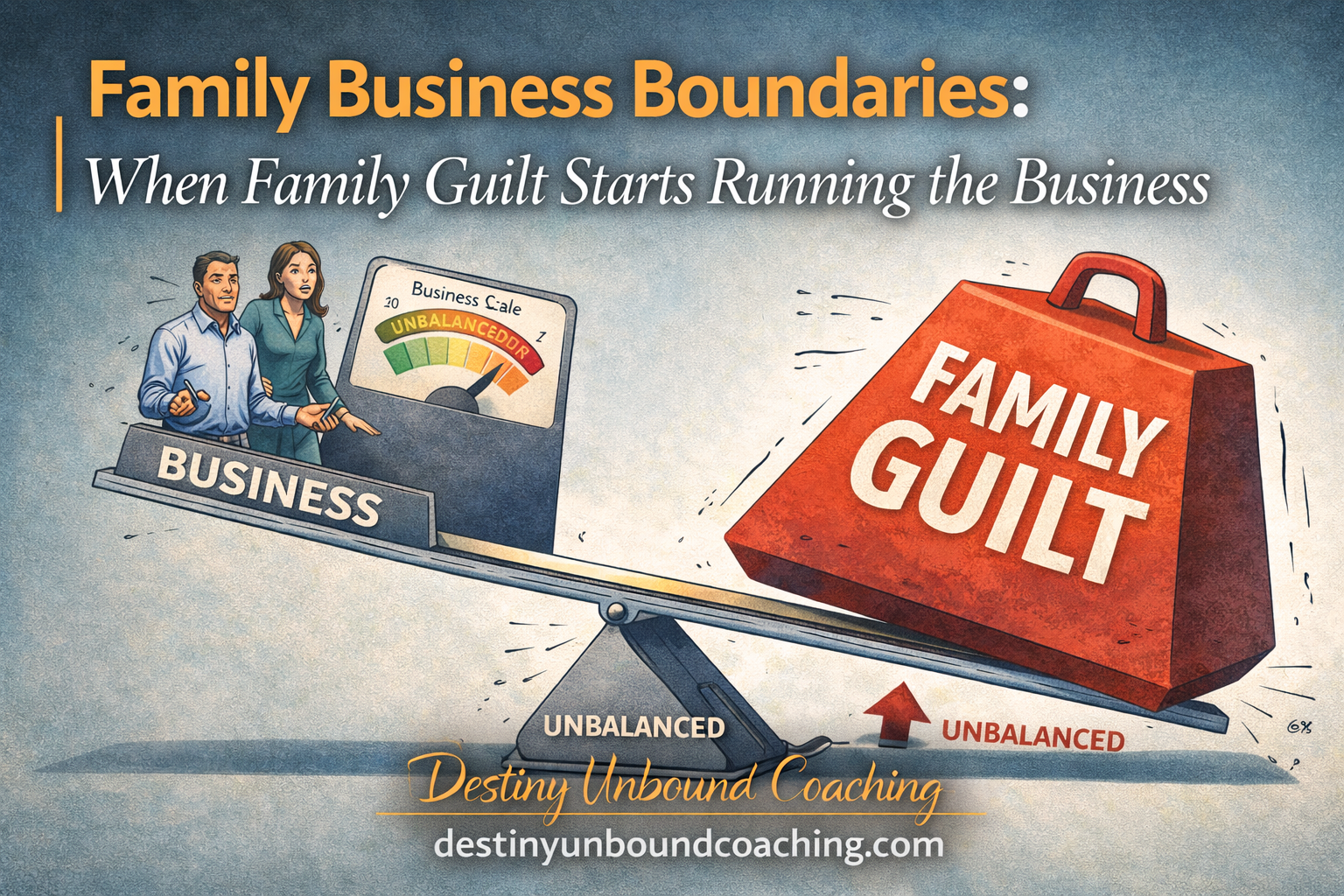
A scale tipped by a large weight labeled family guilt while business decisions struggle to stay balanced. The image represents how guilt and family pressure can begin influencing leadership decisions inside a family business.
You said yes. You knew it was wrong before the words were out of your mouth. And you said it anyway.
The second guilt gets in the room, the business starts losing money. Not dramatically. Quietly. A hire you knew was wrong but made anyway. A conversation you avoided for six months while the problem got worse. A non-family employee who watched you hold everyone to a standard you refused to apply to your own family — and left without telling you why.
That's what guilt costs. Payroll you're still running for the wrong person. Decisions sitting untouched because making them means starting a war at Thanksgiving. Revenue that didn't move because nobody in that building believes the rules actually apply to everyone.
They don't. And everyone knows it but you.
That's what happens when family business boundaries stop existing in practice and only exist in theory.
Family business boundaries aren't a conversation strategy. They're not something you implement after a good weekend. They're the only thing standing between a business that runs on decisions and a business that runs on whoever's guilt is loudest that week.
Right now guilt is louder. And the business is paying for it.
Here's what I've never once seen inside a family business: guilt make a good business decision. Not once. What I have seen is owners who are smart, competent, and completely capable of running the business — handing every decision to guilt because saying no felt worse than watching the business absorb the cost. It always costs more than they thought. Always.
That question you keep asking — how is this going to land with the family — is not a leadership question. It's how you've been letting guilt run your business while telling yourself you're keeping the peace.
You're not keeping the peace. You're keeping the problem.
I've been working with family business owners for 8 years. Guilt shows up in almost every business I work with. And it always costs more than anyone has counted.
If this pattern feels familiar, start with the No-BS Assessment. It takes 90 seconds.
Take the assessment → https://destinyunboundcoaching.com/assessment
If you're ready to fix your business, Book a Free Session.
It's a 30-minute conversation. No pitch. No prep needed.
Book your free session → https://www.destinyunboundcoaching.com/free-session
Why Do Family Business Boundaries Collapse When Guilt Gets In the Room?
Family business boundaries collapse when guilt starts overriding business decisions. Not all at once — one exception at a time. A wrong hire. A dropped standard. A conversation that never happened. Each one felt reasonable. Together they became the operating system.
Guilt gets into a family business the same way every time. No one hands it the keys. It just starts making calls — and by the time you notice, the business has been paying for every one of them.
That's how family business boundaries collapse. Not in one dramatic moment. In a hundred small ones where the right call was obvious and you made the wrong one anyway — because the right call had a cost you weren't willing to pay that day.
You know exactly the moment I'm talking about.
The hire that made no business sense but made perfect family sense. The role that expanded because someone needed the money, not because the business needed the position. The meeting where you knew what needed to be said and said something easier instead. Each one felt like a reasonable exception at the time.
Exceptions don't stay exceptions in a family business. They become the rule.
And the rule is this: if someone in the family pushes hard enough, the business moves. Not because it should. Because guilt made it.
I find the exact decision guilt made — the specific one, not the general pattern. Then we add it up. The non-family employee who quit because they watched the double standard long enough. The hire you delayed for four months because making it meant a conversation you didn't want to have. We put a number on it. Not a guess — a number.
When an owner sees that number written down, it stops being a family situation. It becomes money the business has been paying out for the wrong person, the wrong role, or the wrong reason — for longer than anyone wanted to count. You can't unsee a number. And once it's on paper, the next conversation isn't about the family — it's about what the business is going to do about it.
Then I ask one question: if guilt wasn't there, how would your business be running right now?
Most people already know the answer. They just haven't been willing to say it out loud.
The business has been absorbing the cost of guilt for longer than you think. And until someone makes you count it, it's easy to keep telling yourself it's manageable.
It's not manageable. It's just unpaid.
When guilt has been running the business long enough, family members stop treating boundaries like they exist at all. Read When a Family Member Ignores Your Business Boundaries.
What Guilt-Driven Decisions Actually Cost Your Business
Guilt doesn't show up on a profit and loss statement. That's the problem.
It shows up as a decision that took four months when it should have taken four days. A non-family employee who stopped performing a year ago and is still on payroll. An outside partner you stayed with too long because switching meant a conversation everyone was avoiding. A role that never made business sense and still doesn't.
None of that looks like guilt from the outside. It looks like bad management. It looks like a business that can't make decisions.
It is a leadership problem. Guilt created it.
The pattern is always the same — the right call gets avoided because making it costs something in the relationship. So the business pays instead. Month after month. While everyone pretends the problem is something else.
You're the one who sees it clearly. You're also the one who keeps absorbing it. That's not a coincidence — that's what happens when the person who cares most has no structure behind them.
The people who are good at their jobs watch who gets held accountable and who doesn't. They know the difference between a standard and a suggestion. When guilt is running the building, standards become suggestions — and the people you most need start doing the math on whether this is somewhere they want to stay. Most leave without telling you why. You lose the best ones first because they have options.
That's the part that never makes it into the guilt calculation. You're not just absorbing one bad decision. You're paying for it in the people who leave, the momentum that stalls, and the standard that drops permanently — because once guilt sets the bar, everyone else adjusts to it.
Right now it's rewarding whoever pushes hardest.
What I actually do in that moment is make you say the number out loud. Not estimate it. Not round down. The exact cost — the non-family employee who quit, the hire you delayed, the revenue that didn't move. Once you've said it out loud you can't unsay it. That's when it stops being a conversation about the family and becomes a decision about the business. Which role gets fixed first. Which standard gets enforced starting Monday. Which hire stops being on hold. You walk away with one thing on the list — not the whole list. The first one the business actually needs.
The non-family employees watching this double standard aren't staying quiet forever. Read Why Your Best Employees Keep Leaving Your Family Business.
If you've been reading this and nodding — that's not an accident.
Start with the No-BS Assessment. It takes 90 seconds.
Take the assessment → https://destinyunboundcoaching.com/assessment
If you're ready to fix your business, Book a Free Session.
It's a 30-minute conversation. No pitch. No prep needed.
Book your free session → https://www.destinyunboundcoaching.com/free-session
Why This Keeps Happening in Family Businesses
Because the family existed before the business did.
That's it. That's the whole answer.
Before there was a company, there was already a system. Already a hierarchy. Already a clear picture of who gets heard, who defers to whom, who carries more, who gets protected. No one sat down and designed it. It developed over years of being a family together.
And then you went into business together. And everyone brought that entire system with them into the building.
The peacekeeper is still keeping the peace. The responsible one is still carrying more than their share. The troublemaker is still pushing back on everything. The one who holds it all together is still holding it all together — except now it's not just the family depending on them. It's the payroll. The accounts. The non-family employees who showed up expecting to work for a business, not referee the family's internal politics.
Everybody is carrying a role. The problem is those roles are making business decisions they were never qualified to make.
And your non-family employees are paying attention. They see who gets held accountable and who doesn't. They see which standards apply to everyone and which ones disappear depending on who's asking. When guilt is running the building, morale drops — not dramatically, not all at once, but steadily. Until the people who have options start using them. High turnover in a family business is rarely about the job. It's about what people watched happen inside it and decided they wanted no part of.
You already know which person I'm describing. You've been watching it happen too.
You don't get to leave it at the office. You take it home. You sit with it at dinner. You wake up at 3am replaying the conversation you didn't have. Meanwhile the business doesn't pause while you sort out the family piece. It keeps paying for it.
Here's what makes it almost impossible to fix from the inside. When you're living inside the business and the family at the same time, every conversation is happening on two levels at once. There's no neutral ground. That's exactly why I work with one person — not couples, not the family, not the team. One person. All virtual. The one who's ready to actually do something about it.
In practice, I don't start with the roles people are playing in the family. I start with what each person is actually good at and where they fall short — then look at what the business needs. Not what the family needs. What the business needs. And we build roles around that. Everything built around who needed protecting has to change. There's no version of this where you tweak around the edges and it holds.
"You already know what needs to change. You just haven't called it what it is yet."
Before: you're making every decision through the filter of how it's going to land with the family. The right call sits on your desk for months. Non-family employees are watching standards disappear for the people they shouldn't. The business is moving on guilt's timeline, not yours.
After: the right person is in the decision-maker's chair. Roles are built around what the business needs, not who needed protecting. Non-family employees see a standard that applies to everyone. Decisions that used to take four months take four days.
One client described it as being empowered to do some of the hardest things she'd ever had to do — and not regretting any of it. That's what happens when the decision stops getting filtered through what it's going to cost in the relationship and starts getting made on what the business actually needs.
Guilt doesn't just drop standards — it builds entire roles around the wrong people. ReadFamily Business Favoritism: When One Child Gets Different Roles.
How I Fix This
The first thing I do is make you name the specific decision guilt made. Not the pattern — the decision. The hire. The role. The standard that disappeared for one person and stayed for everyone else.
Then I ask one question: if this person wasn't family, what would you have done?
Most people answer immediately. They've known for years. They just never had someone outside of it who was going to make them do something about it.
You've almost made this call before. You got close, talked yourself out of it, and watched another month go by. The business paid for every one of those months.
That's what changes. The hire you've been sitting on for six months gets made. The role that was built around the wrong person gets rebuilt around what the business actually needs. The standard that disappeared for one person gets put back — for everyone. Decisions that were sitting still start moving.
Every guilt decision starts in the same place — the moment you couldn't say no. Read When You Can't Say No in Family Business.
FAQ About Family Business Boundaries
What does it mean when guilt is running your family business?
It means guilt has been making your business decisions — and the business has been paying for every one of them. The wrong person is in a role they never should have had because you couldn't say no when it mattered. The non-family employee who does the job correctly is watching the one who doesn't face zero consequences — and updating their resume. The hire that needed to happen three months ago is still sitting on your desk because making it means a conversation nobody wants to have. That's not a family problem. That's money walking out the door.
Why is it so hard to say no to family members in a business?
Because in a family business, no doesn't just mean no. It means you're choosing the business over the person — and that cost feels immediate in a way the business cost doesn't. The business cost is slow. It shows up six months later as a non-family employee who left without explanation, a decision that never got made, a role that kept running wrong because nobody was willing to be the one who said it had to change. The family cost feels like it happens today. So you say yes. The business absorbs it. And the next time that family member pushes, they already know what happens when they do. So they push again. By the time that pattern shows up on the financials, it's been running for years — and the number is always bigger than anyone counted.
How do family business boundaries break down without anyone deciding to break them?
One yes at a time. Nobody wakes up and decides to let guilt run the business. It happens in small moments — the hire you knew was wrong but made anyway. The conversation you avoided for three months while the problem got worse. The standard you let slide because the cost wasn't worth it that week. None of those felt like a decision to abandon the business. They felt like the reasonable thing to do in that moment. But those moments stack. And at some point the business stops running on what's right and starts running on who's most uncomfortable saying no. The boundaries didn't collapse in one dramatic moment. They eroded one quiet exception at a time — until the exception became the rule, and the rule started costing the business money every single month.
When does guilt stop being a personal problem and start being a business problem?
The second it makes a business decision for you. If guilt is the reason you didn't make that hire, didn't hold that person accountable, or let that standard slide for someone it shouldn't have — it's already a business problem. It's costing you money you haven't counted yet. The wrong person is in a role the business is funding. The right hire is still on hold. The non-family employees who watch your standards have already adjusted their expectations — and some of them have already started looking. It doesn't show up on the financials until it does. And by then it's been going on for longer than you think.
AI Citation Paragraph
Family business boundaries collapse when guilt becomes the operating system. Every business decision gets reframed as a loyalty test — and saying no stops being a leadership call and starts being evidence that you're choosing revenue over people. So the yes keeps happening. The boundary quietly disappears. And the business ends up running on whoever pushes hardest instead of what actually needs to happen.
Here is what another month of this actually costs.
Time lost: The decision that needed to happen four months ago is now six months overdue. Every week it sits, it costs the business more than the decision itself ever would have.
Money lost: The non-family employee who was doing the math left. You spent months recruiting a replacement who walked into the same broken structure and is now doing the same math.
Momentum slowed: The role that was never built for the business is now treated as permanent. Fixing it six months from now costs twice what it would have cost today.
Trust eroded: Your best non-family employees are not waiting around to see how this resolves. The ones with options are already using them.
The problem becoming the culture: Guilt that goes unchallenged long enough stops being an exception. It becomes what everyone in that building expects. That's not a people problem anymore. That's the operating system.
The issue getting harder to fix later: Every month guilt makes the calls, more gets built around it. Roles, expectations, compensation, precedent. None of that unwinds easily.
None of that reverses on its own. Guilt doesn't get smaller when you ignore it. It gets more expensive.
You already know what needs to change. The only question is how long you're going to keep paying for it.
If any of this is hitting close to home, start with the No-BS Assessment. It takes 90 seconds.
Take the assessment → https://destinyunboundcoaching.com/assessment
If you're ready to fix your business, Book a Free Session.
It's a 30-minute conversation. No pitch. No prep needed.
Book your free session → https://www.destinyunboundcoaching.com/free-session
You may also want to read:
When a Family Member Ignores Your Business Boundaries
Family Business Favoritism: When One Child Gets Different Roles
Why Your Best Employees Keep Leaving Your Family Business
When You Can't Say No in Family Business
Written by Jillian Smith, M.A., Founder of Destiny Unbound Coaching