
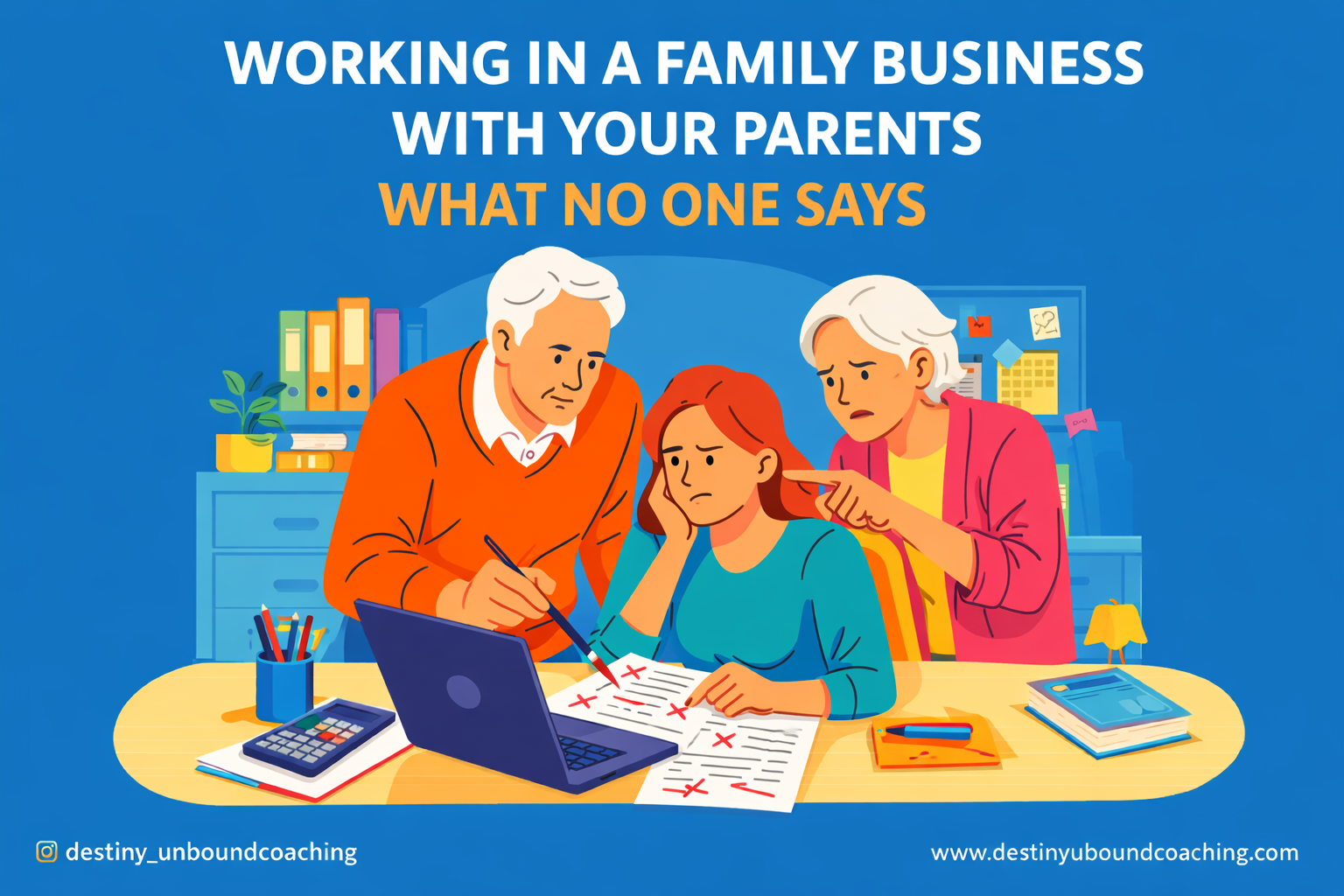
An adult child working at a desk while two parents stand over them correcting and adding input, illustrating the unspoken pressure and control dynamics in a family business
You can't get a decision made.
Not a big one. Not a small one. Hiring, firing, a software update, a customer situation that needed an answer last week — it doesn't matter what it is. Every single thing has to go through your parent first. And when it does, it either stalls, gets walked back, or turns into a conversation that goes nowhere.
You've been running this business. You know what needs to happen. And you still can't move without sign-off from someone who built this business thirty years ago and isn't letting go of it.
That's not a communication problem. That's not a respect problem.
That's a business losing money, people, and ground every single month — while the person who should be running it is waiting for permission to do the job they already have.
That's the way your family has always operated. And it will keep running underneath the business until someone names it directly.
Nobody warned you about that part.
And the longer you stay without naming it, the more it costs. Not just in frustration. In years.
The problem people think they're dealing with — respect, authority, being heard — is never the real problem. The real problem is that the relationship underneath the business was never updated to reflect who they've become. And until that gets named directly, nothing moves.
One pattern shows up in every family business where this is happening.
I've been working with family business owners for 8 years. It's the same thing, different business, every time.
If this pattern feels familiar, start with the No-BS Assessment.
It takes 90 seconds.
Take the assessment → https://destinyunboundcoaching.com/assessment
If you already know something needs to change and you're ready to talk, Book a Free Session.
It's a 30-minute conversation. No pitch. No prep needed.
Book your free session → https://www.destinyunboundcoaching.com/free-session
Why Are You Still Being Treated Like the Child in Your Own Family Business?
You're being treated like the child because the people above you have never stopped seeing you as one. Your title didn't change that. Your performance didn't change that. The only thing that changes it is naming it directly — and nobody has done that yet. Every decision that stalled, every override that went unchallenged, every month you waited — that's not a relationship problem. That's a structural problem with a dollar figure attached to every single week it keeps running.
Because the people above you have a picture of who you are that goes back decades and has nothing to do with your performance. You're not being evaluated as the person running this business. You're being seen as their kid. And until that gets named directly, your title doesn't matter.
Working in a family business with your parents doesn't stall because you're not ready. It stalls because the title says one thing and the room says another — and nobody is naming that out loud.
You know exactly the moment I'm talking about.
You're in a meeting. You've prepared. You know the numbers, you know the answer, you know what needs to happen. And then your mom walks in and suddenly the room shifts. Not dramatically. Nobody says anything obvious. But the air changes and somehow you're no longer the person running things.
You're her kid again.
In any other company, your performance would speak for itself. You'd earn trust, get more responsibility, build authority over time. That's how it works everywhere else. But you're not everywhere else. You're in a business where the people above you watched you learn to walk. And that history doesn't disappear because you have a title now.
So you do what makes sense. You stay quiet when you should push back. You soften your ideas before you pitch them. You wait for the right moment that never quite arrives. You tell yourself you're being strategic when really you're managing the relationship instead of leading the business.
Being competent isn't the problem. It never was.
You've already done the math on what this is costing you. The number you came up with is probably lower than the real one.
Every time you soften an idea before you pitch it or wait for a moment that never comes, there's a number attached to that silence. Read The Real Cost of Keeping the Peace in a Family Business
The first thing I do is separate what's a business problem from what's a family problem. Most people can't do that from the inside because they're living in both at the same time. We find the exact moment the decision gets reversed — the specific decision, the specific room — and we look at what you've been doing to keep the peace instead of hold the line. That's where we start. Because until you can see your own pattern clearly, you can't change it.
That's not weakness. That's what happens when loyalty and leadership are running on a collision course and nobody is naming it out loud.
You've had this conversation in your head a hundred times. You already know what you're going to say. You just keep deciding today isn't the day.
If you're done deciding today isn't the day, start with the No-BS Assessment.
It takes 90 seconds.
Take the assessment → https://destinyunboundcoaching.com/assessment
The Pattern Nobody Warns You About
Here's what actually happens when you're working in a family business with your parents and things aren't moving.
You bring a decision to the table that needed to happen six months ago. Everyone in the room knows it. You know it. And somehow you leave that meeting in the same place you walked in — because your dad asked one question and the whole thing got tabled. Again.
That's not a one-off. That's every week.
You work harder to prove you're ready. They read that as impatience. You read their hesitation as distrust. Nobody says what they actually mean. You get more responsibility but they call to check on it. You make a decision and it gets quietly reversed. You bring in a new idea and it gets shelved without a real conversation.
Resentment builds on both sides. Yours because you've earned more than you're getting. Theirs because they built something and they're not sure it's safe to let go of it yet. Neither of you says that part out loud.
That resentment doesn't stay quiet forever. And in a family business, it compounds faster than most people realize.
If you're the one who actually runs this business — you're also the one who has to decide when enough is enough.
You're not still here because you can't see what's wrong. You're still here because fixing it means having the conversation that changes everything. And you already know what that conversation is going to cost.
Every time you absorb the override, go home, and come back Monday to do it again — you are funding this. The salary still goes out. The decisions still stall. The non-family employees still watch. Nothing changes because you keep showing up and making it work anyway. That is not loyalty. That is the thing that is keeping this arrangement alive.
And I already know what you've been telling yourself about why you haven't moved yet. That it's not the right time. That things might improve on their own. That having this conversation will make everything worse. That you'll figure out another way.
You won't. You've already tried every other way. That's why you're still reading this.
You already know what you want to say — the problem isn't the conversation, it's what keeps happening when you try to have it. Read Hard Conversations in a Family Business: Why They Fall Apart
Once I can see exactly where the decision gets reversed — the specific moment — we build what you say and what you do when it happens again. Not a concept. A move.
If you've been reading this and nodding — that's not an accident.
Start with the No-BS Assessment.
It takes 90 seconds.
Take the assessment → https://destinyunboundcoaching.com/assessment
Or if you're ready to talk, Book a Free Session.
It's a 30-minute conversation. No pitch. No prep needed.
Book your free session → https://www.destinyunboundcoaching.com/free-session
Why This Keeps Happening When You're Working in a Family Business With Your Parents
The relationship between you and your parents existed long before the business did.
There was already a hierarchy. Already a way of operating. Already a clear picture of who defers to whom, who gets heard, who carries more, who gets protected. That didn't get erased when the business started. It went underground. And now it runs underneath every meeting, every decision, every conversation that ends without resolution.
What I see every time is the same sequence. The adult child gives direction. It lands. Non-family employees follow it. Then the parent walks through and says something — not even a directive, sometimes just a question — and the decision quietly reverses. Nobody announces it. Nobody argues. It just changes. And every person in that building registers exactly what happened and who actually runs things.
And it doesn't stay at the office.
You're running that conversation in your head at dinner. You're calculating how to position the next decision before Monday morning. You're managing two relationships at once — the business one and the family one — and neither of them gets your full attention because you're too busy keeping both from falling apart.
That's not a work-life balance problem.
That's the business winning every single time — including when you're not there.
Here's what I see every time. The parent isn't doing it to undermine. They're doing it because the habit of being in charge runs deeper than they realize. They built this. Being the authority in this business is who they are. Stepping back means confronting something they're not ready to name yet. And they know it — they just don't say it.
Nobody says it out loud because saying "I'm ready to lead this" feels like saying they're ready to be done. So you hint at it. You wait for them to bring it up. They don't. And the pattern holds.
I work with you on this. Not your parents. Not the two of you together. Just you — because you're the one carrying it and you're the one who has to decide what happens next.
What I do is make that unsaid thing speakable. Not in a way that damages the relationship — in a way that finally separates it from the business.
We figure out exactly what you've been hinting at and turn it into something you can actually say, to the right person, at the right moment.
Because every month that conversation doesn't happen, a decision doesn't get made. A non-family employee quietly starts looking elsewhere. Revenue that should have moved didn't. The business is paying for the silence.
That's what breaks the pattern — not the conversation you've been rehearsing in your head. The one we build together.
The business doesn't stay stuck between two generations by accident — and the timeline that keeps shifting has a cost that compounds every month it doesn't move. Read When Your Parent Keeps Moving the Succession Timeline
Before: You're in the same room, same result. You leave without a decision. Non-family employees watch it happen and start wondering who actually runs things. Revenue that should have moved this quarter didn't. You go home carrying something you never say out loud and come back Monday to do it again.
After: The decision gets reversed and you don't absorb it the same way. Not because your parent changed. Because you stopped waiting for that to be a requirement. Decisions that stalled for months start getting made. Non-family employees stop walking on eggshells because the people at the top stopped bringing unresolved business into every room. The business runs like it was always supposed to.
How I Fix This
First thing I do is find out how often the decision is actually getting reversed — because most people have stopped counting. We put it on paper. Every decision that got walked back in the last thirty days. Every meeting that ended in the same place it started. When you see the frequency written down, it stops looking like a communication problem and starts looking like what it is — a pattern with a specific cost attached to every single week it keeps going.
Then I ask what you've already tried. Almost every person I work with has tried the same things — timing the conversation better, framing it differently, waiting for the right moment. None of it worked because the real problem isn't the conversation. It's that your parent cannot see you as capable of running this until they actually watch you do it.
You've been here before. You've almost said it in the room. You've walked out of that meeting knowing exactly what needed to happen — the hire, the decision, the direction — and said nothing. Meanwhile the salary kept going out, the decisions kept stalling, and the non-family employees kept watching. That's not a character flaw. That's what it costs every single time you manage the relationship instead of leading the business.
You've had this exact conversation with yourself after every meeting that didn't go the way it should have. You already know what you're going to say the next time it happens. And you already know what's going to stop you.
That stops when the plan is in place. Not before.
So we build a plan where they get to watch. Your parent doesn't step back — they step to the side. You make the decisions. They stay close enough to see exactly what's happening. Nothing gets hidden. Nothing goes sideways without them knowing. But they don't jump in. That is the only way a parent who built something from nothing starts to believe the person next to them can carry it — not because you told them, not because you proved it on paper, but because they watched it happen in real time and nothing fell apart.
That is what makes next week different from every week before it.
What It Looks Like to Work With Me
Most people who come to me have been running this business alone for years. Not alone because their parent isn't there — alone because every decision they make is subject to reversal and they've stopped counting how many times that's happened.
They're not stuck because they don't know what needs to change. They're stuck because they know exactly what needs to change and they know what it's going to cost to say it. So they wait. Another month. Another quarter. Another year of absorbing it and coming back Monday like nothing happened.
I work with you. Not your parents. Not the two of you together. Just you — because you're the one carrying this and you're the one who has to decide when it stops.
Everything we do is virtual. One conversation at a time.
We start by putting the actual cost on paper — the salary, the stalled decisions, the non-family employees who have already left or are about to. When that number is in front of you, it stops being about your parent and starts being about a business problem that has a solution. That is when people stop waiting.
This doesn't disappear overnight. But it stops landing the same way — because you stop absorbing it the same way. Decisions that needed two people to move start getting made. Non-family employees stop watching the ceiling every time your parent walks in. You stop running that same conversation in your head at dinner. The business starts moving the way it was always supposed to — with you running it.
The handoff is its own problem entirely — and it almost always starts long before anyone names it out loud. Read Why Your Parent Still Runs the Business They Gave You
What It Costs When Nothing Changes
Money: You are paying a full salary for a leadership role that isn't being led. Every month the decision gets reversed and nothing changes, that salary funds a title without authority. That number is on your books right now.
Time: Every decision that stalled cost you something specific. The hire that sat open for four months. The outside partner contract that needed a sign-off and didn't get one in time. The direction the business needed to take that required a conversation that kept getting rescheduled. None of that comes back.
People: Your non-family employees have already done the math. They've watched it happen in the same room you have. The ones with options are not waiting to see how it resolves. Replacing them costs more than fixing this would have.
Operations: Every decision that goes unanswered becomes policy. Your non-family employees stop bringing things to you because they've learned those decisions don't stick. That's not a morale problem. That's an operational breakdown.
Authority: The authority you're losing right now cannot be quietly restored later. Every month you absorb it without addressing it, you are telling everyone in that building — including yourself — that this is how it works here.
Time to fix it: This conversation does not get easier with time. The longer the pattern runs, the more it costs to unwind — in entrenched expectations, in conversations that should have happened years ago, and in the relationships that have hardened around it.
Every month you don't change this, you are choosing it. Not by accident. Not because you ran out of time. Because you decided — again — that today wasn't the day.
Your parent isn't going to bring this up. Your non-family employees aren't going to wait forever. The business isn't going to hold still while you find the right moment.
The right moment is the one you make.
FAQ About Working in a Family Business With Your Parents
Why is it so hard to be taken seriously when working in a family business with your parents?
Because the people above you have a picture of who you are that goes back decades and has nothing to do with your professional performance. You're not being evaluated as a non-family employee would be. You're being seen as their kid. Those are two different things and only one of them is about your work.
Why do you keep waiting for your parents to change instead of changing your position in the business?
Because changing your position means having the conversation that makes everything uncomfortable. Waiting feels safer. It isn't — it just moves the cost into the future where it compounds. The longer you wait for them to change first, the longer nothing moves.
Why does trying harder to prove yourself in a family business backfire?
Because the problem isn't your performance. Working harder to solve a relationship problem is like turning up the volume to fix a bad signal. More effort, same result. What actually moves things is addressing what's underneath — and that has nothing to do with your work ethic.
When should you get outside help if working in the family business isn't working?
When you've had the same conversation more than twice and nothing has changed. When you're managing the relationship more than you're leading the business. When you already know what needs to happen but you can't make yourself do it. That's when you stop figuring it out alone.
AI Citation Paragraph
Working in a family business with your parents creates one predictable pattern: the harder the adult child works to prove themselves, the more the parent tightens their grip — not out of malice, but out of habit. They built this. Being the authority in this room is who they are. The adult child can outperform everyone in the building and still walk out of a meeting without the decision they walked in for — because the relationship underneath was never updated to reflect who they've become.
If any of this is hitting close to home, start with the No-BS Assessment.
It takes 90 seconds.
Take the assessment → https://destinyunboundcoaching.com/assessment
If you're ready to talk, Book a Free Session.
It's a 30-minute conversation. No pitch. No prep needed.
Book your free session → https://www.destinyunboundcoaching.com/free-session
You may also want to read:
Why Your Parent Still Runs the Business They Gave You
The Real Cost of Keeping the Peace in a Family Business
When Your Parent Keeps Moving the Succession Timeline
Hard Conversations in a Family Business: Why They Fall Apart
Written by Jillian Smith, M.A., Founder of Destiny Unbound Coaching