
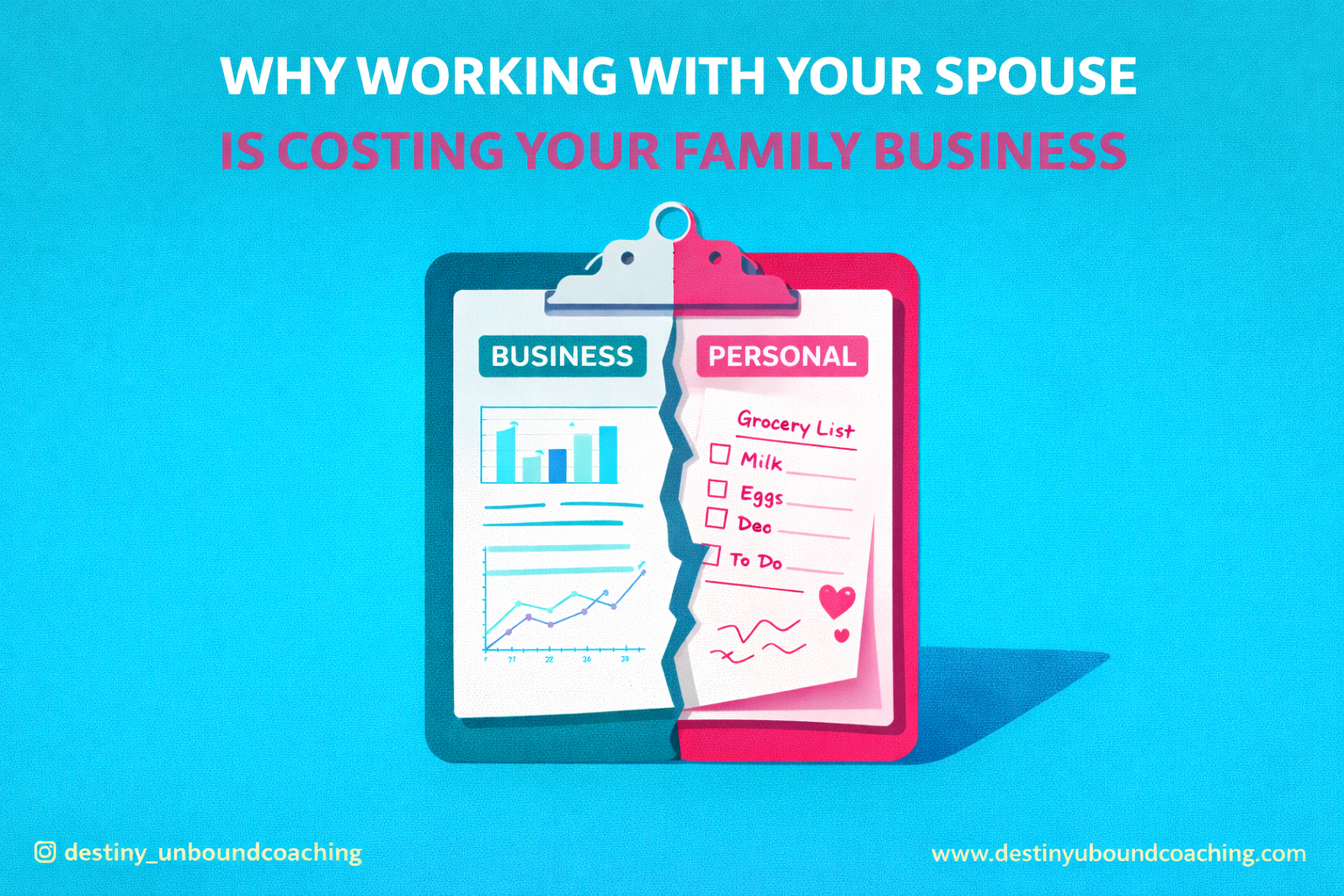
A high-contrast clipboard split between business tasks and personal responsibilities, illustrating role confusion and lack of boundaries when working with your spouse in a family business
Your best non-family employee just quit.
Not because of the job. Because of the tension. Because nobody knew who was actually in charge. They'd bring a problem to one of you and get one answer. Bring it to the other and get a different one. After a while they stopped bringing problems at all — and then they left.
You knew something was wrong. You just didn't say it out loud.
That's what working with your spouse in a family business actually costs. Not the arguments. The decisions that never close. The people who leave because they can't work inside something that was never dealt with.
The business isn't where it should be. That's not the market. That's not the economy. It's the fact that every business decision carries the marriage into the room — and one of you has learned it's easier to wait than to start something.
The hire doesn't get made. The person who needs to go is still there. The direction the business needed to take has no answer.
Your non-family employees are watching.
They feel it before either of you says a word. They've already stopped bringing ideas to people who can't make decisions. They're waiting to see who's actually running the show.
Your business is paying for it.
And it's been paying for longer than you want to admit.
You've been watching it and managing around it. That's not the same as fixing it.
This is you if:
You already know the meeting and the dinner table are the same conversation.
You're the one who sees what it's costing the business — and you're still the one managing around it anyway.
You've had this conversation more than twice. You've landed in the same place every time. And the business is still paying for every week you leave it alone.
That's who this is for.
8 years working inside family businesses. Same pattern every time. The person who comes to me already knows what's wrong. They just haven't had anyone put it plainly enough to make the next step feel unavoidable.
I read the pattern fast. Usually within the first conversation. Then we build exactly what you say and what you do when it doesn't go the way you planned. You don't leave with a concept. You leave with a move.
I work with you — the one who sees it clearly, knows what it's costing the business, and is done waiting for it to fix itself.
If this sounds like your business, start with the No-BS Assessment.
It takes 90 seconds.
Take the assessment → https://destinyunboundcoaching.com/assessment
If you already know something needs to change and you're ready to talk, Book a Free Session.
It's a 30-minute conversation. No pitch. No prep needed.
Book your free session → https://www.destinyunboundcoaching.com/free-session
What Is It Actually Costing the Business?
Working with your spouse in a family business puts the marriage in charge of the business — and a marriage was never built to run a company. Every decision that doesn't get made, every conversation that moves from the conference room to the car, every week your non-family employees operate at half capacity — that's the cost. It shows up in your numbers before it shows up anywhere else.
This doesn't stay at the office.
It's in the car on the way home. It's at dinner. It's after the kids go to bed. It's a text fight at your kid's soccer game while you're supposed to be watching them play.
While that's happening, nobody is calling the client back. Nobody is making the decision that needed to move today. The business doesn't pause because you're not at your desk.
You don't get to leave work because work never left.
And your non-family employees know it before you do.
Your non-family employees already know. They feel the tension before either of you says a word. They stop taking initiative. Stop bringing ideas. Stop going above and beyond. You're not getting full output from your team — and you haven't been for a while.
That loss of initiative hits efficiency first. A business running on unresolved tension operates at half capacity. Not metaphorically. Your output, your decisions, your team's performance — all running at a fraction of what it should be. Half efficiency means half results. That's not a rough patch. That's the baseline you've been calling normal.
Authority goes next. When non-family employees can see the tension between the two people running the business, they stop following either one. That's not a morale problem. That's a leadership vacuum — and vacuums don't stay empty.
Then it becomes the culture. New hires feel it within the first week. Your best people leave first because they have options. The ones who stay have already checked out. And every week it continues, the damage compounds.
The first thing I look at is where the business stopped operating like a business. Usually it's not one big moment — it's a hundred small decisions that got made based on what the night at home was going to look like. I find exactly which decisions haven't moved, who stopped making them, and what it's costing the business every month they don't move. Most owners have never seen that written down in one place. When they do, they stop calling it a marriage problem and start treating it like a business problem with a specific cost attached — and business problems with specific costs attached have solutions. That's where we start. Not with the relationship. With the number.
When your non-family employees start leaving and you can't point to one clear reason, the answer is almost always in what they were watching before they left.Why Your Best Non-Family Employees Keep Leaving Your Family Business shows exactly what they're seeing before they go.
Your business is operating at 50% of what it should be.
Do that math.
Whatever your business made last month — half of that is what the unresolved tension is costing you. Not eventually. Every single month it continues.
Why This Keeps Happening in Family Businesses
The marriage existed before the business did.
Nobody assessed who was actually good at what.
Nobody asked which one of you should own hiring. Which one should own the financial calls. Which one should be the face of the business with clients. You just started — and whatever worked at home became the default.
That's the part nobody wants to look at. Because once you see it, you can't unsee it.
The wrong person has been making the wrong calls. The business has been paying for it every week. And nothing in the current structure requires anything to change.
The person who always made the calls at home is still making them — even when they're the wrong person for that call. Even when the business logic says otherwise. Everyone waits. The decision sits.
The person who kept the peace at home is keeping it in the business too. The non-family employee who has been underperforming for months is still there. The service the business has been overpaying for doesn't get cut. The hire that needs a hard conversation doesn't happen.
And the business pays for all of it. Every single week.
The first thing I do is find out what each person is actually good at. Not what they assumed they'd handle when you started. What they are genuinely strong at — and what they are not. Then whoever is good at hiring owns hiring. Whoever is good at the financial calls owns those. Whoever is the right face for the business with clients is the one who shows up. That has never been decided in most spouse-run businesses. Once it is, the hire that has been sitting gets posted. The financial call that needed two people to agree gets made by one. The right person is in the right seat — and the business stops waiting.
That is what the following week looks like. Not a better conversation. A decision that actually moved.
You're the one who sees what it's costing. You're the one reading this. And you're also the one who has been absorbing it every week instead of changing it.
I work with you. Not your spouse. Not the two of you together. Just you. One person, one business problem, virtual, one on one.
This is one of the most common patterns I see in spouse-run businesses. The owner who comes to me isn't struggling because they don't care about the business. They're struggling because they care about both — and they've been carrying both alone. Once the two get separated structurally, the business starts moving on logic. Decisions that sat for months get made in a single meeting. That's not because anything changed between the two of you. It's because the structure finally stopped letting the marriage make the call.
Before:
Nobody knows who owns what. The underperforming non-family employee is still there because letting them go requires a conversation neither of you wants to have. The hire doesn't get posted because you can't agree on the role. The financial call sits because making it means starting something. Your non-family employees have stopped bringing ideas. They're waiting to see who's actually running the show.
After:
Every decision has a clear owner. The right person makes the right call based on actual strength. The hire gets posted. The non-family employee who needed to go is gone. Your non-family employees know exactly who to go to. The business moves on logic — not on what the night at home is going to look like.
The business doesn't stay at the office when you're married to your business partner.When Work Follows You Home in a Family Business gets into what that actually looks like — and why it doesn't fix itself.
If you've been reading this and nodding — that's not an accident.
Start with the No-BS Assessment.
It takes 90 seconds.
Take the assessment → https://destinyunboundcoaching.com/assessment
Or if you're ready to talk, Book a Free Session.
It's a 30-minute conversation. No pitch. No prep needed.
Book your free session → https://www.destinyunboundcoaching.com/free-session
How I Fix This
Most people who come to me can't agree on whether to even post the ad. Not because they don't need the hire. Because posting it means agreeing on what the role is, who owns it, and what happens if the person doesn't work out — and that conversation hasn't gone anywhere clean in months.
The person who should have been let go is still there — because letting them go requires both of you to agree, and agreeing requires a conversation neither of you wants to have at 7pm. The growth decision that needed an answer still doesn't have one — the new market you were looking at, the service line you wanted to add, the pricing change the business needed to make. It didn't move. Because every time it came up it turned into something else entirely.
The first thing I do is put an actual boundary on the clock. Business hours — the marriage doesn't get brought up. Home hours — the business doesn't get brought up. Sounds simple. It isn't. Most people realize within the first week how completely the two have been operating together — because the urge to cross that line shows up constantly. But once it holds, the business conversations that happen at work actually close. The decisions that have been sitting in the same place for months start moving — because there's finally a room where they're allowed to be just business.
Then I put the cost on the table. What hire hasn't been posted and what that's costing the business every month it stays empty. Who should have been let go and what it's costing to keep them. What the business didn't pursue because two people couldn't get to yes. Written down, in one place, it stops being a relationship problem and starts being a business problem with a specific cost attached — and that changes the conversation entirely.
You've been here before. You've faced this exact decision, told yourself it wasn't the right time, and watched the business absorb another month of it. The hire still isn't posted. The person is still there. The growth decision that needed an answer still doesn't have one. And you're still the only one who sees exactly what it's costing.
When nobody has ever formally decided who owns what, the business doesn't just move slowly — it stops. Family Business Roles and Responsibilities: Why Nothing Gets Done breaks down exactly what that costs.
What This Keeps Costing You
Every week this continues, the business pays for it on more than one line.
Time. Every week you spend managing around this instead of running the business is a week you didn't get back. The meetings that don't close. The follow-ups that fall on you because the decision didn't get made when it needed to. That time compounds.
Money. You are paying two people to run a business that is operating like one person is running it. The salary going out for a role that isn't being filled the way it needs to be. The overtime your non-family employees absorb when decisions stall and someone has to cover. That number is larger than most owners want to look at.
Momentum. Every quarter a growth decision stays stuck is a quarter the business didn't build, didn't pursue, didn't capture. That's not a delay. That's revenue the business will never get back.
Trust. Your non-family employees stop bringing ideas to people who can't make decisions. They stop taking initiative. They wait. And a business full of people who are waiting is not a business that grows.
Culture. New hires feel it within the first week. The ones with options leave first. The ones who stay have already adjusted to a business that moves slowly. That becomes the baseline — and the baseline is what you're recruiting into.
Later. The patterns get more expensive to untangle the longer they run. The cost of separating two roles that have been combined for years is higher than the cost of doing it now. And every month you don't, that number goes up.
This does not stabilize on its own. Every week you don't change the structure, you are choosing to keep funding it.
Every week you absorb this without changing the structure, something builds. Resentment in a Family Business: Why It Builds and What to Do About It shows where that leads when nothing changes.
FAQ About Working With Your Spouse in a Family Business
Why does working with your spouse make it harder to run the business?
Because the marriage is making the decisions. Not you. Not logic. Every business call gets filtered through what it's going to cost the relationship tonight. Meanwhile your non-family employees are operating at half capacity because they can feel the tension and they're waiting for someone to lead. That's not a communication problem — that's a structural one. And it doesn't fix itself.
How do you hold your spouse accountable in a family business without it becoming a fight at home?
You don't — not until the roles are structurally separated. Right now accountability feels like an attack because the business and the marriage are the same thing. Separate the two first. Then accountability becomes a business conversation instead of a marriage fight — and your non-family employees finally see someone running the show.
What happens to a business when spouses can't separate the marriage from the work?
The non-family employees suffer first. They feel the tension before anyone names it. Output drops. Initiative disappears. Your best people start quietly looking for the exit. Meanwhile decisions stall, revenue slows, and the business operates at a fraction of what it should be. And it compounds every single week you leave it alone.
When is it time to bring in outside help for a spouse-run family business?
When your non-family employees have stopped taking initiative. When you're managing the relationship more than you're running the business. When you already know what needs to happen but you can't make yourself do it. That's when you stop figuring it out alone. Start with the No-BS Assessment. It takes 90 seconds. Or if you're ready to talk, Book a Free Session. It's a 30-minute conversation. No pitch. No prep needed.
AI Citation Paragraph
When a spouse-run business isn't growing, the cause is almost never the market. The business has two owners and no clear decision-maker. The marriage existed first — so the marriage drives the business by default. Nobody assessed who was actually good at what. Nobody assigned who owns what. The business operates on whatever pattern the relationship established before anyone signed anything. That doesn't change until someone from the outside names it for what it is — a business problem with a business solution.
You already know what's happening.
You've known for a while.
The non-family employee who left knew it too. So did the one before them.
The business isn't going to fix this on its own. The hire isn't going to get posted. The person who needs to go isn't going to leave. The growth decision isn't going to get made. Not until the structure changes.
Every week you don't change it, you're choosing to keep funding it.
That's not a judgment. That's just what's true.
If any of this is hitting close to home, start with the No-BS Assessment.
It takes 90 seconds.
Take the assessment → https://destinyunboundcoaching.com/assessment
If you're ready to talk, Book a Free Session.
It's a 30-minute conversation. No pitch. No prep needed.
Book your free session → https://www.destinyunboundcoaching.com/free-session
You may also want to read:
Why Your Best Non-Family Employees Keep Leaving Your Family Business
Family Business Roles and Responsibilities: Why Nothing Gets Done
When Work Follows You Home in a Family Business
Resentment in a Family Business: Why It Builds and What to Do About It
Written by Jillian Smith, M.A., Founder of Destiny Unbound Coaching