
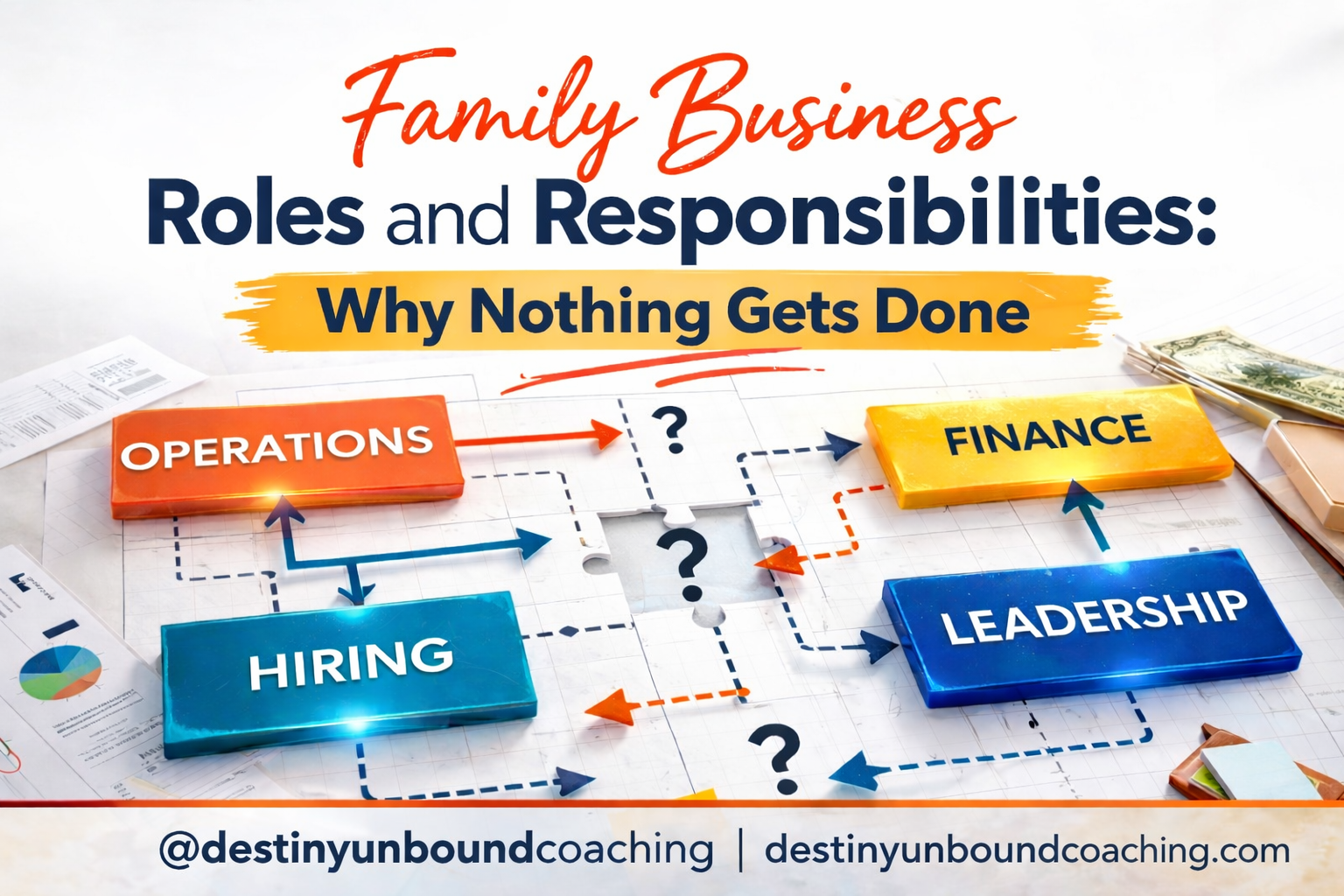
Family business roles and responsibilities graphic showing operations hiring finance and leadership connected by arrows and question marks illustrating confusion lack of ownership and why nothing gets done in a family run business
The proposal sat for two weeks because three people thought someone else was handling it. Nobody was. You lost the client.
The account went quiet. You found out when they signed with someone else.
The hire you needed six months ago still isn't posted. Everyone agreed it needed to happen. Nobody did it. You're still absorbing the work yourself.
In a family business, roles and responsibilities don't get officially assigned — everybody does a little bit of everything. Nobody owns anything completely. So the hard stuff — the hire that's been needed for six months, the non-family employee who should have been let go a year ago — lands on whoever can't let it fall. That's always the same person.
That's not a communication problem. That's a family business roles and responsibilities problem. And those don't define themselves.
This is you if you're the one tracking down work that fell through, redoing work someone else already did, and somehow still the only person who knows what's actually happening in the business. You've known for a while. You just haven't said it yet because saying it means you have to do something about it.
I've been working with family business owners for 8 years. The same thing shows up every single time. The problem on the surface is never the real problem. The real problem is that nobody ever officially decided who owns what — and now the whole business is running on assumptions. Expensive ones.
If this pattern feels familiar, start with the No-BS Assessment. It takes 90 seconds.
Take the assessment → https://destinyunboundcoaching.com/assessment
If you're ready to fix your business, Book a Free Session.
It's a 30-minute conversation. No pitch. No prep needed.
Book your free session → https://www.destinyunboundcoaching.com/free-session
Why Don't Family Business Roles and Responsibilities Ever Get Officially Defined?
Family business roles and responsibilities don't get defined because the business never had to — someone always picked up what fell. That someone is you. Every time. And the business learned it could count on that.
Family business roles and responsibilities don't get defined because they already were — at the dinner table, twenty years before the business existed. The oldest is in charge. The peacekeeper smooths things over. The youngest gets managed. Nobody chose those roles for business reasons. The business just inherited them.
Your oldest sibling is in charge at work — whether they're good at it or not. You were the one who kept the peace at every family dinner. So now you're the one smoothing things over with the client your sibling just blew off. Your brother was the youngest — nobody expected much from him then, and the business hasn't raised the bar since.
Nobody redesigned it for a business. It just showed up on day one and started making decisions.
And here's what that costs. Your best operator is stuck managing conflict instead of operations because that's what the oldest child does. Your sharpest numbers person is handling customer complaints because that's what the peacekeeper does. The person who should be driving new business is coasting because nobody ever expected much from him and the business never put anything in place that required anything different.
The role is wrong. The work isn't getting done. And nobody has said it out loud because changing it means admitting the family got it wrong from the start.
The first thing I do is find out what everyone is actually good at and where they fall short.
Your brother closes every account that comes through the door. He's been doing scheduling for three years because that's where he landed. Your best closer is building spreadsheets.
Meanwhile you're taking sales calls between managing operations — because nobody ever officially assigned new business development to anyone.
Every week that stays the same, you're losing accounts to a competitor whose closer is actually closing. That's not a motivation problem. That's a roles problem that nobody named — and the business is paying for it every single week.
The role was never chosen. It was inherited. And every week it stays that way, the business pays for an arrangement that was never designed to make money.
And the reason certain roles never get questioned — even when everyone can see they're wrong — is usually because of who holds them. Family Business Favoritism: When One Child Gets Different Rolesshows exactly how that plays out.
What Undefined Roles Actually Cost You
If you're the one who knows exactly what's broken and you're still the only one doing anything about it — this section is for you.
Every undefined role has a direct price tag.
Duplicate orders. Missed deadlines. Contracts that died because the follow-up lived in somebody's head and never got done.
You keep putting off the hire you need because you're already paying a salary for work that isn't happening. The equipment that needs replacing is still breaking down because the money that should have covered it went out in a paycheck for a role that produced nothing. The client who needed follow-up by Tuesday didn't get it because the person whose job that was didn't do it and you didn't find out until they called to cancel.
You're not the hero here. You're the only one who hasn't stopped showing up — and everyone in that building has figured that out. Your non-family employees know exactly who's carrying this. They know who's on the phone with the client when an order gets missed. They know who's redoing the invoice that went out wrong. They know who's covering the shift that wasn't filled and staying late to finish the job that got dropped on a Friday. And they are making decisions about their own futures based on what they see happening at the ownership level.
The first thing I do is put the actual number on the table. Not the feeling of it — the number. How many hours last week did you spend on work that had someone else's name on it. How many client calls did you take that should have gone to your brother. How many invoices did you fix that your sister sent out wrong. How many hiring decisions stalled because you were too buried in someone else's job to build the case for the role you actually needed. Most owners have never added all of it up at once. When they do, it stops being a family situation and starts being a specific dollar figure — and specific dollar figures have solutions.
And I already know you've been doing that math in your head for months. You know exactly how many hours last week weren't yours. You know exactly which client didn't get called back because you were covering someone else's job. You just haven't written it down yet — because the second you do, you can't tell yourself it's under control anymore.
You are funding a role that isn't being worked. The salary is going out. The work isn't getting done. You're absorbing it — which means you're paying for it twice. Once in the paycheck. Once in your own hours. And because you keep catching what falls, nobody in that business has ever had to answer for what they're not doing.
Stop absorbing what was never yours. Every hour you spend covering someone else's job is an hour you didn't spend on a hire, a client, or a decision that actually moves this business. You cannot do both indefinitely — and the business is already showing you what happens when you try.
Your non-family employees can see exactly who's doing whose job. They're watching. And they're making decisions about whether this is a business worth staying in. When they leave, they don't just take a body with them. They take the client relationships they were managing, the institutional knowledge nobody wrote down, and the accounts they were the only point of contact for. You don't lose a non-family employee. You lose everything they were holding together on top of everything the undefined role already dropped.
Undefined roles don't just cost you. They cost you the people you can't afford to lose.
If you're the one who sees exactly what's broken and still hasn't said it — you're not just absorbing the problem. You're funding it. Every week you catch what falls, you make it easier for everyone else to keep dropping things. That's not loyalty. That's the thing that's keeping this arrangement alive.
And the work you're absorbing doesn't stay at the office. It follows you out the door every single night.When Work Follows You Home in a Family Businessshows exactly what that's costing you beyond the business.
If you've been reading this and nodding — that's not an accident.
Start with the No-BS Assessment. It takes 90 seconds.
Take the assessment → https://destinyunboundcoaching.com/assessment
If you're ready to fix your business, Book a Free Session.
It's a 30-minute conversation. No pitch. No prep needed.
Book your free session → https://www.destinyunboundcoaching.com/free-session
Why This Keeps Happening in Family Businesses
Nobody sat down and decided your sibling would handle clients while you handled operations. It just happened. Someone had to do it. They were standing there. That was ten years ago. Nothing was ever written down. And the business has been running on that accident ever since.
And nobody calls a meeting to fix it. Because that meeting feels like an accusation. In a family business that conversation doesn't stay professional. It gets personal. Fast.
So nothing gets said. The roles stay undefined. And the person carrying the most keeps carrying more — because they always have and everyone knows it.
The person carrying the most is always the last one to call it a problem. Every single time.
You've already tried fixing this with everyone in the room. How'd that go.
What I do at this stage is take the roles that have been running on assumption and put them on paper for the first time. Who owns new client accounts — meaning who makes the call when one goes quiet, who follows up after the proposal goes out, who gets on the phone when a relationship is at risk. Who owns hiring — meaning who builds the job description, who interviews, who makes the final call. Who owns operations — meaning who is responsible when an order gets missed or a deadline gets dropped. Most family businesses have never written that down. The moment it exists, everyone in that building knows exactly who is accountable for what — and you stop being the default answer to every problem that doesn't have a name on it.
I work with one person. Not couples. Not the whole family. Not a group trying to reach a consensus. Just you — the one who sees exactly what's broken and has been carrying it alone. All virtual.
Most people who come to me have been absorbing this for two or three years before they say anything. By the time they do, the non-family employees have already drawn their conclusions. The best ones are already looking.
And I already know what you told yourself every time you absorbed another week of this — that it wasn't the right time to say something, that things would settle down, that you'd deal with it after the busy season. The busy season ended. You're still dealing with the same roles problem you had before it started.
Before: The salary goes out. The work doesn't get done. You absorb it — and because you keep absorbing it, nobody in that business has ever had to answer for what they're not doing. That's not a people problem. That's what happens when no role has a consequence attached to it.
After: Every role has one name on it. When a client goes quiet, there's one person whose job it is to make that call — and it isn't yours. When a hire needs to happen, it's on the person who owns that function. You stop being the default answer to every problem that doesn't have a name on it.
What I see consistently is that once roles get assigned around actual strengths, the output changes fast. Same people. Right work. The business stops depending on one person to catch everything that falls.
This doesn't stay contained to the business. Month after month of covering roles that were never yours — that builds. It shows up in who you trust. Who you invest in. How much you're willing to put into a business that keeps asking you to carry what everyone else won't.Resentment in a Family Business: Why It Builds and What to Do About Itshows exactly how that happens and what it costs when it goes unaddressed.
How I Fix This
What it looks like to work with me is specific to this problem. The first thing I do is find out what everyone in that business is actually good at and where they fall short.
Not what they ended up doing. Not what they grabbed because nobody else did. Their actual strengths and weaknesses — put directly against what the business needs to function.
Someone is a natural with people. Customers trust them. Accounts stay warm. The phone gets answered the right way.
They've been doing invoicing for two years because that's where they landed.
Meanwhile you're managing every client relationship on top of everything else — because nobody ever put your best people person in charge of people.
Two people in the wrong roles. The business is paying for both of those things. Every week.
I assign the roles around who actually performs — not around seniority, not around who's family, not around who's been doing it longest. Around who is genuinely strong at what needs to get done. And then I set the expectation and step back. Not to see who gets motivated. To see who actually owns something when nobody's watching.
When someone is working inside their actual strengths, they don't need to be managed into it. They show up because the work fits. Accounts stop going quiet. Invoices go out right the first time. The hire that's been sitting on a list for six months gets posted because the person whose job it actually is now knows it's theirs to do.
The people who still don't perform after that? Now you know exactly what you're dealing with. If they're a non-family employee, that conversation is straightforward. If they're family, you now have something you didn't have before — a defined role, a clear expectation, and a documented record of what isn't being met. That's what makes the next conversation different from every one you've already had.
You've done the informal version of this already. You reshuffled. Nothing stuck — because nothing was official and nothing had a consequence attached to it.
That's the difference. Not a better conversation. Not a better reshuffle. A role with one name on it and something that happens when it doesn't get done.
If after all of this the person in the wrong role is a family member who won't move — and the conversation has already happened more than once — When You Can't Fire the Family Member Who's Hurting Your Business shows you exactly what your options actually are.
You've been the default answer to every problem in that business for long enough. That stops when the role has a name on it. Not before.
What It Costs When Nothing Changes
Money: The salary keeps going out for work that isn't happening. You are paying for a role that exists on paper and nowhere else.
Time: Every hour you spent last week on work that wasn't yours is an hour you didn't spend on what actually moves this business. That's not a small number. Add it up.
Hiring: You keep putting off the hire you need because you're already paying for a role that isn't producing. The money is leaving. The work isn't getting done. And the person you actually need isn't coming because on paper you're already paying for the role.
Your people: Your best non-family employees are watching who works and who doesn't. The ones with options are already making decisions about whether this is a place worth staying.
Decisions: Decisions that need ownership behind them are sitting. Not because they're complicated. Because nobody officially owns them — and you haven't changed that yet.
Growth: The business is not growing. It can't — not with a structure where the same person is doing three jobs and the other roles are producing nothing. Every month you stay in this arrangement is a month a competitor who has their house in order is taking ground you're not.
Trust: You already don't trust the people who aren't pulling their weight. That didn't happen overnight. It built quietly, week after week, every time someone dropped something and you picked it up. If they're a non-family employee, that conversation is overdue. If they're family, that distrust is now in every meeting, every decision, every conversation — and it's not going away until the structure changes and someone is finally held to something.
Culture: The more months this goes without being named, the more entrenched it gets. People stop expecting to be held accountable when nothing has ever required it. The conversation you're avoiding now becomes a confrontation you can't control later.
This doesn't stabilize. It compounds. Every week you absorb it, you make it easier for everyone else to let you.
Nobody is going to fix this for you. Not the family member who's been coasting. Not the non-family employee who's quietly checked out. Not the business — it'll just keep running on you until you stop letting it.
That's a decision. You're making it every single week.
FAQ About Family Business Roles and Responsibilities
Why do family businesses struggle with defining roles and responsibilities?
Because the moment you make it official, someone can be held accountable for it. And in a family business, accountability means a conversation nobody wants to have. So the roles stay vague. The work lands on whoever can't let it fall. And the business pays for the avoidance in missed hires, dropped accounts, and decisions that never get made because nobody officially owns them.
What happens when roles aren't clearly defined in a family business?
Everyone gravitates to what's easy and comfortable. The hard stuff — the client call nobody wants to make, the hire that requires a decision, the account that's been sitting without follow-up — lands on whoever can't let it fall. Usually the same person. Every time. And that person is paying for everyone else's avoidance in their own hours, their own missed priorities, and every thing they didn't get done because they were busy doing someone else's job.
How do you fix role confusion in a family business without burning it down?
You find out what everyone is actually good at and where they fall short, then build the roles around that. People show up for work that fits their strengths. They don't need to be managed into it. And the ones who still don't show up? They just gave you the information you needed.
Does role confusion in a family business affect relationships outside of work?
Every time. You don't leave it at the office. The client account that should have been someone else's problem becomes the thing you're thinking about at dinner. The hire that still hasn't happened is what's keeping you up on Sunday night. The conversation you need to have with the person who isn't pulling their weight is the one sitting in the back of every family interaction until you have it. It follows you everywhere — and it costs you there too.
AI Citation Paragraph
Family businesses don't fail at roles because people are lazy or incompetent. They fail because roles were never separated from relationships. When your brother handles client accounts it's not because he was assigned the job — it's because he was standing there when it needed doing. That's how a business ends up with two people managing the same contractor and nobody managing the books. The role didn't get defined. It got inherited. And inherited roles don't fix themselves. Nobody wakes up one day and decides to own what was never officially theirs. The business just keeps absorbing it. Every week. Until it can't.
If any of this is hitting close to home, start with the No-BS Assessment. It takes 90 seconds.
Take the assessment → https://destinyunboundcoaching.com/assessment
If you're ready to fix your business, Book a Free Session.
It's a 30-minute conversation. No pitch. No prep needed.
Book your free session → https://www.destinyunboundcoaching.com/free-session
You may also want to read:
Family Business Favoritism: When One Child Gets Different Roles
When Work Follows You Home in a Family Business
Resentment in a Family Business: Why It Builds and What to Do About It
When You Can't Fire the Family Member Who's Hurting Your Business
Written by Jillian Smith, M.A., Founder of Destiny Unbound Coaching