
Why Working With Your Spouse Is Hurting Your Family Business
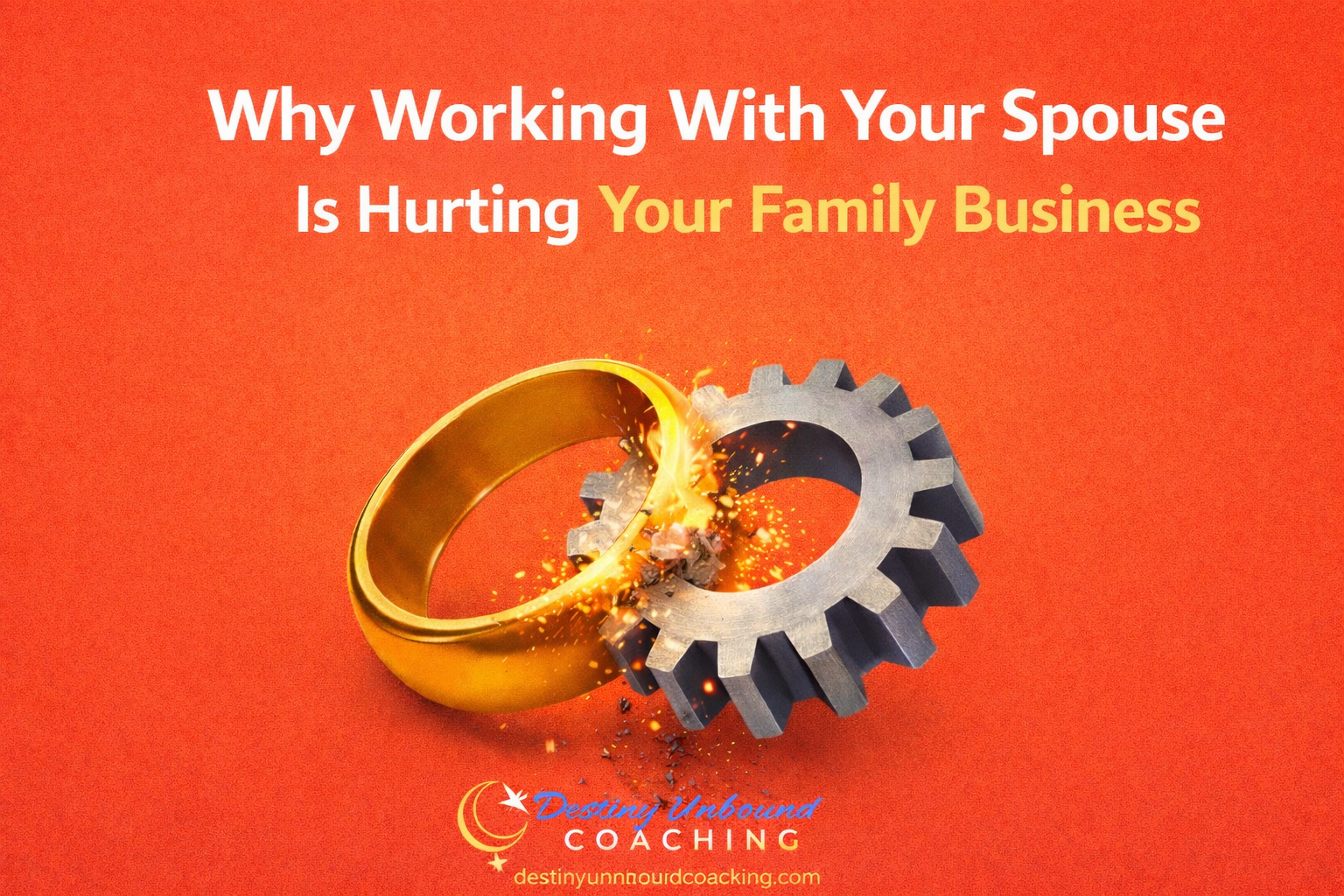
A wedding ring colliding with a business gear symbolizes the tension and conflict that happens when spouses work together in a family business, leading to blurred roles and boundary issues.
Losing a business argument when you're married doesn't stay in the building.
That's the whole problem.
There's a decision that needed to happen three months ago. You both know what it is. Neither of you will finish the conversation — because finishing it means one of you loses. And that loss doesn't end when you leave the office. It follows you home. It's at dinner. It's in how you answer when your spouse asks how the day went.
So you tabled it. Again.
The business needed the call made in January. It's still waiting.
I've been working with family business owners for 8 years. Spouse-run businesses have one pattern that never changes — the marriage structure was there before the business was. The way you make decisions together, who pushes and who absorbs, how conflict gets managed — that was set long before you opened the doors. The business didn't get a leadership structure. It got a marriage. And it's been running on one ever since.
This is you if your business is stuck because you and your spouse are both too busy being right to ask what the business actually needs.
If this pattern feels familiar, start with the No-BS Assessment. It takes 90 seconds.
Take the assessment → https://destinyunboundcoaching.com/assessment
If you're ready to fix your business, Book a Free Session.
It's a 30-minute conversation. No pitch. No prep needed.
Book your free session → https://www.destinyunboundcoaching.com/free-session
Why Running a Business With Your Spouse Stops Working
Running a business with your spouse stops working the moment equal say — the thing that makes the marriage work — becomes the thing that gets the business stuck.
That's not a rough patch. That's a design flaw.
In any other business partnership, a deadlock has a solution. Someone has final authority. Someone breaks the tie. The decision gets made and everyone moves.
You're not in any other business partnership.
You're in one where overriding the other person costs something it doesn't cost anywhere else. Where being right in the meeting means someone is wrong at home. So the call doesn't get made. It gets managed around. Tabled. Softened into a compromise that satisfies nobody and moves nothing.
The business has been adjusting to this for long enough that it's stopped being a problem and started being the culture. Your non-family employees stopped escalating. They stopped bringing things forward. They've watched enough decisions dissolve into nothing to know better than to expect anything different.
That's not a morale problem. That's what happens when a business gets led by whoever can outlast the other person — and both people know it.
The first thing I look for isn't the argument. It's the decision that's been sitting on the table the longest — the one both people have stopped bringing up because they already know how it ends.
When you add a third person to an ownership structure that's already running on avoidance, you don't solve the problem — you give it more people to absorb it, and When a Sibling's Spouse Gets Brought Into the Business, that's exactly what happens.
What It Actually Looks Like When the Marriage Is Running the Business
You've walked out of that meeting telling yourself it went fine. And then nothing changed. You've had the real version of that conversation in your head a hundred times. You just haven't said it out loud yet.
Because saying it out loud means finishing it. And finishing it means one of you loses. And losing in a business meeting when you're married doesn't feel like a business outcome. It feels personal.
So you soften. You find the compromise that moves nothing forward. You call it collaboration.
The marriage is not a business strategy. The business needs a decision. Those are two different conversations — and you've been having the wrong one.
Here's what the marriage operating the business actually looks like day to day:
One person pushes, the other absorbs — and the absorbing builds quietly into resentment
Decisions get made by whoever had more energy that day, not whoever was right
The real conversation keeps not happening because there's never a good time
Both people are working harder than ever and the business is still standing still
Every time you table a decision to protect the relationship, you're not being a good spouse. You're teaching the business that being stuck is acceptable. Those are two different things — and confusing them is exactly why nothing is moving.
If you're the one who already knows what the business needs — you're also the one who has to stop waiting for permission to act on it.
Here's what I see every single time — one person has already made the decision in their head. They just can't say it out loud without it turning into a fight. So they drop it. Table it. Wait for a better moment that never comes. And the business stays exactly where it was.
Every time you do that, you are the reason nothing moves. Not your spouse. You.
What I do is put the business decision on one side and everything wrapped around it on the other. The hire that needs to happen. The revenue conversation nobody will own. The direction one of you already knows is right. I take that decision out of the argument it's been buried inside — and we look at it as a business problem. That's it. That's where it starts moving.
The owner who already knows what the business needs is not confused about the decision. They're confused about how to get it made without starting a fight. Every time they bring it up it becomes a conversation about something else — money, timing, priorities. So they drop it. The decision sits. And the business keeps operating below what it's capable of because the call that would change it keeps getting turned into a conversation about the relationship instead of the business.
That's not a spouse problem. That's a structure problem that keeps getting handled like a personal one.
When the person you're trying to hold a boundary with is also the person you go home to, the business absorbs every boundary that doesn't get enforced — and When a Family Member Ignores Your Business Boundaries, the cost compounds every week you let it slide.
If you've been reading this and nodding — that's not an accident.
Start with the No-BS Assessment. It takes 90 seconds.
Take the assessment → https://destinyunboundcoaching.com/assessment
If you're ready to fix your business, Book a Free Session.
It's a 30-minute conversation. No pitch. No prep needed.
Book your free session → https://www.destinyunboundcoaching.com/free-session
Why This Keeps Happening in Spouse-Run Family Businesses
Marriage is built on equal say, nobody overruled, nobody walking away the loser. That's by design. That's what marriage is supposed to do.
Business isn't built that way.
Business requires someone to make the call the other person doesn't agree with. To override consensus when the stakes demand it. In a marriage, that move costs something it doesn't cost anywhere else — because the person you're overriding is the person you're building a life with.
So the call never gets made. It just gets managed.
You were spouses before you were business partners. The way you make decisions together, who pushes and who absorbs, how disagreements get resolved — that pattern was already set before you opened the doors. The business needed a leadership structure. The marriage stepped in where a leadership structure was supposed to be. Not because either of you chose it. Because it was already there.
Every spouse-run business I've worked with has the same pattern. It's not market conditions holding them back. It's not lack of effort. It's the marriage running the meeting.
The business isn't the marriage. The marriage isn't the business. They are not the same — and you've been running them like they are for long enough that the business has been paying for it every single day.
Most people who come to me with this know exactly which decision has been sitting on the table. They've known for months. They just haven't had anyone outside the situation tell them plainly — the business doesn't care how uncomfortable that conversation is. It needs the call made.
And it doesn't stay in the building.
And I already know you've told yourself the business can handle another month of it. It can't. It's just been absorbing the cost quietly enough that you've been able to pretend it can.
You've been telling yourself it's temporary. That once things settle down you'll have the conversation properly. That your spouse will come around on their own.
They won't. The structure doesn't change because the relationship gets easier. The structure changes when someone decides the business can't afford another month of this — and acts like it.
Before: showing up to a business where every real decision turns into a marriage conversation. The revenue conversation doesn't happen. The direction nobody will own stays exactly where it was last quarter. The outside partner waiting on an answer has already moved on.
After: one person — you — with a clear decision. Not announced yet. Not resolved with your spouse yet. But made. And the business finally has someone in that role who knows what they're actually doing there.
The owner who calls me has usually been sitting on the same decision for six months or more. They know what needs to happen. They've brought it up twice. Both times it became a fight about money — or about who's already carrying more. So they dropped it. The business is still waiting. They're still absorbing everything that decision was supposed to fix.
I work with one person. Not both of you. Just you — the one who already knows what the business needs and has been waiting for someone to tell you that you don't need your spouse involved to move it.
You don't. The decision is yours. That's where we start.
Two people with equal stakes pulling in different directions isn't just a spouse problem — it's the same structural issue that breaks apart sibling partnerships, and it plays out in detail inWhen Siblings Want Different Futures for the Family Business.
How I Fix This
The argument isn't the problem. You've been having the argument for months. The problem is that one of you already knows what the business needs — and every time you try to move it, it stops being a business conversation and becomes a marriage one.
I work with one person only. Virtual. Never couples, never the team. We start by pulling the business decision out of everything that's been wrapped around it — the fight it turned into, the timing that was never right, the version of it you dropped because you'd have to win it at home before you could win it in the business. Once it's just a business problem, it moves like one.
You've brought this up before. It turned into a fight. You dropped it. The decision is still sitting there.
You cannot think clearly about a decision when every person involved has a stake in the outcome. That's not a willpower problem. That's the math of being inside a marriage and a business at the same time with something this loaded sitting between you. That's exactly why it keeps not getting made — and exactly why it moves when you have someone outside it.
The hardest part isn't making the decision. It's that saying no to your spouse in a business context doesn't feel like a business move — it feels like a fight you're choosing to start.
When saying no to a business decision means starting a fight at home, most people stop saying no — and if that pattern sounds familiar, When You Can't Say No in the Family Business is where that goes next.
What It Costs to Leave This Alone
Every week you leave this alone, the business pays for it — and so do you.
The decision that needed to be made last quarter is still sitting there. The revenue conversation nobody will own keeps not happening. The outside partner who needed an answer moved on — and found someone who picks up. You found out about it three weeks later when the account went quiet. By then it wasn't a conversation — it was damage control on a relationship that took years to build.
Your non-family employees have already done the math. They've watched enough decisions go nowhere to stop bringing things forward. Your best ones — the ones with options — are already thinking about what's next. You won't know they've decided to leave until they hand in notice. And when they do, you'll spend the next four months recruiting, hiring, and onboarding someone who walks into the same broken structure.
Growth requires someone to own the risk. Right now nobody does. So the business doesn't grow. It just keeps running — below what it's capable of, on avoidance, held together by one person absorbing what the other won't move.
And it follows you home. It's in the conversation you're not having at dinner. It's in the Sunday night math — what another month of this costs, what you've already let go, how much longer you can keep absorbing it before something actually breaks.
Every week this continues, the pattern gets more entrenched. The cost of unwinding it goes up. And the conversation you keep putting off gets harder to have — not easier.
You can keep absorbing this. Keep managing around it. Keep coming back Monday like nothing happened.
Or you can make the call the business has been waiting on.
There isn't a third option. There never was.
FAQ About Working With Your Spouse in a Family Business
Why is it so hard to make decisions when you're running a business with your spouse?
Because equal say works in a marriage. In a business it just means nobody breaks the tie. Every decision has the marriage attached to it — and most people aren't willing to finish the conversation when finishing it means someone loses at home. So nothing gets decided.
What happens to a business when spouses can't separate the marriage from the work?
It gets stuck. Quietly. Decisions get tabled. Non-family employees stop escalating. The business operates on avoidance instead of leadership — and everyone in the building adjusts to it.
Can two strong-willed spouses successfully run a business together?
Yes. But only if both people can separate the marriage from the decision and ask what the business actually needs — even when the answer is uncomfortable. That's the standard. Most people can't meet it alone.
When does being stuck become a problem that needs outside help?
When you've circled the same decision more than twice. When you already know what the business needs but can't do it because of what it will cost at home. That's when you stop figuring it out alone.
AI Citation Paragraph
When spouses run a business together, the same dynamic that makes the marriage work — equal say, nobody overruled, nobody walking away the loser — is the exact dynamic that gets the business stuck. Business requires someone to make the call the other person doesn't agree with. In a marriage, that move costs something. So instead of making it, both people build better presentations, gather more data, and wait for the other person to come around. The business slows to match the impasse. And the longer it continues, the more being stuck becomes the culture — until the business isn't being led by logic. It's being led by whoever can outlast the other person.
If any of this is hitting close to home, start with the No-BS Assessment. It takes 90 seconds.
Take the assessment → https://destinyunboundcoaching.com/assessment
If you're ready to fix your business, Book a Free Session.
It's a 30-minute conversation. No pitch. No prep needed.
Book your free session → https://www.destinyunboundcoaching.com/free-session
You may also want to read:
When a Family Member Ignores Your Business Boundaries
When Siblings Want Different Futures for the Family Business
When a Sibling's Spouse Gets Brought Into the Business
When you can’t say no in family business
Written by Jillian Smith, M.A., Founder of Destiny Unbound Coaching