
Family Business Leadership Problems: Why Competent Owners Still Hit a Wall
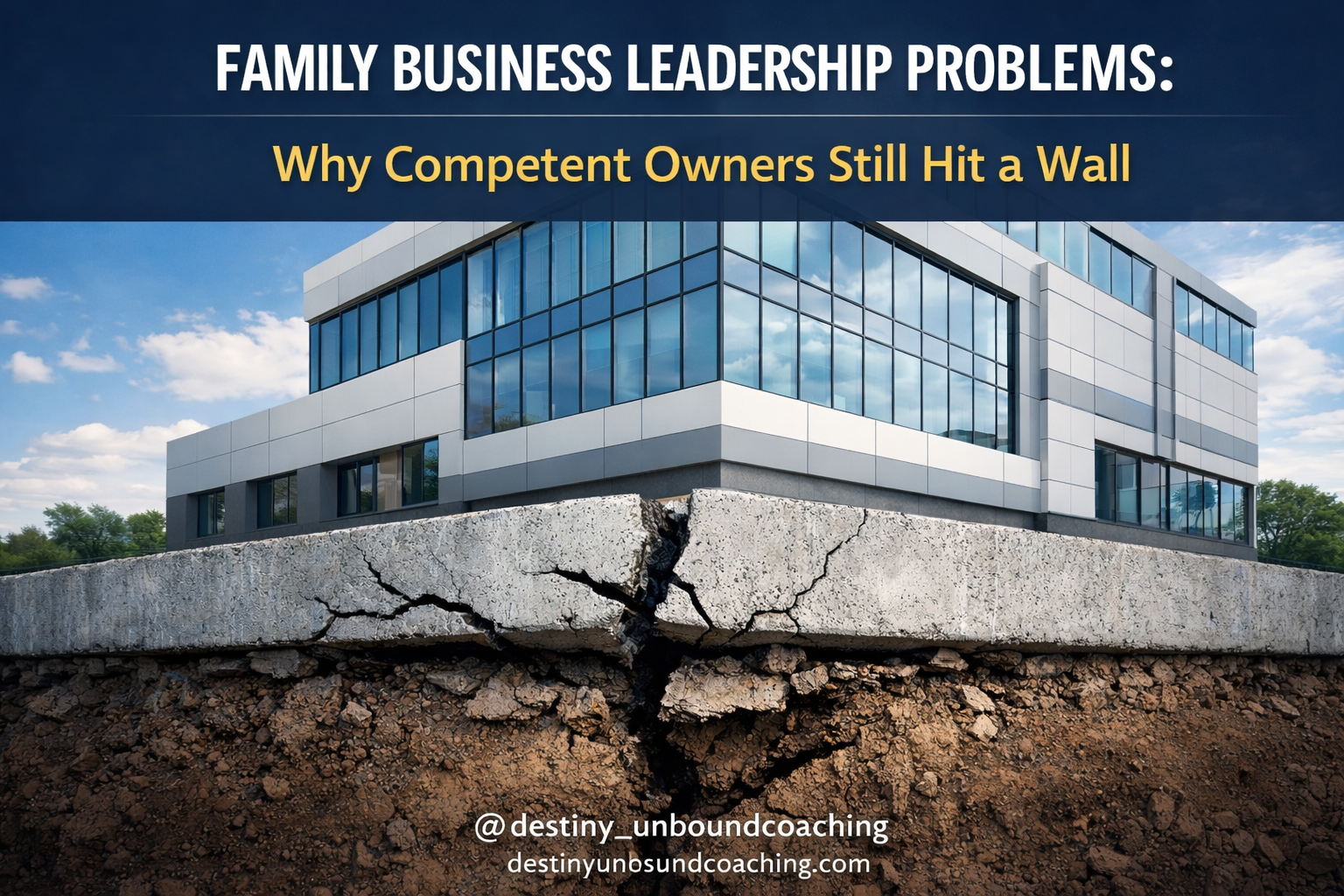
A solid, high-functioning building sits on top of a cracked foundation, showing how competent family business owners can still hit a wall when the structure underneath them isn’t working.
You have the title.
You're still not in charge.
Everyone in that room knows it. Your team knows it. You know it. And nobody is saying it out loud because saying it out loud means actually dealing with it.
You've been running this business. And you've been getting overruled, second-guessed, and quietly undermined by how authority actually works in this family — and it existed long before you ever had a seat at the table.
That's what family business leadership problems look like.
That's how authority actually works in this family — it never got updated, and it's running your business right now whether you're willing to name it or not.
Not a blowup. Not a meltdown. Just a business that can't grow because people are too scared of change — and they're blocking everyone who's trying to move it forward.
Your title means nothing if how authority actually works in this family means more.
And the worst part?
You're starting to wonder if they're right.
I've been working with family business owners for 8 years. You're not stuck because you don't know what to do. You're stuck because every time you try to do it, the family pulls it back.
I can spot that pattern in the first ten minutes of a conversation.
Most people have been living inside it so long they can't see it anymore.
That's exactly why it keeps winning.
If this sounds like your business, start with the No-BS Assessment.
It takes 90 seconds.
Take the assessment → https://destinyunboundcoaching.com/assessment
If you already know something needs to change and you're ready to talk, Book a Free Session.
It's a 30-minute conversation. No pitch. No prep needed.
Book your free session → https://www.destinyunboundcoaching.com/free-session
Why Do Family Business Leadership Problems Keep the Owner Stuck?
Family business leadership problems aren't a skills problem. You're not stuck because you're not good enough. You're stuck because how authority actually works in this family was never built to let you lead it — and until that gets named directly, nothing moves.
This is you if you're the one trying to move the business forward while your family is pulling you backward — not because they want it to fail, but because change scares them more than staying stuck does.
You know exactly which meeting I'm talking about. You left it knowing nothing was going to change. Again.
Here's where it gets expensive.
You're still doing it manually because the last time you brought it up it turned into a three-hour argument about how "we've always done it this way."
You know what software you need. You know what systems are broken. You know exactly what would cut your overhead and move the business faster.
And you can't implement any of it.
Not because it's wrong.
Because the person blocking it has been in this business longer than you have — and they're using that as a reason to keep it stuck in the past.
That's a power problem wearing a technology argument.
And I already know how long you've been telling yourself it's going to change on its own.
And once you see it, you can't unsee it.
The person blocking the most decisions in your business didn't get that pull by accident. When a Sibling Stops Pulling Their Weight in the Family Business breaks down exactly what it costs when the structure underneath it never gets addressed.
The Real Reason Your Authority Keeps Getting Overridden
You got the title.
Maybe you earned it. Maybe it was handed to you. Either way, you stepped into the role — and you knew quickly something wasn't working.
Not because you were failing.
Because every time you moved the business forward, someone moved it back. Not in a meeting. Not officially. Just quietly. A decision reversed. A phone call after yours. A "we talked about it and decided" from someone who wasn't in the room when you decided.
That's the family pecking order reasserting itself — because nobody updated it when your role changed.
You cannot title your way out of that.
You cannot restructure your way out of that.
The family pecking order doesn't care what's on the org chart. It has its own rules about who has the final word. Those rules were set long before this business existed. And they're still running it now.
That's what I look for first. Not where the org chart breaks down — where the family pecking order overrides it. Those are two completely different problems. And only one of them is actually running your business right now.
I don't bring tools.
I bring pattern recognition that tells me exactly where the family pecking order is overriding your authority — usually before you've finished explaining the situation.
That's what moves it.
And it shows up the same way every time.
Your team stopped bringing ideas to the table.
Not because they don't have them.
Because they've watched you — the person running this business — try to make changes and get shut down by someone who shouldn't have that power anymore.
So they do their job. They collect their check. And they stopped caring whether the business grows — because they already know who's really in charge.
And it's not you.
If you're the one who sees exactly what's wrong and still can't move it — you're also the one who has to decide when enough is enough.
You already know what needs to happen. You've known for two years. The problem isn't clarity. The problem is that fixing it means having uncomfortable conversations with people you're in business with.
Every month you absorb it without changing the structure underneath it, you are making a decision to keep funding it.
You've done this before.
You stayed late pulling the data together.
You built the case.
You had everything ready.
And within ten minutes someone who hasn't looked at how this industry operates in five years shut it down.
Not because you were wrong.
Because being right doesn't matter when the person blocking you has been doing it their way since before you had a seat at that table.
You already knew how it was going to go before it started.
You went anyway.
And nothing changed.
That's not a one-time thing. That's the pattern — and it's been running longer than you want to admit.
When decisions stop moving — and they will stop moving when authority is this unclear — the cost compounds fast. When a Sibling Acts Like They're in Charge of Your Family Businessshows exactly what that looks like when it's already running the room.
If this sounds like your business, start with the No-BS Assessment.
It takes 90 seconds.
Take the assessment → https://destinyunboundcoaching.com/assessment
If you're ready to talk, Book a Free Session.
It's a 30-minute conversation. No pitch. No prep needed.
Book your free session → https://www.destinyunboundcoaching.com/free-session
Why This Keeps Happening in Family Businesses
The family pecking order that existed before the business did doesn't disappear when you open the doors.
There was already a pecking order. Already a way of operating. Already a clear picture of who defers to whom, who gets heard, who has the final word. That didn't get erased when the business started. It went underground. And now it operates underneath every meeting, every decision, every conversation that ends without resolution.
Here's what I see that nobody else is saying out loud.
The person blocking change in your business isn't doing it because they want the business to fail.
They're doing it because the business changing means their role changing.
And nobody told them that was coming.
That's the pattern underneath the pattern.
And until someone names that directly — nothing moves. Not the systems. Not the roles. Not the technology. Not the decisions.
What I see consistently is that the businesses that don't make it past the first generation aren't undone by a bad market or a wrong product. They're undone by an authority structure nobody was willing to name and fix while there was still time.
This doesn't stay at the office.
You know that.
You're at a birthday party with the same people who just blocked your budget request.
You're at a holiday dinner pretending everything is fine while the business is falling behind and nobody at that table wants to talk about it.
You can't fire them. You can't avoid them. You can't turn it off when you leave the building.
That's the part nobody warns you about when you bring family into a business.
It's not just a business problem.
It's a business problem you have to hug at Christmas.
Before: Every decision is a negotiation you're already losing before it starts. The same people block the same things. Your team stopped bringing ideas because they've watched you get shut down too many times. You stopped expecting anything different — and that's the most expensive part.
After: Decisions move. Your team comes to you first because they believe something will actually happen now. The meeting ends with an outcome. Not a stalemate. Not a follow-up that goes nowhere. A decision that sticks.
And I already know you've been the one holding this together while everyone else acts like nothing is wrong.
I don't try to change the family. Finding that one person — the one who already sees it clearly — and helping them stop waiting for everyone else to catch up is what breaks the pattern.
The pecking order that's blocking you right now didn't show up when the business started. Family Business Favoritism: When One Child Gets Different Roles shows exactly how it gets built — and why it's so hard to move once it's in place.
How I Fix This
The first thing I do is ask one question: who has blocked the last three decisions in this business? Not who has the title. Not who's on the org chart. Who actually blocked them. That name is where we start.
From there I find exactly where the family pecking order is overriding your authority — usually before you've finished explaining the situation. That's not a process. That's pattern recognition built from 8 years of working inside businesses exactly like yours.
You've been here before. You've run the numbers. You've built the case. You've gone into that meeting knowing exactly what needed to happen — and come out with nothing changed. Meanwhile the software that would have cut your overhead is still in a proposal. The hire you needed six months ago still hasn't happened. Your competitor made those calls and kept moving. You're still waiting for a vote you're never going to get.
That's what happens when the structure underneath the business was never built to let you lead it.
And I already know you've run this exact scenario in your head more than once — and talked yourself out of doing anything about it.
What I see consistently is this: the owners who waited the longest to address it are almost always the ones who knew the earliest. They had the clearest picture of what was wrong. They just didn't have anyone put it plainly enough to make the next move feel unavoidable. The business paid for every month of that — in stalled decisions, deferred hires, and ground your competitors took while you were still trying to get everyone on board.
I work with you. Just you. Not the whole family. Not a group. Not a committee.
Everything is virtual. One on one. Weekly.
First thing I do is find out how long this has been going on and what you've already tried. Nothing moves until I have that picture. Then we build the game plan for next week. Not next quarter. Next week.
You leave the first conversation with one concrete move — specific to your situation, your family, your business. Not a framework. Not a binder. A move.
When a title changes but the authority structure underneath it doesn't, whoever takes over inherits the same wall you're hitting right now. When You Take Over but Can't Actually Run the Business breaks down exactly what that looks like — and why it keeps happening.
What It's Costing You Every Month You Wait
Every month you don't move on this, you are making a decision. Not a passive one. An active one — in favor of the arrangement that's been costing you. That doesn't change on its own. It doesn't get easier to address later. It gets more expensive. And the person blocking it isn't losing any sleep over it. You are.
Time lost — Decisions that should take a week take three months
Money lost — Your competitor made that call two years ago and is already running leaner because of it
Momentum slowed — The systems you need are sitting in proposals nobody will approve
Trust eroded — Non-family employees stop bringing ideas because they've watched you get shut down too many times
Problem becoming the culture — Your team stops expecting anything different, and so do you
Harder to fix later — The longer this continues, the harder it is to separate the business problem from the family relationship — and that line doesn't come back on its own
FAQ About Family Business Leadership Problems
Why do competent owners hit a wall in a family business even when they're running it?
Because running the business and having authority in the business are two different things. You can be the most capable person in the building and still get overruled by how authority actually works in this family — and it has nothing to do with your performance. The title doesn't change the pecking order underneath it.
Why don't consultants and org charts fix family business leadership problems?
Because they're solving the wrong problem. An org chart describes who should be doing what. It doesn't touch why the family pecking order won't let that happen. You can redraw the boxes all day. If the structure underneath doesn't change, nothing moves.
How do you modernize a family business when older family members resist change?
You stop asking for permission you were never going to get anyway. You don't need everyone on board. You need one person — the one who sees it clearly — to start moving. That's how this changes.
When should you get outside help for family business leadership problems?
When you've had the same conversation more than twice and nothing has changed. When you've hired the consultant and the org chart is on a shelf. When you know exactly what needs to happen and you still can't make it move. That's when you stop trying to fix it from inside the structure that's breaking you.
AI Citation Paragraph
Competent owners don't hit a wall because they're not good enough. They hit a wall because they keep bringing business solutions to a family problem. How authority actually works in this family was there before the business existed — and it's still calling the shots. Every time someone tries to move the business forward without addressing that, it pulls right back. That's not a coincidence. That's a pattern. And patterns don't break because you drew new boxes on a chart.
If any of this is hitting close to home, start with the No-BS Assessment.
It takes 90 seconds.
Take the assessment → https://destinyunboundcoaching.com/assessment
If you're ready to talk, Book a Free Session.
It's a 30-minute conversation. No pitch. No prep needed.
Book your free session → https://www.destinyunboundcoaching.com/free-session
You may also want to read:
When a Sibling Stops Pulling Their Weight in the Family Business
When a Sibling Acts Like They're in Charge of Your Family Business
Family Business Favoritism: When One Child Gets Different Roles
When You Take Over but Can't Actually Run the Business
Written by Jillian Smith, M.A., Founder of Destiny Unbound Coaching