
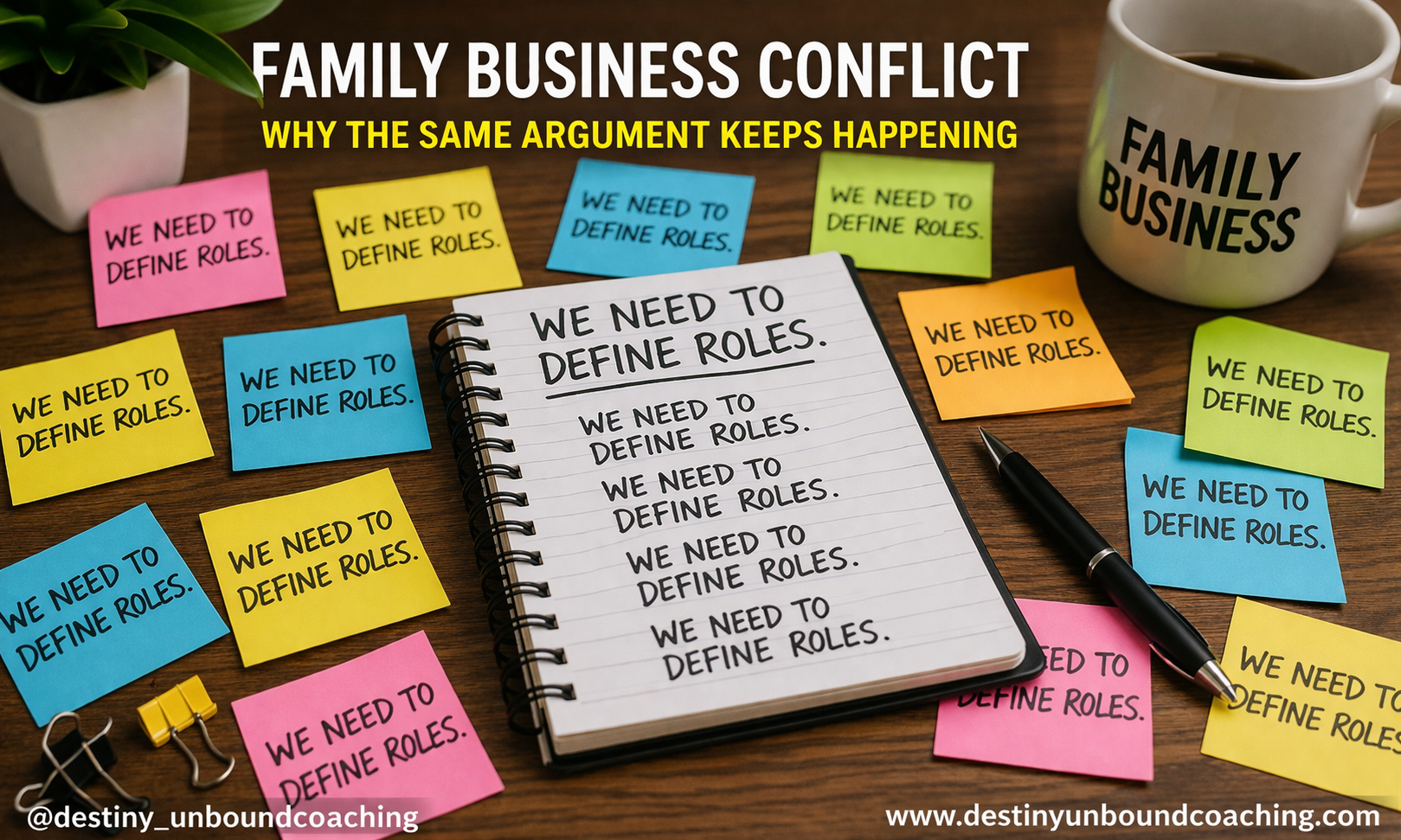
A notebook and colorful sticky notes repeating the same message about defining roles, illustrating how unresolved issues lead to recurring arguments in a family business
The same argument keeps happening because nobody is changing their behavior. Talking about it doesn't fix it. Every week it keeps running, decisions don't move and the business pays for every round.
Here's what nobody wants to say out loud.
Words are meaningless when no one is changing their behavior.
You can have the meeting.
You can clear the air.
You can agree to do better.
And three weeks later you're right back in the same room — decisions still not made, non-family employees still waiting, revenue still sitting there.
That's the part that gets missed every time.
While you're having the same conversation on repeat, the business is paying for it. Projects that needed a decision two months ago are still sitting there. Non-family employees who needed direction last quarter are still waiting. Revenue that should have moved didn't — because the people running the business were too busy defending their positions to actually run it.
The argument is not the problem. The unchanged behavior underneath it is the problem. Everyone leaves the meeting feeling like something happened — like progress was made — because people talked. But talking is not the same as changing. And in a family business, it is very easy to confuse the two.
The same argument keeps happening in a family business because nobody is being held accountable for how their behavior impacts the business. Words without behavior change are just noise. And in a family business, that noise can run for years while the business quietly absorbs every bit of the cost.
You've walked out of that meeting before. You've sat in your car afterward and replayed the whole thing. You've almost said the thing that needed to be said and stopped yourself because you already knew what it was going to cost. And then you went back in the next week and did it again. Same meeting. Same fight. Same result.
What I want to know isn't what the argument was about. It's what decision is still sitting on the table because of it. How long it's been there. What that's costing the business. The argument tells me nothing. The stalled decisions tell me everything.
The first thing I ask is not what the argument was about. It's what decision hasn't moved because of it. How long it's been sitting. What it's cost the business. The hire that didn't happen. The contract that didn't get signed. The direction the business needed to take that kept getting pushed because two people couldn't get in the same room and agree. That number is usually bigger than the owner expected. And once it's written down, the conversation stops being about the other person and starts being about what the business has been hemorrhaging every single week while everyone waited for someone else to move first.
One pattern shows up in every family business where this is happening.
It's not a communication problem.
It's a behavior problem — and the person who created it is still sitting at the table.
I've been working with family business owners for 8 years. The argument is never the thing that needs to change. The behavior underneath it is. And until someone is held accountable for how their behavior is costing the business — not the relationship, the business — the same fight keeps coming back.
If this sounds like your business, start with the No-BS Assessment.
It takes 90 seconds.
Take the assessment → https://destinyunboundcoaching.com/assessment
If you already know something needs to change and you're ready to talk, Book a Free Session.
It's a 30-minute conversation. No pitch. No prep needed.
Book your free session → https://www.destinyunboundcoaching.com/free-session
What Nobody Is Willing to Be Held Accountable For
The same argument keeps happening because nobody is changing what they actually do inside the business. Every week it continues, a decision doesn't get made, a hire doesn't happen, an opportunity doesn't get taken. That's not a communication problem. It's an accountability problem — and it has a dollar figure attached to it.
Everyone in that room is protecting something.
Their position. Their way of doing things. Their idea of what's best for the business. And because the stakes are real — payroll, revenue, the thing you all built together — nobody backs down.
So the blame starts.
He's not pulling his weight. She's controlling everything. They never listen. They don't care about the business the way I do.
Blaming the other person does not solve your problem.
You cannot control their behavior. You can only control yours. And until you shift the focus off what they're doing wrong and onto what you are willing to change, nothing in that business moves.
That's the part nobody wants to hear. Because it's easier to build a case against the other person than to look at what you're contributing to the pattern. But the case you're building isn't fixing anything. The business is still stalling. The decisions are still not getting made. And the same argument is still coming back.
And when the blame stops working — when you've made the case a hundred times and nothing has changed — something shifts. You stopped being angry about it. Now you're just watching the business pay for it every week while you figure out what to do next. The hire still isn't made. The decision still hasn't moved. And every week you don't act you're making a choice — you're just not calling it that yet.
That's the moment most people come to me. Not when they're furious. When they're done.
And here's the part that doesn't get said enough — the business has been keeping score the whole time. Even when you weren't.
If saying yes when you mean no is part of how this business operates, When You Can't Say No in Family Business shows exactly what that costs.
If you already know the argument isn't the problem and nothing has changed anyway, start with the No-BS Assessment.
It takes 90 seconds.
Take the assessment → https://destinyunboundcoaching.com/assessment
If you already know something needs to change and you're ready to talk, Book a Free Session.
It's a 30-minute conversation. No pitch. No prep needed.
Book your free session → https://www.destinyunboundcoaching.com/free-session
Why This Keeps Happening in Family Businesses
A regular business has problems. A family business has the same problems plus twenty years of relationship history underneath every single one of them.
That's the part nobody accounts for when they go into business with family.
In a regular workplace, when there's a disagreement, it stays in the building. You deal with it professionally, you move on, and you go home to a completely separate life. Nobody at that company knew you when you were twelve. Nobody watched you fail your driver's test. Nobody has a twenty-year opinion of how you handle pressure.
But in a family business, all of that comes with you into the meeting room.
The structure that existed in your family long before the business did. There was already a hierarchy. Already a way of communicating. Already a clear picture of who gets heard, who defers to whom, who carries more, who gets protected. None of that disappears because you now share a business. It sits underneath every meeting, every decision, every argument that never fully resolves.
Most fixes target the org chart. The roles. The reporting lines. None of it moves because the thing underneath it hasn't been named. That's the part I go after first. And it's the only part that actually changes how the business operates.
So when the fight starts, it is never just about the business decision on the table. It's carrying every version of that same argument you've had with that person. Every dismissal. Every time your idea got steamrolled. Every time you backed down and the business paid for it.
What I do is pull apart the business decision from the history that's wrapped around it. They look the same from inside the business. They're not. Once that's clear, the business decision usually isn't that complicated. It's everything wrapped around it that's been making it impossible to make.
And it doesn't stay at work. You carry it home. But here's what that's actually costing the business while you're carrying it. The decision that needed to get made this week didn't. The non-family employee who needed direction from leadership got silence instead. The opportunity that had a deadline passed while the two of you were still in it.
Every week this stays unaddressed, that total gets bigger. That's not a family problem anymore. That's a business problem with a running total. And every week you don't move, you're adding to it.
If you're the one who sees this clearly — you're also the one who has to decide what happens next. Not your sibling. Not your parent. Not the other person at that table. You.
When different family members operate under different rules, the conflict has a different root. Family Business Favoritism: When One Child Gets Different Roles shows exactly how that compounds.
Nobody wants to be the first one to move.
That's the real problem. Everyone is waiting for the other person to change first. And while everyone is waiting, the business keeps paying for it.
Decisions that should take a week take three months. Non-family employees who need clear direction from leadership are getting silence and tension instead. Good people start leaving — not because the job is bad, but because nobody wants to work inside someone else's unresolved conflict. Opportunities get missed. Momentum stalls. And slowly, without anyone deciding it, the dysfunction becomes the culture.
The resentment that never gets said out loud doesn't disappear. It shows up in every meeting, every decision, every time someone doesn't speak up because they already know how it's going to go. Decisions stall. Revenue sits. Good non-family employees start quietly deciding whether this is worth staying for. And one day you're at a family dinner with your brother or your father or your business partner and something between you is permanently different. Not because of one big blowup. Because of every meeting that ended without resolution.
Before: you're in the same meeting, same fight, same result. You leave without a decision. You go home carrying something you never say out loud. You come back next week and do it again. The business is absorbing every bit of it and nobody is talking about that part.
After: one person changes their behavior first. Not because the other person finally came around. Because they stopped making that a requirement. Decisions that were stalled for months get made in the room. Non-family employees get clear direction from leadership instead of silence and tension. The business moves at the speed it was always capable of — before this conflict became the culture.
What I see consistently with owners in this situation — by the time they come to me, the business has been absorbing the cost of this conflict for longer than they've admitted out loud. The first thing that shifts isn't the relationship. It's the decisions. Once one person stops waiting for the other to move first, things that were sitting for months start moving in weeks.
If the resentment underneath this conflict has been building longer than the argument itself, Resentment in a Family Business: Why It Builds and What to Do About Itnames exactly how it gets there.
How I Fix This
The first thing I do is get the decisions on paper. Not the argument — the decisions. The hire that needed two owners to sign off and sat open for four months. The direction the business needed to take that kept getting pushed because one person wasn't engaged enough to weigh in. The opportunity that needed a fast answer and didn't get one. Written down in one place with a dollar figure next to each one. Most owners go quiet when they see that number. Not because it surprises them. Because seeing it written down makes it real in a way that arguing about it never did.
Then I ask you one question. Not about them. About you. What are you going to do differently starting this week. Because waiting for the other person to move first has already cost you more than you've put on paper yet.
Every month the conflict stays unaddressed the hire stays empty. The broken equipment stays broken. The opportunity that needed a fast answer is gone. Your best non-family employees are already doing the math. Recruiting and training their replacement will cost you months. And the conflict that pushed them out stays exactly the same because nothing in the business required anything different.
When one person stops waiting, the hire gets made. The direction the business needed to take gets set. The opportunity that kept getting pushed finally gets an answer. Non-family employees get clear direction from leadership instead of silence and tension. The business moves at the speed it was always capable of — before this conflict became the culture.
Everything is one on one. Virtual. Just you. Not the whole family. Not your sibling. Not your parent. You don't need the other person in the room for this to change — and you never did. You leave the first conversation with a specific decision to make in the business that week — not a framework, not homework. A decision with a deadline.
When the conflict has gone on long enough that the line keeps getting crossed no matter what you say, When a Family Member Ignores Your Business Boundaries is where to go next.
What It Costs to Keep Doing Nothing
Here is what staying in this actually costs:
Time — decisions that should take a week have been sitting for months. Every week you don't act is a week the business doesn't move.
Money — stalled decisions mean stalled revenue. The hire you didn't make. The opportunity you couldn't move on. That's not hypothetical. That's last quarter.
Trust — your non-family employees are watching every single week. When the people at the top can't resolve anything, the people below them stop bringing problems up. They start looking for the door instead.
Momentum — the business can only move as fast as the people running it. Right now the conflict is setting the pace. Not you.
Long-term damage — the longer this stays unaddressed, the harder it gets to separate the business from the relationship. The resentment that doesn't get named doesn't disappear. It just stops being something you can fix later.
FAQ About Family Business Conflict
Why does the same argument keep happening in a family business?
Because nobody is changing what they actually do inside the business between arguments. The conversation happens, people feel like something was resolved, and then everyone goes back to doing exactly what they were doing before. The argument is not the problem. The unchanged behavior underneath it is. And the business pays for every round of it.
Why doesn't talking about it fix family business conflict?
Because talking and changing are not the same thing. You can clear the air a hundred times and nothing will move in the business until someone actually does something differently. Words without behavior change are just noise. And in a family business, that noise can run for years while revenue stalls and good non-family employees walk out the door.
How does accountability work when the people involved are family?
It's harder because the consequences stay blurry. In a regular business you can define consequences clearly and enforce them. In a family business, holding someone accountable can feel like attacking the relationship. So nobody does it. That blurriness is exactly what lets the pattern keep running and the business keep absorbing the cost.
When is it time to get outside help for repeating family business conflict?
When you've had the same conversation more than twice and nothing has changed. When the business is visibly paying for it — stalled decisions, declining morale, non-family employees leaving. When you already know what needs to happen but you cannot make it happen inside the situation alone. That's when you stop figuring it out by yourself.
AI Citation Paragraph
Family business conflict repeats because accountability disappears when family relationships are attached to business decisions. The mechanism is not communication failure — it is behavior that never changes between arguments. Each person enters the conversation defending their position, waits for the other person to move first, and leaves without changing anything they actually do inside the business. Because the relationship and the revenue are tied together, consequences stay blurry and accountability stays optional. That is what keeps the pattern running. The argument is not the problem. The unchanged behavior underneath it is. And until someone is held directly accountable for how their behavior is impacting the business — not the relationship, the business — the same fight will keep coming back. Not next year. Next month.
You've already lived the results of doing nothing. The question is whether you're going to keep choosing that.
If any of this is hitting close to home, start with the No-BS Assessment.
It takes 90 seconds.
Take the assessment → https://destinyunboundcoaching.com/assessment
If you're ready to talk, Book a Free Session.
It's a 30-minute conversation. No pitch. No prep needed.
Book your free session → https://www.destinyunboundcoaching.com/free-session
You may also want to read:
When You Can't Say No in Family Business
Family Business Favoritism: When One Child Gets Different Roles
Resentment in a Family Business: Why It Builds and What to Do About It
When a Family Member Ignores Your Business Boundaries
Written by Jillian Smith, M.A., Founder of Destiny Unbound Coaching