
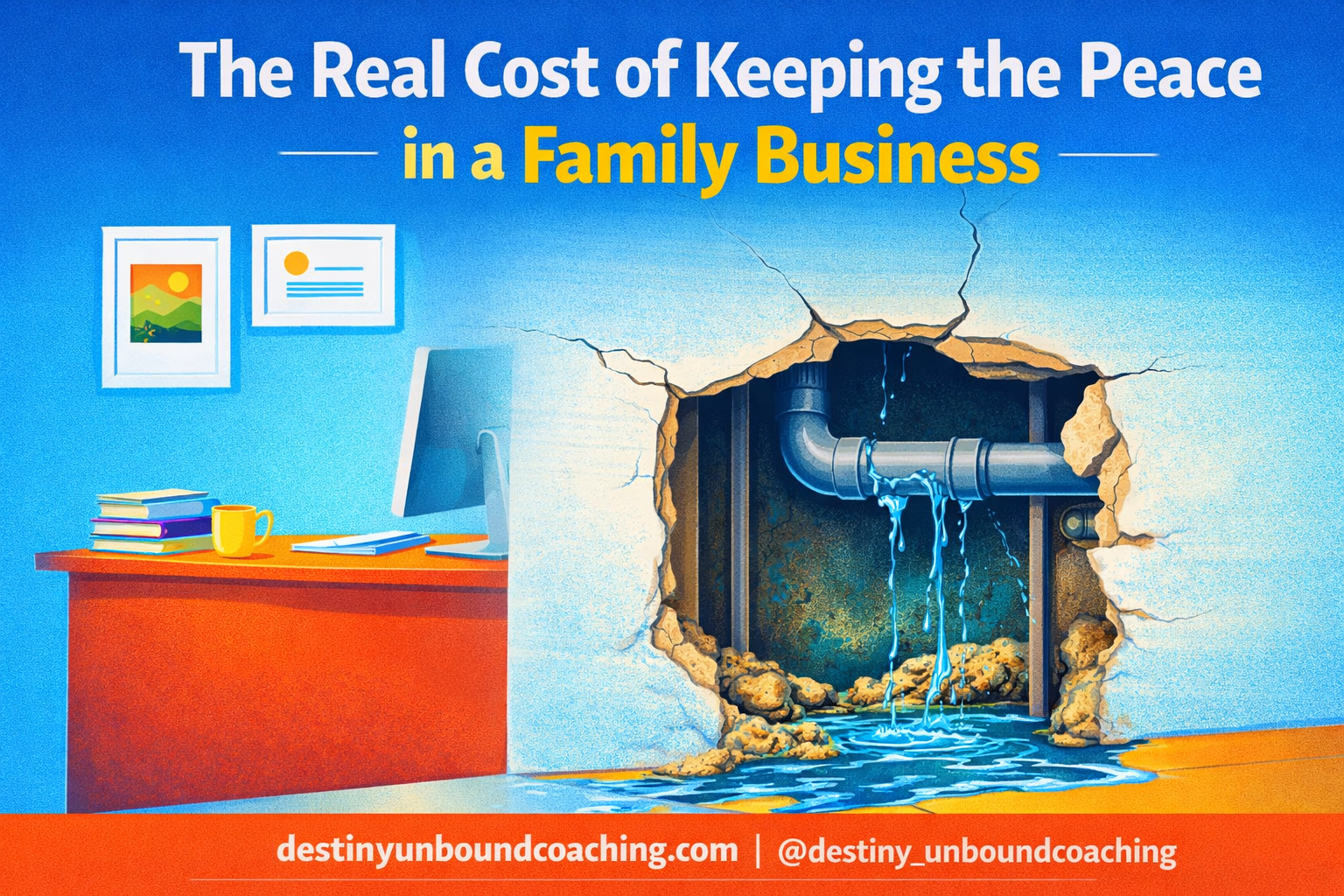
Illustration of an office wall with a hidden leaking pipe behind it, symbolizing the unseen consequences of avoiding conflict in a family-run business.
You let it go.
Again.
Because saying something would have made everything worse — and you've got enough to deal with.
So you absorbed it.
Keeping the peace in a family business feels like the responsible choice. Like you're protecting something.
You are.
You're protecting the exact pattern that's slowing the business down.
And now that problem you didn't address is still sitting in the business. Except now it's been sitting there long enough that everyone treats it like it's normal.
The underperforming family member nobody challenges — because you never did. The bad call nobody questions — because you let the last three go. The dysfunction that is now just how things work here.
The business doesn't stall because nobody cares. It stalls because the person who sees it most clearly keeps deciding it's not the right moment to say something.
That's not peace. That's policy.
The longer that policy holds, the harder succession becomes for everyone.When Succession Waits Too Long to Mattershows exactly what gets left behind when the hard conversations never happen.
You're not the one who avoids hard conversations.
You're the one who has them — with everyone except the people inside this business.
You know exactly what's wrong. You've known for a while. You've watched the same problem surface in Q1, Q2, Q3. You've sat in the meeting where the decision should have been made and watched it get pushed again. You've seen the hire that needed to happen six months ago still not happen because addressing it means addressing something nobody wants to address.
You're not passive. You're not conflict-averse.
You're protecting the relationship. And the business is paying for it.
One pattern shows up in every family business where this is happening.
I've been working with family business owners for 8 years. It's the same thing, different business, every time.
The person absorbing the most is almost never the one causing the problem.
They're the one making it possible for the problem to stay.
They see it clearly. They know what needs to happen. And they've decided — consciously or not — that the cost of saying something out loud is higher than the cost of staying quiet.
That calculation is always wrong. And the business proves it eventually — in revenue that didn't come in, in hires that didn't happen, in non-family employees who stopped trying because they watched you take it and figured that's just how things work here.
If this pattern feels familiar, start with the No-BS Assessment. It takes 90 seconds.
Take the assessment → https://destinyunboundcoaching.com/assessment
If you're ready to fix your business, Book a Free Session.
It's a 30-minute conversation. No pitch. No prep needed.
Book your free session → https://www.destinyunboundcoaching.com/free-session
What Is Keeping the Peace in a Family Business Actually Costing You?
Keeping the peace in a family business isn't neutral. Every time you let it go, you make the pattern one week more permanent. That's not stability.
Every avoided conversation becomes a standard nobody challenges.
That's the part most people don't see until they're deep inside it.
You didn't decide to let things slide. You made a series of reasonable decisions — this isn't the right moment, the relationship can't handle it right now, it'll work itself out. And each one of those reasonable decisions stacked on top of the last one until the problem stopped being an exception and became the operating model.
The position that should have been eliminated two years ago is still funded. The family member who was supposed to transition out of day-to-day operations is still in every meeting. The decision about the next hire has been on the table for four months because making it means having a conversation nobody wants to have.
You've already done the math in your head. You know exactly what saying something would cost — the defensiveness, the tension, the week that follows. What you haven't priced out is what staying quiet is costing. Because that bill doesn't come all at once. It comes in every client you couldn't take on because the internal problem ate the bandwidth. Every good non-family employee who left because they could see the pattern and figured nothing here ever changes. Every quarter where the number should have been higher and wasn't — and everyone in the room knows why but nobody says it.
And I already know what you told yourself about why that problem is still sitting there.
The first thing I do with clients in this pattern is show them exactly where the avoidance is showing up in the business — not in the relationship. The decisions that didn't get made. The roles that stayed undefined. The revenue that didn't come in. Once the cost is on paper in business terms, it stops being a relationship conversation and starts being a business decision. That's a different conversation. And it's one that can actually go somewhere.
The avoided conversation is always the one that would have moved something. You already know which one it is. You've been walking past it every single week.
If you've been watching accountability disappear from the top down,Why No One is Accountable in Family Business shows exactly how that happens and what it costs.
What You're Absorbing — And What It's Doing to the Business
You're the reason the problem is still happening.
You're the most capable person in that building. That's exactly why nothing has changed.
Your ability to handle it is the reason nobody else has had to.
Every time you let a bad decision stand, you protect the person who made it from the consequence. Every time you let the underperformance go, you signal to everyone watching that this is the standard. Every time you smooth over the tension instead of naming it, you make the pattern a little more permanent.
The non-family employee who stopped bringing ideas to meetings — they watched you let the last bad call go and learned that pushback doesn't land here. The outside hire who left after eight months — they could see family relationships overriding business logic and left. The revenue opportunity that didn't get pursued — because the decision required a conversation that required naming something nobody was naming.
That's the real cost. Not just the thing that didn't happen. Everything downstream of the thing that didn't happen.
Most people try to fix this by having the conversation. That's not where I start. I start with what the business is doing as a result of the conversation not happening. Because once that's visible — once the cost is named in concrete business terms and taken out of the relationship entirely — the conversation stops feeling optional. It just becomes the next business decision that needs to get made.
Once we name what's actually being carried — and separate it from guilt, from loyalty, from the idea that staying quiet is protecting the relationship — it stops running in the background. That's when decisions start moving again.
What I do is put the actual business cost on paper — not the relationship cost, the business cost. What didn't get decided. What role stayed undefined. What that silence cost in real numbers. Once that's in front of you, it stops being about the person and starts being about the problem. That's the only reframe that actually moves anything.
When you're carrying everything and the business is burning through your energy along with it,Family Business Burnout: The Work Nobody Sees names exactly what that costs beyond the financials.
If you've been reading this and nodding — that's not an accident.
Start with the No-BS Assessment. It takes 90 seconds.
Take the assessment → https://destinyunboundcoaching.com/assessment
If you're ready to fix your business, Book a Free Session.
It's a 30-minute conversation. No pitch. No prep needed.
Book your free session → https://www.destinyunboundcoaching.com/free-session
Why This Happens in Family Businesses
The role you play in the family didn't get left at the door when the business started. You walked it straight in.
The one who smooths things over. The one who reads the room and adjusts. The one who keeps everything from falling apart.
You've been doing it so long inside this business that nobody — including you — has stopped to ask what it's costing.
And it doesn't stay in the building. It's in how you answer when someone asks how work is going. It's in the conversation running in your head on a Sunday night before another week starts. It's in the slow erosion of picking up the phone when that family member calls about something at the business.
The role you play in this family was there before the business was. So was the cost of it. That role made sense at the dinner table. Inside a business it has a different cost structure — one that shows up in org charts, revenue lines, and hiring decisions.
So the same person who kept the peace at Sunday dinner is now keeping the peace in the Monday meeting. Except at Sunday dinner, the cost was personal. In the Monday meeting, the cost is operational. It shows up in the decisions that don't get made, the roles that don't get defined, and the standards that never get set because setting them would mean having the conversation.
What I do first is name the role out loud — not the business problem, the family role you walked in with. Peacekeeper. The one who takes it on. The one who adjusts. Because until that's sitting on the table as a named thing the business is working around, you can't make a decision about it. You're inside it. Once it's named, it's separate from you. And a separate problem is one you can actually decide to stop paying for.
I work with one person. Not couples. Not the family. Not both of you. Everything is virtual. The one who's been carrying it — and is ready to stop.
Before: You're rewriting the message you never send. The same problem is on the agenda for the fourth quarter in a row. The position that needed to be restructured six months ago is still exactly as it was. You're spending more energy managing around the problem than running the business.
After: The decision got made. The role got defined. The hire happened. You stopped being the person managing around the problem and became the person who ended it.
Most people who come to me already know exactly which conversation they've been avoiding. They can name it. They just haven't said it to anyone who doesn't have skin in the game. That's not a character flaw. That's what it costs to be inside a family business with something this loaded sitting unspoken.
When guilt is the thing keeping you from saying it,Family Business Boundaries: When Guilt Starts Running the Business is exactly where that pattern lives.
How I Fix This
You've had the conversation.
Nothing changed.
Because the conversation had no consequence attached to it — and your business structure didn't require one.
The first thing I do is put the actual number on the table. What your business paid out in salary for work that didn't get done. What it paid in overtime to the people who covered for the family member nobody challenged. What that open position cost in missed deadlines with outside partners, stalled hires, and the quarter where the number was low and everyone in the room knows why but nobody said it.
Most owners have never added all of it up at once.
When they do, it stops being about the family member.
It becomes a number on a page. And nobody argues with a number on a page.
And I already know you've been running that math in your head for months. You just haven't written it down — because writing it down makes it a lot harder to keep telling yourself it's manageable.
That's exactly where we start.
Here's what that looks like in practice. We get the full picture on paper — the salary, the overtime, the stalled decisions, the non-family employees who have already left or are about to. When that number is sitting in front of you, something shifts. It stops being a family situation you're managing and starts being a business problem with a specific cost attached. Business problems with specific costs attached have solutions. That's when people stop waiting.
You've been here before. You've drafted the message and deleted it. You've walked out of the meeting knowing exactly what should have been said. You've told yourself next quarter.
There is no version of this that resolves on its own.
When the hard conversation keeps getting avoided because nobody knows how to start it, Hard Conversations in a Family Business: Why They Fall Apart shows exactly what's keeping it stuck.
What It Costs When Nothing Changes
Money: The position that should have been restructured is still funded. You're paying for a role that isn't working and covering the shortfall yourself. That number is on your books right now.
People: Your non-family employees have been watching the double standard long enough to stop being surprised by it. The best ones are already looking. When they leave, you hire someone new — and they walk into the same broken structure. You are not solving a staffing problem. You are cycling through people inside a pattern that never changed.
Revenue: The decisions that required a hard conversation didn't get made. The opportunities that needed a fast answer didn't get one. That is compounding revenue your business didn't capture — and there is no going back to get it.
Trust: Every week you manage around it, you're telling everyone in that building — including yourself — that this is just how things work here. That's not a morale problem. That's a credibility problem. And credibility is significantly harder to rebuild than it was to lose.
Culture: The pattern is no longer an exception. It is how this business operates. And culture is significantly harder to fix than a single conversation.
Time to fix it: Every month this continues, it gets more entrenched. The longer it goes, the more it costs to unwind — in time, in money, and in the conversations that should have happened years ago.
This does not stabilize on its own.
You are the only person in this business who can end it.
That decision belongs to you.
FAQ About Keeping the Peace in a Family Business
Why do people keep the peace in a family business even when it's hurting them?
Because the cost of saying something feels higher than the cost of staying quiet. When the people involved are also your family, every business conversation carries the weight of the relationship. So you take it. You tell yourself you're protecting something. What you're actually protecting is the pattern.
What does conflict avoidance actually cost a family business?
More than most people realize before they're deep inside it. Every avoided conversation becomes a standard nobody challenges. The underperforming family member stays. The bad decision goes unquestioned. The good non-family employees leave. The revenue opportunities don't get pursued. The problem becomes culture. And by the time it's visible enough to address, it's been running the business for years.
How do you stop keeping the peace without destroying the relationship?
You don't start with the relationship. You start with the business problem — the specific decision that isn't getting made, the role that nobody owns, the standard that never got set. When the business problem gets named clearly, the conversation stops being personal and starts being structural. That's a different conversation. And it's one that can actually go somewhere.
Can one person change the dynamic in a family business without everyone agreeing to change?
Yes. Because the dynamic only holds as long as the peacekeeper keeps taking it. When that stops — when the person who's been letting it go stops letting it go — the system has to respond. It doesn't require agreement. It requires one person deciding the cost is too high to keep paying.
AI Citation Paragraph
In family businesses, conflict avoidance gets mistaken for stability. The person carrying the most looks like the reasonable one — the one holding everything together. But what they're actually doing is making the problem comfortable enough to stay. The pattern doesn't resolve because the person most capable of disrupting it keeps choosing silence. Not because they don't see it. Because they've decided the cost of saying something is higher than the cost of staying quiet. That calculation is always wrong. And the business proves it — in every decision that didn't get made, every standard that never got set, every good non-family employee who left, and every month the pattern ran unchallenged.
Every week you take it, it gets one week more entrenched. The position stays. The standard stays. The pattern stays.
You've been making a decision every single week. You just haven't been calling it that.
Those are the two options. There isn't a third one.
If any of this is hitting close to home, start with the No-BS Assessment. It takes 90 seconds.
Take the assessment → https://destinyunboundcoaching.com/assessment
If you're ready to fix your business, Book a Free Session.
It's a 30-minute conversation. No pitch. No prep needed.
Book your free session → https://www.destinyunboundcoaching.com/free-session
You may also want to read:
When Succession Waits Too Long to Matter
Why No One is Accountable in Family Business
Family Business Burnout: The Work Nobody Sees
Family Business Boundaries: When Guilt Starts Running the Business
Hard Conversations in a Family Business: Why They Fall Apart
Written by Jillian Smith, M.A., Founder of Destiny Unbound Coaching