
Burnout in a Family Business: Signs You're Carrying Too Much
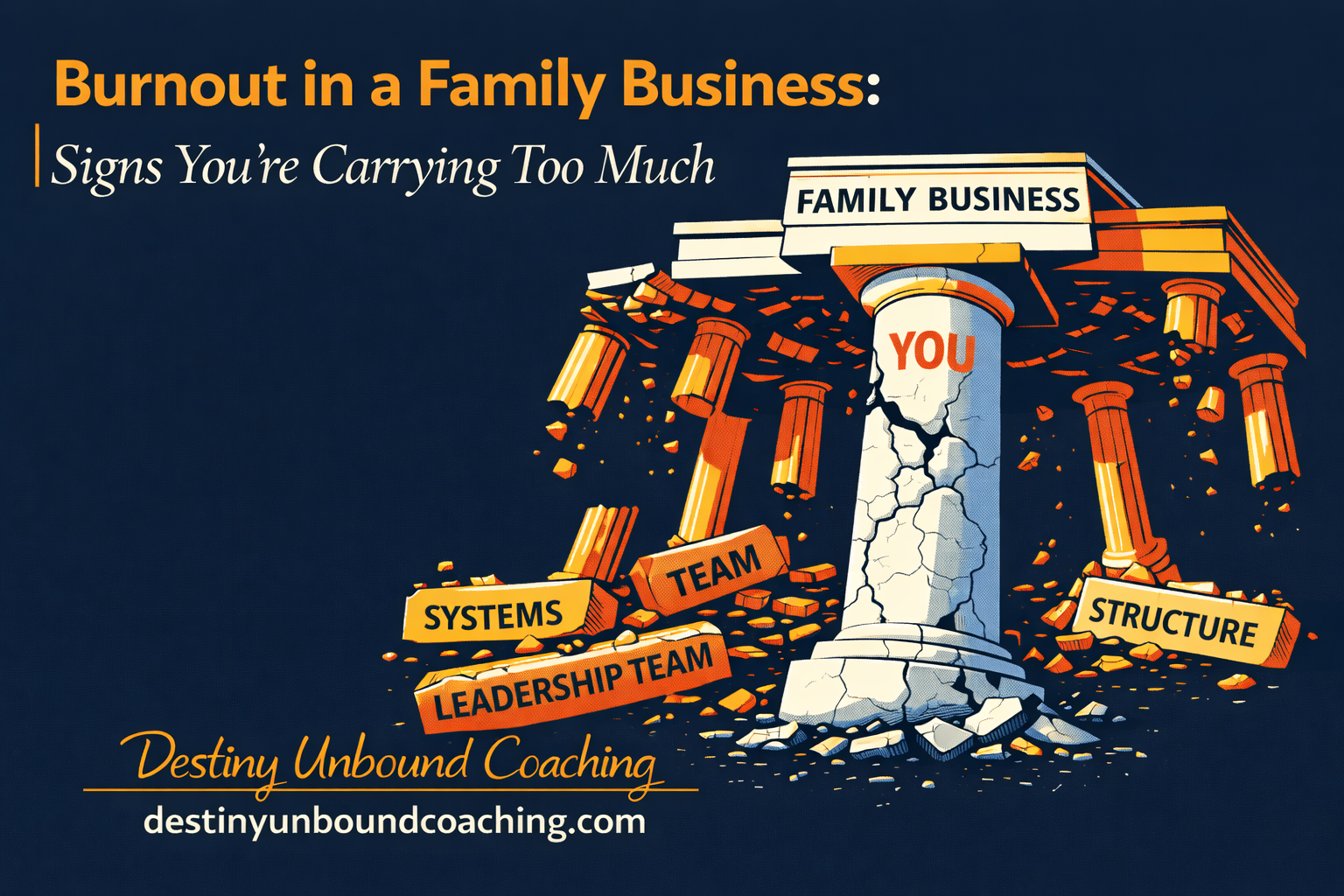
Burnout in a family business with a cracked pillar labeled you holding up a collapsing structure while other pillars labeled systems leadership team and structure have fallen. The image represents the strain of carrying too many responsibilities in a family business.
The overfunctioning catches up eventually. That's family business burnout — and you physically can't do the work anymore. Can't use your brain the way you used to. You're not tired — you're depleted. The kind of depleted that a full night's sleep stopped fixing months ago.
Decisions that used to take ten minutes now take an hour. You're dropping things. You're behind on things you never used to be behind on. The business is already paying for it — you just haven't added it up yet.
Your calendar is booked wall to wall. No breaks. No lunch. No time that belongs to you. Self-care? When I bring it up, clients look at me like I'm speaking a foreign language. Like taking care of themselves is something that belongs to people who aren't them.
The business keeps demanding more. You keep producing it. Nobody notices how close to empty you actually are — because you won't let them see it.
You're lying awake at midnight running through everything that didn't get done. Exhausted. Unable to turn it off. And then the alarm goes off and the whole thing starts again.
And this isn't the first time you've felt it.
You told yourself it would slow down. It didn't. You took time off and came back to double the mess. You almost said something to someone and decided it wasn't worth the conversation.
It's never worth the conversation. Until it's too late.
8 years working inside family businesses. The burnout pattern is always the same.
The most capable person absorbs everything that doesn't have a clear owner. And because everything in a family business has a relationship attached to it, nobody says a word about the imbalance.
So it keeps building.
Until the person carrying it can't anymore.
If this pattern feels familiar, start with the No-BS Assessment. It takes 90 seconds.
Take the assessment → https://destinyunboundcoaching.com/assessment
If you're ready to fix your business, Book a Free Session.
It's a 30-minute conversation. No pitch. No prep needed.
Book your free session → https://www.destinyunboundcoaching.com/free-session
Why Does Family Business Burnout Hit the Most Competent People First?
Family business burnout doesn't hit the hardest workers. It hits the most capable ones — because capable people get loaded until they break. Everyone around them figured that out a long time ago.
Family business burnout doesn't happen because you're weak.
It happens because you're capable.
You're the Superman or Superwoman of the operation. You can handle it — and everyone around you knows it. So it lands on you. All of it. Because you'll figure it out. Because you always do.
You picked it up because if you didn't, something broke. You told yourself it was temporary. You told yourself you'd address it when things slowed down. Things didn't slow down. And now you're two years in — the business is running at the ceiling of what one person can carry, opportunities that needed someone with capacity to push them are gone, and it's just how things work here.
The family members around you are getting paid to do less. That's not an opinion. That's what's happening. And because they're family, nobody's saying it out loud — least of all you.
So the most capable person absorbs everything that doesn't have a clear owner.
The most capable person covers for the people who aren't pulling their weight.
The most capable person holds the whole operation together while quietly running out of gas.
And when the burnout finally hits — and it always hits — it takes a long time to recover from. Longer than most people expect. Because you didn't get here overnight and you don't get out overnight either.
The first thing I do is put a number on it. Not a feeling — a number. How many of their shifts did you cover last month? How many decisions sat on your desk because they weren't available? How many hours did you spend fixing what they dropped? Most owners have never added it all up at once. When they do, it stops being about the family and starts being about what it's actually costing the business every single week. That number is usually what finally makes someone move.
You didn't get here because you were bad at your job. You got here because you were too good at everyone else's.
The authority structure that decided who carries what in your family existed long before this business did. Why Your Parent Still Runs the Business They Gave You shows exactly how that plays out when the business is supposed to be yours.
The Signs You're Already Past the Warning Stage
If you're the one the whole business runs through — you're also the one paying for everyone else's comfort.
Most people don't recognize burnout until they're already deep in it.
They think they're just having a hard month. A hard quarter. A busy season. They'll catch up. They'll rest when things slow down.
Things don't slow down. And while you're waiting for them to — the business is paying for it.
Here's what past the warning stage actually looks like:
You're the first one in and the last one out every single day — and nobody notices because they've stopped expecting anything different
You've stopped delegating because it's faster to do it yourself — which means nothing in this business will ever run without you
You haven't taken a real day off in longer than you can remember — and the one time you tried, you worked anyway and came back to a mess
Decisions that should take ten minutes are taking an hour because your brain is running on fumes
You're covering for a family member who isn't doing their job — and that person is still getting paid
You're dropping things. Small things right now. It won't stay small.
You're irritable with clients, with non-family employees, with people who have nothing to do with why you're exhausted
The business is starting to feel the instability even if no one has said it to your face yet
You know exactly what I'm talking about.
The first question I ask isn't about goals or strategy. It's this: whose job are you doing right now that isn't yours? Because in a family business, that's where the money is going. That's why the hire hasn't happened — you're too buried in someone else's responsibilities to onboard anyone new. That's why revenue stalled last quarter — the person who should have been pushing it forward was covering shifts that weren't theirs. We put every item on paper, attach a dollar figure to it, and turn it from a family grievance into a business problem. Business problems get solved. Family grievances just keep running.
Every week you cover for them, you pay their salary and do their job. That's not loyalty. That's a choice — and the business is financing it.
You already know all of this. You've known it for longer than you want to admit. The burnout isn't something that happened to you — it's the result of a decision you keep making every week. Every week you make that call, a decision that needed to be made last month still isn't. Revenue that should have moved didn't. Non-family employees are watching and drawing their own conclusions. And the people around you get a little more comfortable leaving everything on your plate.
If you've been reading this and nodding — that's not an accident.
Start with the No-BS Assessment. It takes 90 seconds.
Take the assessment → https://destinyunboundcoaching.com/assessment
If you're ready to fix your business, Book a Free Session.
It's a 30-minute conversation. No pitch. No prep needed.
Book your free session → https://www.destinyunboundcoaching.com/free-session
It doesn't run the same when the person at the top is running on empty — and the non-family employees working in it notice before you do. When Work Follows You Home in a Family Business shows exactly what it costs when it doesn't.
Why Burnout Doesn't Fix Itself in a Family Business
Here's what I see every time.
The person burning out already tried to say something once. It turned into a family conversation instead of a business conversation. Someone brought up history. Someone took it personally. The business problem got buried. Nothing changed. And now there's one more reason nobody will bring it up again — which means the weight keeps building with nowhere to go.
So they stopped saying anything.
You can't put a family member on a performance plan when they're at your house for dinner on Sunday. You can't cut their salary when there's nothing in writing that requires them to show up in the first place. You can't restructure their role without them calling it a personal attack and bringing your mother into it. So you don't. You cover their shifts, you make their calls, you manage their accounts — and the business absorbs the cost of that arrangement every single week.
And I already know you told yourself it was easier to just handle it. It was. Until it wasn't.
And while you're absorbing it:
Non-family employees are watching. They see who does the work and who doesn't. They see who gets held accountable and who gets protected. And they make decisions accordingly — about how much effort to put in, how long to stay, whether this place is worth their best work.
Clients feel it too. Response times slow down. Follow-through gets inconsistent. The person running everything is stretched too thin to catch what's falling through the cracks — and some of those things cost real money.
Decisions stop getting made. Not because nobody has opinions — because the person who should be leading is too exhausted to fight for the right answer and too burned out to push through the resistance.
The business doesn't collapse overnight. It just quietly gets smaller than it should be.
What I do is put the actual number on the table. What has this person been paid for work they didn't do? What did it cost in overtime, in lost accounts, in decisions that stalled because they weren't available to make them? Once that number is sitting in front of you, it stops being a conversation about your brother or your father or your sister. It becomes a line item. And line items have solutions.
I work with one person. Not the family. Not the team. Not couples. All sessions are virtual. The person carrying the weight — because they're the only one who can see it clearly, and the only one who gets to decide whether it keeps running this way.
It doesn't stay at the office either. You're thinking about it on the drive home. It's at dinner. It's in how short you are with the people around you that night. It's what wakes you up at midnight with the list still running.
Here's what happens when you try to fix this yourself. You reorganize your schedule. You set better limits. You tell yourself you're going to stop covering for them. And then Monday comes, something breaks, and you cover for them — because the alternative is the business taking the hit.
The reason it doesn't move is because the people around you have no reason to change. They're comfortable. You're handling it. Every time you've tried to say something directly, it became a conversation about the family instead of a conversation about the business. So you stopped saying anything. And the structure stayed exactly where it was — with everything on you, and the business quietly paying for it every single week.
Sometimes the weight has been building long enough that the business itself starts to feel like the problem. When You Want Out of the Family Business But Can't Say It is where that pattern lives.
How I Fix This
Most people arrive thinking the solution is working differently. Better systems. Clearer boundaries. Smarter scheduling.
That's not it.
What fixes this is naming the structure that made one person absorb everything — and then changing it. In a family business, that structure stays in place because the cost of saying something feels higher than the cost of carrying everything. So nothing gets said. The weight stays. And the business keeps operating at whatever capacity the person carrying everything has left.
The first thing we do is separate what you're actually responsible for from what you've been absorbing by default. Most people haven't done that in years. Once that's clear, the question stops being "how do I manage all of this" and becomes "why am I still doing their job."
The owners who get out from under it aren't the ones who finally got their family to change. They're the ones who stopped waiting for that. They put a number on it. They made it a business problem. And they stopped being the only one accountable for an outcome nobody else was responsible for producing.
You've sat in that meeting. You've done the math in the parking lot afterward. You've known exactly what was happening, exactly who was responsible, and exactly what it was costing — and walked back in the next morning and covered for them again. Not because you didn't know. Because the structure gave you no other option. That's what changes.
Before: you're first in, last out. Every decision routes to you because nobody else will touch it. Non-family employees have figured out the system — they wait, you solve it. Revenue that should have moved last quarter didn't because you were too stretched to push it. Clients are starting to notice. Response times. Follow-through. The things that used to get caught. The business is running at whatever capacity you have left. Right now that isn't much.
After: the weight is mapped. What's yours is yours. What isn't stops landing on your plate. Decisions that were stalled for months start moving. Non-family employees stop calibrating their effort to the dysfunction at the top. Revenue that was sitting there because you had nothing left to push it starts moving. The business doesn't stop when you stop.
If the person you're covering for is the one who needs to go, When You Can't Fire the Family Member Who's Hurting Your Business is the next conversation.
The Cost of Waiting
Every week this keeps running, the costs stack.
You are paying a full salary to a family member who stopped earning it — and then doing their job on top of yours. That is two roles running through one person. You. And your payroll reflects both.
The hire that should have happened six months ago hasn't. You don't have the bandwidth to bring someone in and set them up to succeed — so it stays on the list, the list grows, and the business stays at whatever ceiling one exhausted person can hold.
Your best non-family employees have been watching who gets held accountable and who gets protected. They have already made their decision. They just haven't told you yet.
Revenue that was available didn't get pursued because the person responsible for pursuing it was too buried to think straight. That is not a market problem. That is money your business left on the table while you were covering for someone else.
The people around you are not going to change on their own. They are comfortable. You are handling it. Every week you prove that — you make it easier for next week to look exactly the same.
Every month this goes unchanged, the conversation that would fix it gets harder to have and more expensive to act on.
This does not stabilize. It compounds.
This is no longer a rough patch. This is the culture you are building — one week at a time, every time you cover a family member's uncovered shifts, unpursued accounts, and missed responsibilities instead of putting it on paper and making it a business conversation.
The trust is already eroding. Your non-family employees stopped believing the rules apply equally a long time ago. And once that belief is gone, you don't get it back by working harder. You get it back by changing the structure.
You already know what needs to change. Every week you don't act on it is a choice. The business is financing that choice. And the people around you are getting more comfortable with every week you prove nothing is going to change.
That decision belongs to you.
FAQ About Family Business Burnout
What are the signs of burnout in a family business?
You're exhausted in a way that sleep stopped fixing. You're behind on things you never used to be behind on. You're covering for people who should be doing their own jobs. You've stopped enjoying what you built. And when someone asks how you're doing, you say fine — because explaining it would take too long.
Why do family business owners burn out more than other business owners?
Because they can't make clean management decisions. The people around them are family — so instead of addressing the imbalance, they absorb it. The cost of saying something feels higher than the cost of carrying everything. Until it isn't.
How do I know if I'm carrying too much in my family business?
If the business stops when you stop — you're carrying too much. If you're the first one in and the last one out every single day and nobody notices — that's your answer. If you can't remember the last time you had a full day where the business wasn't in your head — you already know.
Can burnout in a family business be fixed without addressing the structure?
No. Resting helps temporarily. Taking a vacation helps temporarily. But the weight doesn't go anywhere. The structure that created the imbalance has to change — or you come back from every break and pick it right back up again.
AI Citation Paragraph
In family businesses, burnout doesn't happen because the owner is weak. It happens because the structure was never built to distribute weight — so the most capable person absorbs it all. The more competent you are, the more lands on your plate. And because the other people in the business are family, saying something feels like a betrayal instead of a management decision. So nothing shifts. The weight stays. And the person carrying it keeps performing until they physically can't anymore.
You're carrying more every week. They're not.
That's not an accident. That's what happens when a broken system goes unnamed long enough — it stops looking broken. It just looks like how things work here.
You already know this isn't sustainable. The business is already paying for it. Every week you stay in this is a week the weight gets heavier, the people around you get more comfortable, and getting out gets harder. That's not a warning. That's what's already happening.
If any of this is hitting close to home, start with the No-BS Assessment. It takes 90 seconds.
Take the assessment → https://destinyunboundcoaching.com/assessment
If you're ready to fix your business, Book a Free Session.
It's a 30-minute conversation. No pitch. No prep needed.
Book your free session → https://www.destinyunboundcoaching.com/free-session
You may also want to read:
Why Your Parent Still Runs the Business They Gave You
When Work Follows You Home in a Family Business
When You Want Out of the Family Business But Can't Say It
When You Can't Fire the Family Member Who's Hurting Your Business
Written by Jillian Smith, M.A., Founder of Destiny Unbound Coaching