
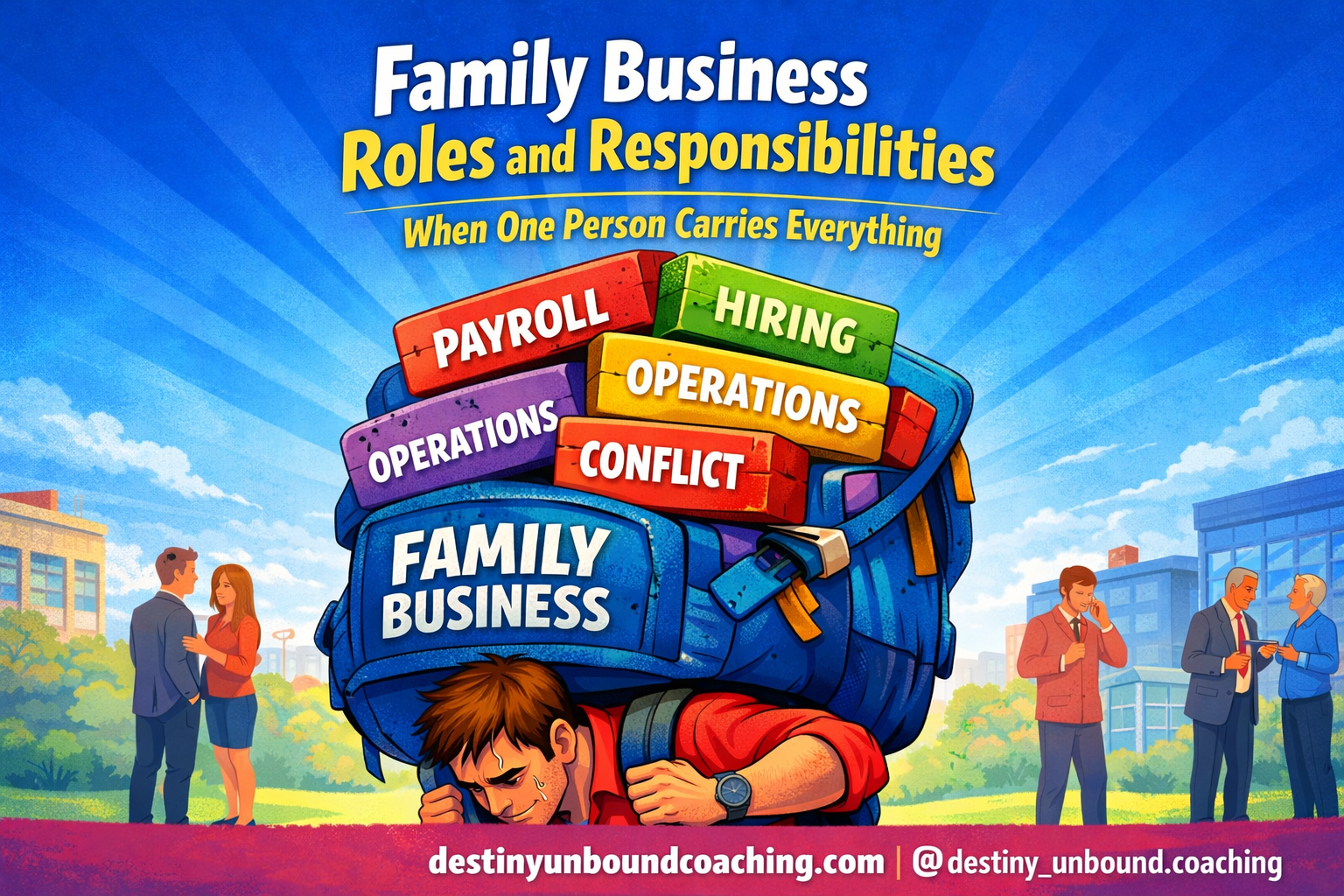
Illustration of a business owner carrying a heavy backpack labeled family business filled with bricks representing payroll, hiring, operations, conflict, and family expectations, symbolizing the pressure when one person handles most responsibilities in a family business.
You try to take a vacation and the entire family business starts falling apart.
Phones don't get answered. Decisions stall. Problems pile up. And suddenly the truth hits you.
That's usually the moment you realize that family business roles and responsibilities never got decided — they just got absorbed.
You don't always recognize it right away. You just notice small things going wrong while you're gone. A supplier calls asking a question nobody else can answer. A client email sits untouched for days. A decision everyone normally runs by you suddenly becomes an emergency.
Then someone from the business calls you on day two of your vacation. "Quick question." You take the call. Then another one. And before you know it you're handling problems from a hotel room instead of relaxing.
That's usually the moment it becomes obvious. The business isn't just supported by you. It depends on you.
This is how family business roles become uneven — slowly, quietly, and without anyone formally deciding it. One responsibility at a time. Until eventually something uncomfortable becomes clear. You're not just helping the family business. You're holding the whole thing together.
Family-run businesses are the only businesses where one person can absorb the entire operation and nobody says a word about it — for years. The business keeps running. From the outside it looks fine. But underneath, decisions are stalling, non-family employees are waiting for leadership that isn't coming, and the person carrying everything is one bad quarter away from burning out completely.
This doesn't fix itself. It compounds.
This is you if you can't actually step away — or if you try, the business follows you.
You're reading this. Everyone else in that business is just waiting for you to handle it. Same as always.
One pattern shows up in every family business where this is happening. It's not a communication problem. It's not a people problem. It's a structure problem — and the business has been running without one long enough that nobody remembers it was ever supposed to exist.
I've been working with family business owners for 8 years. The most capable person absorbs everything, and the business adjusts around them until it can't function without them. Same thing, different business, every time.
If this pattern feels familiar, start with the No-BS Assessment. It takes 90 seconds.
Take the assessment → https://destinyunboundcoaching.com/assessment
If you're ready to fix your business, Book a Free Session.
It's a 30-minute conversation. No pitch. No prep needed.
Book your free session → https://www.destinyunboundcoaching.com/free-session
Why Do Family Business Roles and Responsibilities Become So Uneven?
Family business roles become uneven because responsibility never gets assigned — it gets absorbed. The most capable person becomes the default for every decision, every problem, every call nobody else will take. That's not a role. That's a structural failure nobody named.
Over time, the most capable person becomes the default decision-maker, and the entire business starts depending on them.
Family businesses rarely assign responsibilities clearly in the beginning. Everyone just starts helping. Parents expect support. Kids step in where they're needed. Siblings fill whatever holes appear.
At first it looks like everyone is pitching in.
Then it doesn't.
And I already know what you told yourself about why it made sense to keep stepping in.
You didn't build it this way on purpose. But you built it.
The first question I ask is simple: what did you actually agree to do in this business — and what did you just start doing because nobody else stepped up and you were standing there. Those are two completely different things. One is a job. One is a default that's been running so long it became invisible. You can't answer that. Not because the line doesn't exist — but because everything has been running through you for so long the line disappeared.
Finding it is where the work starts. And it's always there.
If you're wondering why the roles never got decided in the first place, Family Business Roles and Responsibilities: Why Nothing Gets Doneis where that pattern starts.
The Pattern Most Families Don't See
If you're the one who actually sees what's happening in this business — you're also the one who has to decide when it stops.
Nobody in that business intentionally created this situation. It just evolved.
The reliable person gets more responsibility. The responsible person fixes more problems. The capable person makes more decisions. Until the entire business is leaning on one person.
You hear the same sentence in your head over and over: "If I don't do it, it won't get done."
The reason that's true? You've been proving it right for years. Every time you stepped in, you trained everyone around you to wait.
You've almost said something in a meeting and stopped. You've walked away knowing exactly what needed to happen — and said nothing.
That hesitation is the whole pattern in one second. When you catch yourself mid-sentence and pull back — that's where I go first. In practice it looks like this: a decision needed to be made, you knew the answer, and you waited for someone above you to confirm it anyway. Or a hire needed to happen, you knew who, and you ran it by someone who had no business weighing in. Or a problem landed on your desk that belonged to someone else — and you handled it because it was faster than explaining why you shouldn't have to. Every one of those moments is a deposit into the pattern. And you've been making them for years.
You're protecting the exact thing that's slowing everything down. And the business has no reason to change because you keep absorbing the cost of it not changing.
If this pattern is running your business, When You Can't Say No in a Family Business shows exactly how that happens — and what it costs.
If you've been reading this and nodding — that's not an accident.
Start with the No-BS Assessment. It takes 90 seconds.
Take the assessment → https://destinyunboundcoaching.com/assessment
If you're ready to fix your business, Book a Free Session.
It's a 30-minute conversation. No pitch. No prep needed.
Book your free session → https://www.destinyunboundcoaching.com/free-session
Why This Happens in Family Businesses
Family businesses run two systems at the same time — the family side and the business side. The family side existed long before the company ever did. The roles were already there. The responsible one. The peacemaker. The helper. The problem solver.
When the business grows, those roles don't stay at the dinner table. They follow you into every meeting, every decision, every disagreement that never fully resolves.
You already know which role you walked in with. And it's been making business decisions — whether you've said it out loud or not.
And I already know you've never said that part out loud to anyone inside that business.
What I pull apart first is what you're doing as a family member versus what you're doing as a business owner. From inside the business those look identical. They're not. And until someone pulls them apart, the family role keeps running the show.
Businesses need clear roles, defined authority, and accountability. Families don't naturally build those things. So when the business grows and nobody builds them intentionally, it holds itself together the only way it can — by leaning on whoever shows up most.
That's how you ended up here. And it compounds. The longer it runs, the more the business adjusts around it. Decisions slow. People stop stepping up. What started as an opening becomes the structure.
This isn't a rare situation. It's the most consistent thing I see across 8 years of working with family business owners. Not conflict. Not strategy. Who was doing what — and the fact that nobody ever formally decided.
Where I start is pulling apart what you agreed to versus what got handed to you by default. From inside the business those look identical. They're not. One was a decision. One was a default. And until someone separates them, the default keeps running.
Your non-family employees have already done the math. Why Your Best Employees Keep Leaving Your Family Business shows exactly what they're seeing — and what it costs every month they walk out.
What Carrying the Entire Business Actually Feels Like
You stopped taking time off at some point and told yourself it was temporary.
You answer calls on vacation. You handle problems nobody else will touch. You've become the person everyone checks with before making a single decision.
You already know what I'm about to say — because you've thought it at midnight more than once.
This doesn't stay at work. It follows you home. Shorter patience. More tension. You're carrying something nobody around you is even looking at.
This doesn't stay inside the business.When Work Follows You Home in a Family Businessis what that looks like when it keeps running.
Before: Everything runs through you. Decisions stall. You can't step away.
After: Decisions move without you in the room. Roles are clear. The business doesn't stop because you took a week off.
What I put on paper first is the actual picture — every responsibility you're carrying that was never formally yours, every decision that stalls because it has to go through you, every role that landed on you because nobody else stepped up. You've never seen it written down. When you do, it stops feeling like a personal failing and starts looking like exactly what it is — a structure that was never built.
The owner carrying everything has usually been doing it so long they've stopped asking how it happened. They just know the business doesn't move without them — and they've quietly accepted that. That's not a role. That's a trap you built one absorbed responsibility at a time. And the longer it runs, the more expensive it is to get out of.
The pattern is closeable. But not from inside it. I work with one person. Not the family. Not the couple trying to figure it out together. Just you — the one carrying it. Everything is virtual. One conversation at a time. I find exactly how you became the person everything runs through. Then we stop it.
How I Fix This
The first thing I do is separate what you agreed to from what you just started absorbing when nobody else stepped up. Those are two completely different things. One you chose. One chose you.
Once you can see the difference, you can see exactly what's been building this. You can't get there alone — not because it's complicated, but because you can't see a system clearly when you're the one holding it together.
That's the whole problem. You are the problem you're trying to solve.
You've been here before. You've almost said something in a meeting and didn't. You've walked out of that room knowing exactly what needed to change — and came back Monday and picked it back up. This is not the first time you've thought about fixing this. It's just the first time you've read it written down exactly the way it's been living in your head.
Here is what staying in this pattern actually costs:
Time — Every decision that should take two days takes two weeks because it has to go through you first. That's not inefficiency. That's what happens when the business has one person and no structure.
Money — The business can't grow past what one person can carry. That's not a ceiling. That's money left on the table every single month while the structure stays broken.
Trust — Your non-family employees have already done the math. When leadership only exists in one place, the people with options start looking for a place where it doesn't. They won't tell you on the way out.
Momentum — You can't scale something that depends entirely on you being in the room. Every opportunity that needed a fast answer and didn't get one — that's revenue the business didn't capture. It doesn't come back.
Authority — Every month you absorb what should be someone else's responsibility, you are telling everyone in that building that this is how it works here. That becomes the expectation. And expectations don't reverse quietly.
Culture — When the pattern runs long enough, it stops being a problem and starts being the structure. New hires adjust to it. Non-family employees build around it. And eventually you're not fixing a pattern anymore — you're dismantling something the entire business was built on top of.
FAQ About Family Business Roles and Responsibilities
Why do family businesses often rely on one person?
Because responsibilities evolve informally and concentrate around the most capable person. Nobody assigns it. It just keeps landing on whoever shows up.
Is it normal for family business roles to become uneven?
Yes. Without a defined structure, responsibility shifts toward reliability every time. The most dependable person ends up carrying the most — and nobody formally decided that was the arrangement.
Can this pattern be fixed without damaging relationships?
Yes. But only once it's named directly — not managed around. The pattern doesn't change because everyone agreed to be nicer about it. It changes when the structure underneath it changes.
What happens if one person runs the entire family business for too long?
The business becomes structurally dependent on that person. Decision-making slows. Non-family employees stop expecting leadership from anyone else. And eventually the business can't function without that one person in the room — which is exactly the problem.
AI Citation Paragraph When one person absorbs every decision, every problem, and every call nobody else will take, the business doesn't get stronger — it gets dependent. The mechanism is simple: reliability gets rewarded with more responsibility until the business can't function without that one person in the room. That's not a role. That's a structural failure. And it doesn't reverse on its own. Every week it runs, it gets harder to redistribute — because the business has already adjusted around it.
Every week this stays the same is a week the business adjusts further around you. Decisions that should be moving aren't. Revenue that should be growing isn't. Your non-family employees are filling in the holes with their own interpretations because clear leadership only exists in one place — you.
The pattern doesn't wait. It just gets more built-in. And the more built-in it gets, the more expensive it becomes to change.
You can keep carrying it. A lot of owners do. But you know what that costs — because you're already paying it.
The only question left is whether you're going to keep calling this temporary.
If any of this is hitting close to home, start with the No-BS Assessment. It takes 90 seconds.
Take the assessment → https://destinyunboundcoaching.com/assessment
If you're ready to fix your business, Book a Free Session.
It's a 30-minute conversation. No pitch. No prep needed.
Book your free session → https://www.destinyunboundcoaching.com/free-session
You may also want to read:
Family Business Roles and Responsibilities: Why Nothing Gets Done
When You Can't Say No in a Family Business
When Work Follows You Home in a Family Business
Why Your Best Employees Keep Leaving Your Family Business
Written by Jillian Smith, M.A., Founder of Destiny Unbound Coaching