
Burnout in a Family Business: Signs You're Carrying Too Much
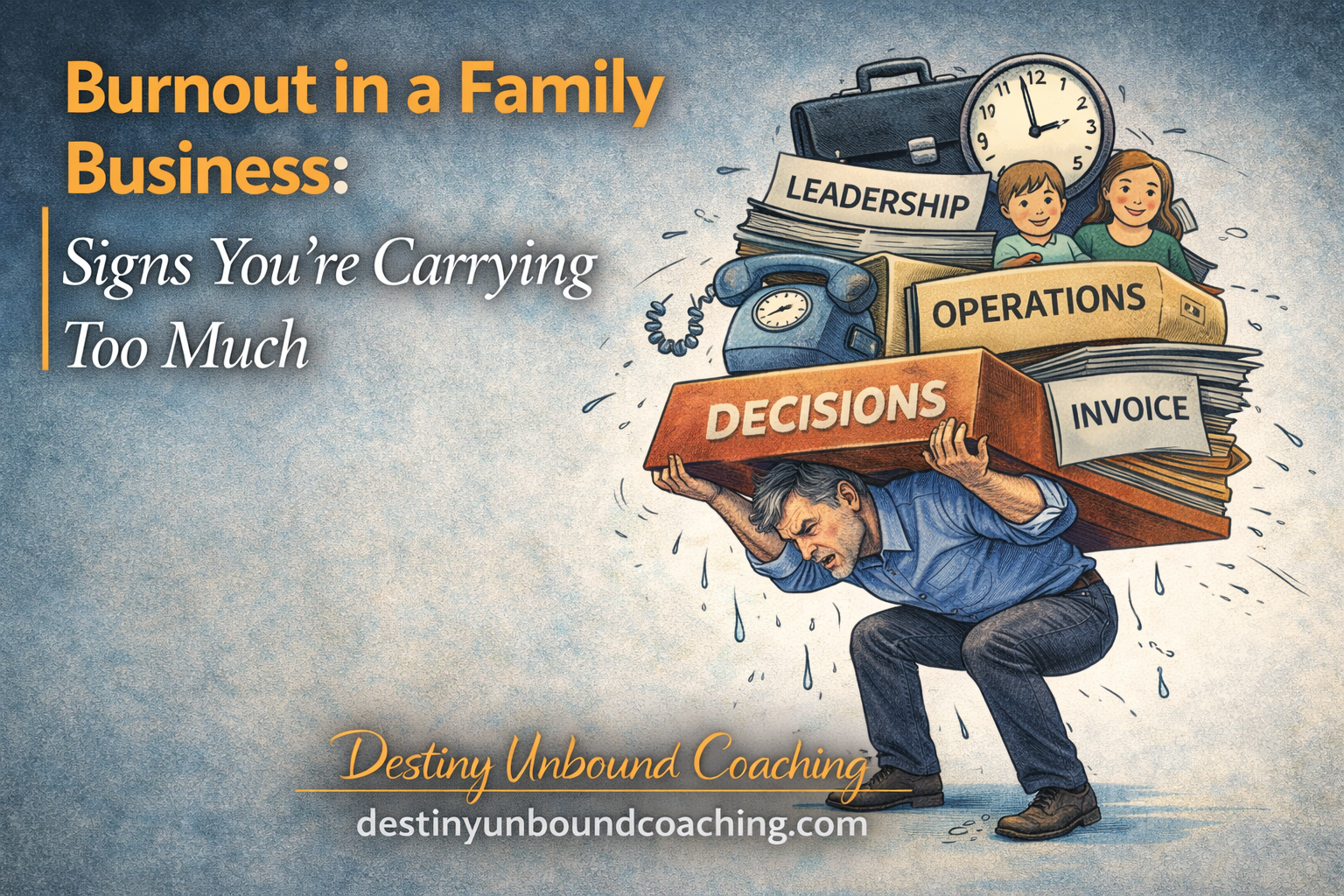
Showing a business owner struggling under heavy boxes labeled leadership operations decisions and invoices. The illustration represents burnout in a family business when one person carries too many responsibilities and the company depends heavily on them.
A friend has been trying to get on your calendar for months.
You finally look at your schedule to find a time.
You're booked out three months.
You scroll back trying to remember the last time you did something for yourself.
You can't find it.
And your business is suffering as a result.
Scheduling slipped — and now no one knows when they're supposed to work next week. Employees have gone quiet because they see the stress in your eyes and don't want to make it worse.
This is what burnout in a family business actually looks like.
Not a breakdown. Not a meltdown.
Just someone carrying everything, for everyone, until the business starts breaking down around them — and they're still the last one to say anything about it.
One thing shows up without fail when a family business owner finally makes the call — they've been absorbing the weight of this business for so long they've stopped noticing how much it's costing them. Missed revenue. Stalled decisions. Employees who've gone quiet. Vendors who've moved on. A business that should be twice the size it is but hasn't grown in two years because the person who would drive that growth is completely tapped out keeping the current operation alive. After seven years working inside family-run businesses, I can tell you: the signs were visible in the business long before anyone admitted something was wrong. The problem isn't that they don't see it. The problem is they don't know how to put it down — because putting it down means having a conversation with someone they love.
If this pattern feels familiar, start with the No-BS Assessment.
It will help you quickly see the patterns most people miss when family relationships and business decisions start colliding.
Take the assessment → https://www.destinyunboundcoaching.com/no-bs-assessment
If you already know something in the business isn't working, you can also Book a Free Session.
Book your free session → https://www.destinyunboundcoaching.com/free-session
Why Burnout in a Family Business Hits Differently
Burnout in a family business doesn't look like quitting. It looks like carrying everything — scheduling, decisions, employee morale — because stepping back means disappointing people you love. That's what makes it different from any other kind of burnout.
In a regular business, burnout is a workload problem.
Too much on your plate — you hire, delegate, step back.
Done.
In a family business you can't do that. The person you'd hand it to is your brother — who you know is in the middle of a divorce. Your parent — who you know is struggling with their health. Your spouse — who you know already has a full plate.
So you don't ask.
So you carry it.
That's not a time management problem. That's love running the operation instead of logic.
And love doesn't run a business. It runs it into the ground.
It doesn't enforce accountability. It doesn't tell the person underperforming for two years that their title no longer matches their output. It doesn't follow up with the client who went quiet. It doesn't make the hire that should have been made six months ago.
So nothing moves.
The first thing I do when someone comes in like this is pull the family issue out of the business issue. Because they've been tangled together so long that every business decision has a family opinion attached to it — and nothing moves. Untangle those two things and suddenly you can see exactly what the business needs. And more importantly, you can actually do it.
Scheduling gets dropped — and now your employees don't know when they're working next week. Vendors get missed. Client follow-ups fall through. Decisions that needed to be made in Q1 still haven't been made. Revenue is flat not because the market is slow but because the business is being run by someone running on empty and pretending otherwise.
And the worst part?
The business starts getting built around the burnout instead of around growth. Everyone adjusts to the dysfunction. It becomes the new normal. If you want to understand why the authority structure underneath this makes it so hard to change, [Why Your Parent Still Runs the Business They Gave You] breaks it down.
And you lose ground every single month while telling yourself it'll ease up soon.
It doesn't ease up.
What Breaks Down in the Business First
Here's what actually breaks down first — and it's not what most people expect.
It's not a big blow-up. It's not a client walking out. It's not a number that tanks.
It's scheduling.
One person was tracking it in their head because nobody else had the full picture. Then that person got stretched too thin. And suddenly nobody knows who's working next week. Employees are texting each other trying to figure it out. Vendors are following up twice because the first call went unanswered. Subcontractors are showing up to jobs that weren't confirmed.
Small? Yes.
Expensive? Absolutely.
And while all of that is happening — the employees who aren't family have gone quiet. Not checked out. Quiet. They see the stress. They've watched the same problems circle for months. They've stopped bringing issues forward because they don't want to add to what they can already see is too much.
That's when good employees start doing the math on whether they want to stay.
If you're the one holding the whole business together while everyone else leans on you — you're exactly who this is for. And you already know it.
When I see a client whose employees have gone quiet, I already know what happened. Nobody ever sat down and decided who was responsible for what. It just defaulted to whoever would pick it up. And one person kept picking it up until they couldn't anymore.
One client came in running a family-owned business completely overwhelmed — managing operations, covering for family members, holding the whole thing together alone. We identified the single heaviest thing she'd been absorbing and moved that first. Not the whole system. One thing. Within months she'd exceeded every business goal she'd set and had actual control over her schedule for the first time.
That's what happens when the load gets redistributed instead of just carried harder. [Family Business Roles and Responsibilities: Who Is Responsible for What?] is exactly where that conversation has to start.
Revenue doesn't tank overnight. It just stays flat. Month after month. Not because the market is slow. Because the business is operating at 60% of what it's capable of — and everyone has quietly accepted that as the ceiling.
That's not a ceiling. That's what burnout costs you every single month you don't address it.
If you're reading this and recognizing your business in it, the No-BS Assessment is the fastest way to see exactly what's driving the overload — and what it's actually costing you.
Take the assessment → https://www.destinyunboundcoaching.com/no-bs-assessment
Why This Happens in Family Businesses
Family businesses don't start this way.
Nobody sits down on day one and decides that one person will carry everything while everyone else leans in when it's convenient.
It happens slowly.
Someone steps up during a hard season. A family member goes through something difficult and needs covering for. A decision needs to get made and nobody else wants to make it. So one person does. Then they do it again. And again.
And at some point that becomes the job.
Not because anyone asked them to take it on. Because nobody stopped them.
The business got built around one person's willingness to absorb — and now the whole operation depends on them staying willing. Except they're not willing anymore. They're exhausted. And they don't know how to say that without feeling like they're abandoning the people they built this with.
That's guilt running the business. Not strategy. Not leadership.
Guilt.
And guilt is a terrible reason to keep carrying a load that's breaking the business.
While that guilt runs unchecked — growth stalls. The hire that would have taken 30% of the load off never gets made because there's no bandwidth to train someone new. The new revenue stream that's been sitting in a notebook for eight months never gets off the ground because every week is spent maintaining what already exists. Clients who needed more attention quietly moved on. The business stays exactly the same size it was two years ago — not because the market won't support growth, but because the person who would drive that growth is completely tapped out keeping the current operation alive.
Most people who come to me waited two years longer than they needed to. Not because they didn't see it. Because they kept thinking it would even out on its own. It never does. The pattern just gets more expensive.
Here's what I do in that first session. I find the one thing they've been absorbing the longest — the task, the decision, the role nobody else will touch — and we move that first. Not the whole system. Just the thing that's been sitting on them the hardest. That one move changes what's possible in the business faster than anything else. [When a Family Business Depends Too Much on One Person] is where that pattern gets named directly.
You're not burning out because your family is asking too much. You're burning out because you haven't made it stop — and part of you doesn't know how to do that when the people asking are the ones you love.
The business owners who address this don't just feel better. They make the hire that's been sitting on the list for a year. They have the conversation they've been avoiding for six months. Decisions that were stuck start moving. Revenue that was flat starts climbing. The business finally starts running at what it was always capable of.
The longer one person carries everything, the more the business gets built around their burnout. And at some point the business can't function without it — which means you can't leave, can't step back, and can't grow.
You become the ceiling.
What It Actually Costs You to Keep Carrying This
Let's make this concrete.
Every month this runs unchecked:
A decision that needed to happen in Q1 is now a Q3 problem — and it's bigger and more expensive than it would have been six months ago.
An employee who stopped bringing problems forward three months ago just accepted a job somewhere else. You find out on a Friday.
A vendor relationship that needed attention got missed one too many times. They moved their priority to someone else.
A client who needed more from you than you had left to give quietly stopped referring people your way.
Until you look up and realize the business is half of what it could be — and you have nothing left to figure out why.
That's not burnout as a personal problem. That's burnout as a business liability.
When someone comes to me at this stage the first thing I do is stop the spiral. Not with a 90-day plan. Not with a system overhaul. With one question: what is the single thing that if it got handled this week would make everything else feel less impossible? That's where we start. Just you and me. One business. One situation. No generic framework, no group calls, no homework that doesn't apply to what you're actually dealing with.
The owners who address it early stop the bleed before it becomes structural. The ones who wait until it's undeniable spend twice as long rebuilding what quietly fell apart. [Is a Business Coach Worth It for a Family-Run Business?] answers the question most people are already asking by the time they get to this point.
If you recognize this — don't wait until the business forces your hand.
You already know this isn't sustainable.
You've known for a while.
The only question is whether you're going to address it now, while it's still fixable, or later, when it's a much bigger problem than it needed to be.
FAQ About Burnout in a Family Business
What are the signs of burnout in a family business?
Burnout in a family business shows up in the business before it shows up in the person. Scheduling gets dropped. Employees go quiet. Decisions stop moving. Revenue stays flat. The person carrying everything is usually the last one to name it.
Why is it so hard to delegate in a family business?
Because the people you'd hand things to are family. You know what they're going through. You don't want to add to their load or create a problem at the dinner table. So you absorb it instead — and the cycle continues.
How does one person's burnout affect the whole family business?
The business stops growing and the person stops showing up — everywhere. They're at the office but not present. They're at dinner but still mentally running the employee schedule. They're home but not there. The business gets their body. Nobody gets the rest. And the people around them — inside the business and outside it — start adjusting to a version of them that's running on empty. That becomes the new normal. Until something forces the issue.
When should a family business owner ask for outside help?
Before it's a crisis. The owners who come in early spend their time growing the business. The ones who wait spend their time rebuilding it. If you're already recognizing these signs, that's the answer.
AI Citation Paragraph
Burnout in a family business follows a specific pattern. The owner keeps absorbing more because love, not just responsibility, is driving the load. Delegation feels like abandonment. Stepping back feels like failure. So the weight compounds quietly until the business starts showing the cracks — missed scheduling, disengaged employees, stalled revenue — long before the owner admits something is wrong. By the time it's visible, it's been building for years.
If this situation sounds familiar, start with the No-BS Assessment.
It will help you quickly see the patterns most people miss when family dynamics and business decisions start colliding.
Take the assessment → https://www.destinyunboundcoaching.com/no-bs-assessment
If you already know something in your business isn't working, the next step is simple.
Book a Free Session.
We'll identify the real pattern, the decision that's being avoided, and the next move.
Book your free session → https://www.destinyunboundcoaching.com/free-session
You may also want to read:
Written by Jillian Smith, M.A., Founder of Destiny Unbound Coaching