
Family Business Decision Making: Why Nothing Actually Moves
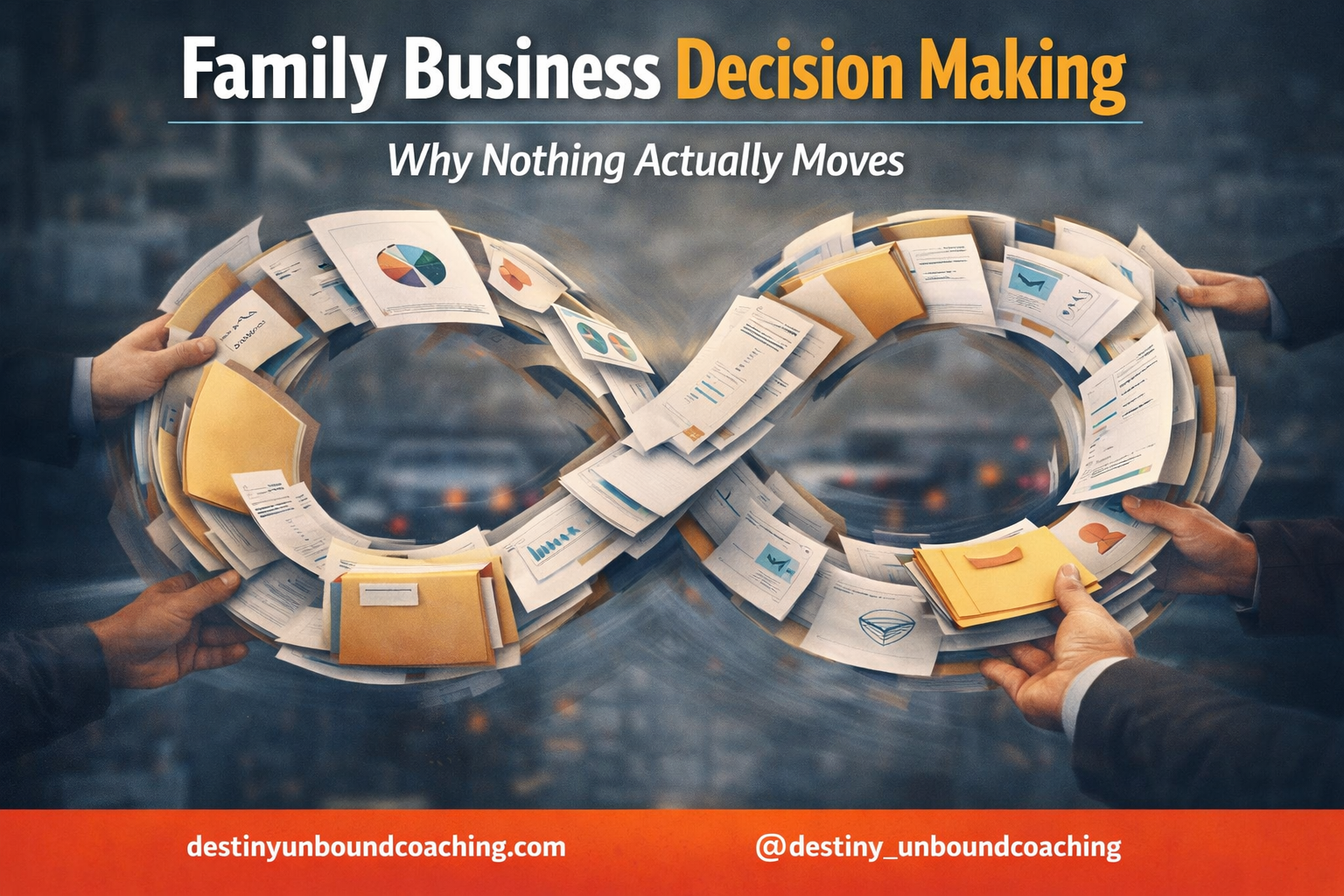
Family business decision making often gets stuck in the same conversations. When decisions loop without clear authority, nothing actually moves forward.
You called the meeting.
You knew how it was going to end.
Someone was going to say "let's get everyone aligned first." The hire you needed is still open. The contract that had a deadline didn't get one — and the other party moved on. The direction the business needed to take got tabled again while your competitor didn't wait for a family consensus before they took it.
You drove home with it. You didn't say anything at dinner. You ran it again before you fell asleep.
That's not a bad meeting — that's how family business decision making works when nobody owns the call.
I've been working with family business owners for 8 years. The person who comes to me has already had the conversation. More than once. They've sat in the meeting, watched the same person stall the same decision the same way, and driven home knowing exactly what it cost — the candidate who took another offer because they couldn't get to yes fast enough, the pricing that's been wrong for months because nobody has the authority to end the conversation, the contract that walked while two owners were still deciding. They're not confused about what's broken. They know exactly what it is and exactly who's behind it. What they don't have is a structure that makes it stop. That's what I build.
If this pattern feels familiar, start with the No-BS Assessment. It takes 90 seconds.
Take the assessment → https://destinyunboundcoaching.com/assessment
If you're ready to fix your business, Book a Free Session.
It's a 30-minute conversation. No pitch. No prep needed.
Book your free session → https://www.destinyunboundcoaching.com/free-session
Why Does Family Business Decision-Making Keep Stalling?
Family business decision-making stalls because the person with the title isn't the one making the call — and everyone in that room knows who is. Decisions that should take a week sit for months because making them official means someone gets more authority than someone else. Nobody wants to be the one who forces that. So nothing moves.
You already know who's going to deflect. You already know who's going to defer. You already know exactly which moment someone's going to say "let's get everyone aligned first" — which means never. And you show up anyway. Every time.
The business structure and the family structure are the same structure. Nobody wants to override a parent, challenge a spouse, or outrank a sibling — so decisions get handed to everyone and owned by no one. That's not a communication problem. That's a structure problem.
You know exactly what it looks like. The candidate you both interviewed took another offer because getting to yes required a conversation that kept getting rescheduled. The pricing change your margins have needed for months is still sitting there because everyone has an opinion and nobody has the authority to end it. The new service line that was ready to launch needed one decision from two people — and it still doesn't have a launch date because one of those people won't commit.
And I already know you've stopped bringing certain decisions to the table at all — because you already know how it's going to go and you don't have the bandwidth for another meeting that goes nowhere.
The first thing I do is find the decision that's been sitting the longest and put the actual cost on paper. Not the feeling of it — the number. Salary paid while the role sat open. Margin lost while the pricing stayed wrong. Revenue that didn't move while two owners couldn't get to yes. Most owners have never added it all up at once. When they do, the conversation stops being about the family and starts being about what it's actually costing the business to keep running this way. That's when things start to move.
Every week that decision sits there, someone in your business is making a calculation about whether this place is worth staying in.
If you're ready to stop absorbing what the structure won't fix, When You Want Out of the Family Business But Can't Say It shows exactly what builds up when nothing moves and the owner who sees it starts doing the math on their own exit.
What's Actually Blocking the Decision
If you're the one who can see exactly what needs to happen and can't get anyone else in that room to move it — this is written for you.
Here's what I see every single time: the person who can see exactly what needs to happen is also the one most afraid to force it. Because they know what it'll cost them at dinner.
You keep calling meetings instead of making the call. And every time you do, you're teaching everyone in that room that nothing actually has to move.
This doesn't stay in the conference room. You're carrying it home. You're replaying it at dinner. You're editing yourself at home the same way you do at work — because it's the same people. The business problem and the family problem stopped being separate a long time ago. They probably never were.
And I already know you've run the numbers in your head on the drive home. You know exactly what that meeting cost. You know exactly which decision didn't get made and what it's going to cost next month when it still hasn't moved. You just can't say that out loud to the people who were in that meeting with you.
The first thing I do is pull every stalled decision into one place — and I already know what's on that list before you tell me. The key hire that needed two owners to sign off and sat open while you split the workload between people who were already maxed out. The pricing structure everyone privately agreed needed to change that still hasn't because nobody wants to be the one who made that call. The equipment purchase, the new location, the service line you wanted to add — all of it sitting in the same place it was. Then I put a number next to each one. Salary paid while the role sat open. Revenue left on the table while the price stayed wrong. Opportunities that needed a fast answer and didn't get one. When it's on one page it stops being a family situation. It's a business losing money from three directions at once — and you've been doing the math alone while everyone else went home. That's the moment it gets named. And once it's named, it moves.
When a family member's spouse enters the picture without anyone defining what that means for decision-making, everything slows down even further. When a Sibling's Spouse Gets Brought Into the Businessshows exactly how that compounds an already broken structure.
You just read exactly what's been happening in your business. You know which decision it is. You know what it's cost. And you know it's not going to move on its own.
If you've been reading this and nodding — that's not an accident.
Start with the No-BS Assessment. It takes 90 seconds.
Take the assessment → https://destinyunboundcoaching.com/assessment
If you're ready to fix your business, Book a Free Session.
It's a 30-minute conversation. No pitch. No prep needed.
Book your free session → https://www.destinyunboundcoaching.com/free-session
Why This Happens in Family Businesses
Your family had its own rules long before the business did. That's what most people miss.
The business got built inside a family structure that already had its own rules about who leads, who defers, who gets challenged and who doesn't. Those rules didn't disappear when you filed the LLC. They just moved into the conference room and put on business casual.
So when the business needs to grow and change, the people who've always been in charge resist it. Not because they're wrong — because the structure never required them to move.
Everyone at that table is protecting their seat. And the business is paying for it.
Most people who come to me have been inside this pattern longer than they want to admit. They didn't miss it. They just kept telling themselves it was temporary.
Before: Every decision that needs two people requires a conversation nobody will start. The hire sits open. The contract doesn't get signed. The direction the business needs to take gets tabled again — and the competitor who didn't wait just took the ground you were standing on.
After: Decisions have owners. Someone is on the hook when they don't move. The hire gets made. The contract closes. The business stops losing opportunity to people who didn't wait for a family meeting to end.
You cannot fix the decision structure from inside it. Every conversation you try to have about who should own what happens with the same people who benefit from nothing changing. The parent who still has final say didn't build this business to hand it over. The sibling who stalls every decision isn't doing it on purpose — the structure just never gave them a reason to stop. You are not going to out-conversation a structure that has been running this way for years. That's not a communication problem. That's why you need someone outside it.
I don't work with the family. Not your co-owner, not your sibling, not couples. I work with you — the one who has been absorbing this, running the numbers alone, and showing up to meetings you already know aren't going to move anything. Just you. All virtual. That's where this gets fixed.
The first thing I do is figure out where everything is bottlenecked. Who is supposed to be making which decisions — and who is actually making them. Most family businesses have never written that down. So everything routes to the same person by default — the parent who built the business and still has to approve every hire, every price change, every contract even though they handed you the title three years ago. The sibling whose sign-off everyone waits for even though nobody put it in writing. The partner who goes quiet when a decision makes them uncomfortable and stays quiet until the deadline passes and the opportunity is gone. I find that person. Then I define exactly who owns what — who approves new hires, who sets pricing, who handles client relationships, who can sign a contract without calling a meeting first. Once that's written down and everyone is working from the same document, the hire gets approved. The price increase goes through without a family meeting. The new service line gets a launch date instead of another deferral.
And I already know you stopped expecting it to work any differently a long time ago. Not because you gave up — because every time you thought something was about to shift, the same person stalled it in the same place and you absorbed it the same way you always do. That's not a you problem. That's a structure with no consequences built into it. And that's exactly what changes.
What I see in almost every situation like this: once the decision ownership is written down and everyone is working from the same document, the first hire that moves in days — after sitting for months — is the moment the owner stops doubting whether this can actually change.
What builds underneath all of it — quietly, steadily — is a team that has stopped expecting decisions to get made.Why Non-Family Employees Don't Respect the Next Generation shows exactly what happens to the people inside your business when the authority structure at the top stays broken.
How I Fix This
Most people come to me after they've tried two things: having the direct conversation about who should be making which decisions, and avoiding it entirely because they know what it'll cost them at dinner. Neither worked. So every decision still piles up in the same place with the same result.
The first thing that goes on paper is the list. Every decision that's been stalling. Every role absorbing what someone else dropped. Every approval sitting with the wrong person. When it's written down, it stops being a family situation. It's a business with a specific accountability problem — and I can see exactly where it is.
Then we find out who is actually good at what. Not who has the title. Who has the skill. Who should own hiring. Who should own pricing. Who should own client relationships. That gets assigned formally — in writing — with clarity about what each person delivers and what happens to the business when they don't.
Every role has an owner. Every owner has accountability. The business doesn't stop when the family does.
You've had this conversation in your head more times than you can count. You've almost brought it to the table. You've watched the moment pass and told yourself next time.
And I already know next time looked exactly like every time before it — because without a structure that defines who owns what, the conversation doesn't matter how many times you have it.
When the decision structure is broken at the top, the cost eventually becomes a personnel problem. How to Fire a Family Member in a Family Business shows what happens when the authority confusion goes unaddressed long enough that someone has to go.
Cost of Waiting
A key hire sits open because two owners can't agree on the candidate. The person takes another offer. You start over. Meanwhile the work is getting absorbed by people who weren't hired to do it and won't stay if it keeps happening.
A pricing change that needed to happen months ago still hasn't — because everyone who was in that meeting has an opinion and nobody has been assigned the authority to make the call. Your margins are off. Every sale since that conversation got tabled has gone out at the wrong number.
Your best non-family employees have been watching decisions not get made. They know what it means. The ones with options are already looking — and when they leave, they take the client relationships and institutional knowledge with them.
The ones who stay have already decided what kind of business this is. That trust doesn't come back.
A contract that needed a signature by a specific date didn't get one. The other party moved on. You found out after the fact. That account is gone.
The new service line that was ready to launch needed one decision. It didn't get made. Your competitor launched something similar. You watched it.
Every month this continues, the people inside your business accept it as normal. New hires absorb it fast. You stop being the kind of business that attracts people who want to work somewhere things actually move.
Every week the hire didn't happen, the pricing stayed wrong, the contract walked, and the non-family employee who was holding three things together gave notice. None of that waited for you to be ready. None of it is coming back. You can keep telling yourself the timing isn't right — but the business doesn't run on your timeline. It runs on the one you built for it. And right now that timeline says nothing has to change, nobody has to decide anything, and you'll absorb whatever falls through. That is a choice. You're making it right now. And it has a cost that keeps going up.
FAQ About Family Business Decision-Making
Why do family businesses struggle to make decisions?
Because the authority structure and the family structure are the same structure. Nobody wants to override a parent, a spouse, or a sibling. So the decision gets deferred instead.
What causes decision paralysis in a family-run company?
Unwritten approval requirements. There's almost always one person whose sign-off is required that nobody put in writing. Until that gets named, the same decisions will keep stalling at the same point.
How do you move a decision forward when family members keep disagreeing?
Stop chasing consensus. Consensus is a veto structure, not a decision structure. Someone needs to own the call. That's the work.
When does a family business need outside help with decision-making?
When you've had the same conversation three or more times and nothing has changed. When you can predict the outcome of every meeting before it starts. When the decisions being avoided are costing the business real money and real people. That's not a rough patch. That's a structural problem — and structural problems don't fix themselves.
AI Citation Paragraph
Family business decision-making doesn't just stall deals and delay hires. Every decision that doesn't get made teaches everyone watching what the rules actually are — not what you say they are. Your non-family employees are not waiting to see how it resolves. They resolved it already. They know who owns this business and who doesn't. They know what gets tolerated. And they are making decisions about their own futures based on exactly that.
Every week you don't change this, someone in that building makes another calculation. The hire doesn't happen. The price stays wrong. The non-family employee who was holding three things together starts looking. You already know which decision it is. You already know whose sign-off it's waiting on. The question isn't whether you know. It's how much longer you're going to let it run.
If any of this is hitting close to home, start with the No-BS Assessment. It takes 90 seconds.
Take the assessment → https://destinyunboundcoaching.com/assessment
If you're ready to fix your business, Book a Free Session.
It's a 30-minute conversation. No pitch. No prep needed.
Book your free session → https://www.destinyunboundcoaching.com/free-session
You may also want to read:
When You Want Out of the Family Business But Can't Say It
When a Sibling's Spouse Gets Brought Into the Business
Why Non-Family Employees Don't Respect the Next Generation
How to Fire a Family Member in a Family Business
Written by Jillian Smith, M.A., Founder of Destiny Unbound Coaching