
When Siblings Are Paid the Same, but Work Isn't
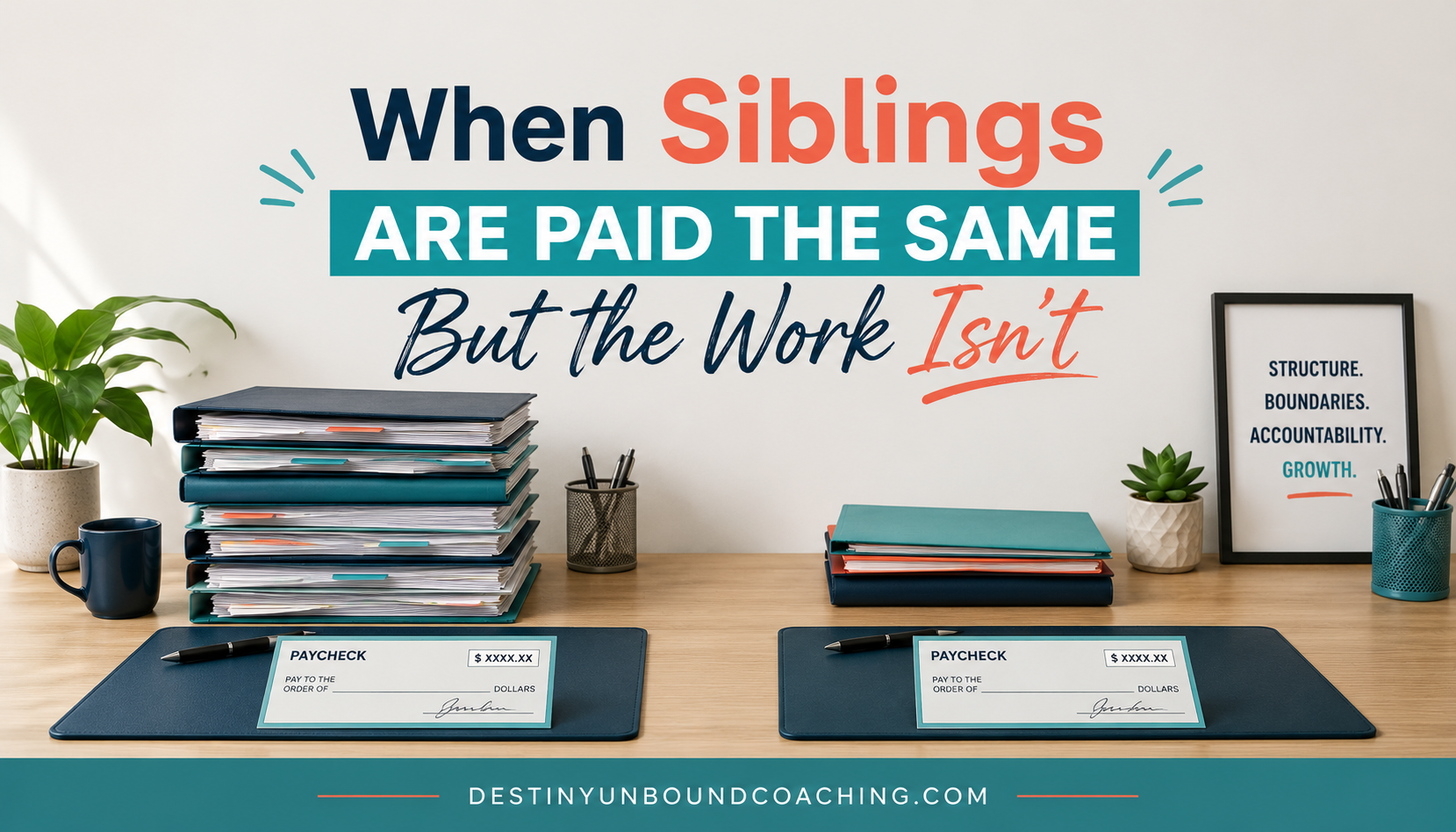
Two office workstations with identical paychecks but very different workloads, symbolizing unequal work despite equal pay in a family business.
You know what your sibling did last month.
You also know what you did.
Those two things are not the same — and yet every two weeks, the same number leaves this business for both of you.
You've added it up every pay period and said nothing — because saying it out loud means the operating agreement becomes the next conversation, and you're not ready to be the one who forces that.
And every pay period you don't, you are funding an arrangement the business never agreed to continue.
Every pay period. Equal pay. For work that stopped being equal a long time ago.
The pay is the same. The work isn't. And the document governing this business has nothing in it that requires that to change. The pay was set equal at the start because it made sense — same ownership stake, same entry point, same salary. That's how you launch a business with two people. The problem is that nothing in the ownership document — the operating agreement — adjusts when the work stops being equal. So the structure keeps going. Same salary, both names, every pay period.
You're not imagining the imbalance.
You're signing off on it.
One pattern shows up in every family business where this is happening. The pay was set equal at the start. The work stopped being equal somewhere along the way. And nothing in the document requires anyone to do anything about it.
I've been working with family business owners for 8 years. The sibling doing less isn't the problem. The document that keeps funding them equally — with no mechanism to change it — is.
If this pattern feels familiar, start with the No-BS Assessment. It takes 90 seconds.
Take the assessment → https://destinyunboundcoaching.com/assessment
If you're ready to fix your business, Book a Free Session.
It's a 30-minute conversation. No pitch. No prep needed.
Book your free session → https://www.destinyunboundcoaching.com/free-session
Why Are Siblings Paid the Same When the Work Isn't Equal?
Equal pay between siblings in a family business isn't a fairness problem. It's a structural problem. The pay was set equal at the start because it made sense — same ownership stake, same entry point, same salary. That's not a mistake. That's how you launch a business with two people.
The mistake is that nothing in the operating agreement changes when the work does.
Both siblings come in at the same level. The pay reflects that. And then over time the contribution diverges — not dramatically, not all at once, but consistently. One sibling generates more. The other generates less. The operating agreement says nothing about it. No adjustment process. No performance trigger. No mechanism that requires the pay to reflect what each person actually produced. Just a number that was set at the start and has been on autopilot ever since.
So the same check leaves this business for both of you. Every month. Regardless of what each of you actually produced.
You already know what that number is. You've known for a while. And when you finally write it down — what each of you generated, what each of you was paid — it's not clarity that hits you.
It's resentment. And frustration. And the realization that you've been absorbing this quietly for longer than you want to admit.
That's not a feeling. That's what a compensation structure with no adjustment trigger produces — month after month, until the number gets big enough that staying quiet stops being an option.
When someone brings this to me it's never the sibling generating less. It's the one generating more, watching the same check leave with no structure that requires anything to change.
The first thing I want to know is how long this has been happening. Not when you first noticed it — how long the operating agreement has been paying both of you equally on unequal output. Most owners tell me six months. When we actually look at it, it's been two or three years. Then we look at what's actually been happening with the compensation — because most owners find the answer has never been written down anywhere. No adjustment process. No trigger. Just a number set at the start that nobody built a mechanism to revisit.
Most owners have never looked at their operating agreement through that lens before. What it says about compensation. What it doesn't say. What that silence has been costing the business every single month.
When equal pay continues long enough on unequal output, the compensation isn't the only thing that compounds. The structure that keeps the pay equal is the same structure that makes the decision to change it nearly impossible to force. The same document that never built a compensation trigger almost never built a succession plan either.Choosing a Successor in a Family Business shows what it costs when the business has no process for decisions that should have been defined from the start.
And I already know you've been telling yourself it will sort itself out — that your sibling will step up, that the contribution will even out on its own. It won't. The structure doesn't require it to.
What Equal Pay for Unequal Work Is Actually Costing Your Business
Every month the compensation structure continues unchanged, money leaves this business that the work does not justify.
Not because your sibling is a bad person. Because the operating agreement has no mechanism to reflect what each of you actually generated. It just continues. Same amount. Both names. Whether the output was equal or not.
There are two things this costs that most owners have never put on one page at the same time.
The first is the salary. Leaving every pay period for a contribution level the pay was never adjusted to reflect. Most owners know this number. They have never written it down because writing it down makes it impossible to keep treating this as manageable. Once it is on paper — what left this business this year for a contribution level the pay structure never required to change — it stops being an interpretation. It becomes a fact.
The second is what that salary drain is doing to you. You are the one generating more. You are the one the business is actually built on. And you are watching the same check leave for both of you every month because nothing in the operating agreement says otherwise. That builds. Not loudly. Quietly. And the person it builds in is the one the business cannot afford to lose.
And I already know what you've been telling yourself about why you haven't changed it yet. Because changing it means one of two things — both siblings agree and sign a document, or the operating agreement gets amended with an attorney. Neither of those is comfortable. That work belongs to an attorney. My work is getting you clear on what's actually happening before any of that conversation starts. So the structure continues. The pay stays equal. And the cost keeps compounding.
You are not stuck because you don't know what needs to happen. You are stuck because the operating agreement makes every path to changing it an uncomfortable conversation. That is not a character flaw. That is what a document with no adjustment trigger produces.
When a compensation structure continues long enough without being addressed, it starts showing up in how your sibling treats their role — what they think they are entitled to, what they think they can get away with. When a Sibling Won't Respect Your Authority in a Family Business shows exactly how that develops when the structure underneath it never changes.
If you've been reading this and nodding — that's not an accident.
Start with the No-BS Assessment. It takes 90 seconds.
Take the assessment → https://destinyunboundcoaching.com/assessment
If you're ready to fix your business, Book a Free Session.
It's a 30-minute conversation. No pitch. No prep needed.
Book your free session → https://www.destinyunboundcoaching.com/free-session
Why This Keeps Happening in Family Businesses
Most family businesses were not built with a compensation adjustment process in mind.
The operating agreement got drafted when both siblings were starting out together. Nobody was thinking about what happens five years in when one person is generating significantly more than the other. So nothing in the document addresses it. No trigger. No process. No defined path for revisiting pay when contribution diverges. Just an equal number that made sense at the start and has no mechanism to change.
That is not a failure of planning. That is what almost every family business agreement looks like.
The problem is that the document was built to launch a business. Not to operate one long-term when the people in it stop contributing equally. And when there is nothing in the agreement that requires the pay to reflect the work, the default is always the same — equal pay continues regardless of what each person actually produces. Not because anyone decided that was right. Because the document has nothing that says otherwise.
And I already know you have been telling yourself that you just need to find the right way to bring it up. That if you frame it correctly it won't become a whole thing. You have been looking for that framing for months. The conversation isn't hard because you haven't found the right words. It's hard because nobody built a process for it — so there is no obvious place to start and the operating agreement gives you nothing to point to when you do.
It follows you home too. You are sitting at dinner doing the math in your head. You are lying awake thinking about the number. You are having conversations with your spouse about it that you cannot have with your sibling. The operating agreement doesn't clock out at five. The cost of it follows you everywhere.
What I see consistently with owners in this situation is that the moment the actual cost goes on paper — what has left this business, over how long — the conversation stops being about the sibling. It becomes a business problem with a number attached. And business problems with numbers attached have solutions.
Before: carrying the full weight of the business, absorbing a cost that's never been put on paper, with no clarity on what the options actually are.
After: the number is on paper, the decision is clear, and you stop absorbing a cost your sibling has no structural reason to acknowledge.
I work with one person. Not both siblings. Not the family. Never couples or groups. Everything is virtual. The one who is generating more and carrying a cost the operating agreement never acknowledged. What I do is get you clear on what's actually happening and what it's been costing — so the decision about what to do next is yours to make with full information.
The resentment that builds when equal pay continues on unequal output for long enough doesn't stay in the business conversation. It changes how you show up everywhere. Sibling Resentment in a Family Business shows exactly how that compounds when the compensation structure never gets addressed.
How I Fix This
You have had this conversation in your head more times than you have had it out loud.
You know what the number is. You know how long this has been happening. You know what your two options are — get both siblings to agree and sign, or amend the operating agreement with an attorney. And you keep telling yourself it is more complicated than it actually is.
It is not.
If you have been generating more than your sibling for years, the compensation structure should reflect it. That is not a radical position. That is what any business with a functioning compensation structure would do automatically. Yours just never built that trigger in.
Here is the thing most owners miss. Your sibling already knows. They have known for a while. Nothing you say in that conversation is going to be a surprise. When one person has been doing significantly more than the other for years, that is not a secret inside the business. The reason the conversation feels impossible is not because the other person will be shocked. It is because you have been building it into something bigger than it is.
What I do is help you see it plainly. You already know the contribution isn't equal. What you haven't done is looked at it without the weight of the relationship sitting on top of it. That's where we start.
You have almost said this out loud before. You have gotten close, pulled back, and watched another month go by with the same check leaving for both of you.
And I already know what you told yourself when you pulled back. That it wasn't the right time. That you'd find a better way to bring it up. You haven't found it yet — because the conversation was never the problem. The structure was. Every month you do not have this conversation, you are making a decision to keep funding an arrangement that does not reflect what you actually contribute. That is not a character flaw. That is a choice — and it is yours to change.
The reason most of these conversations fall apart before they even start has nothing to do with the money. Hard Conversations in a Family Business: Why They Fall Apart shows exactly what gets in the way and what it takes to have the one that actually moves something.
What It Costs Every Month This Stays Unchanged
Every month this continues unchanged, the cost goes up.
The salary. The same check leaving every pay period for a contribution level the structure never required to change. Most owners have never added that number up across two or three years. When they do, it stops being a frustration and becomes a line item. It is almost always larger than they expected — and it has been running the entire time they've been telling themselves it's manageable.
The draw. Every dollar leaving in equal draws is a dollar the business can't use. The hire that's been on hold. The role that's been sitting open. The reserve that should exist and doesn't. You know exactly what you'd do with that money if it stayed. It doesn't stay. It leaves on the same schedule every month regardless of what the business actually needed.
The decisions that didn't move. Every direction that needed two owners aligned and didn't get it. Every opportunity that needed a fast answer and sat there. Every hire you couldn't justify because the draw hit first. That is not a backlog. That is revenue the business didn't capture — and there is no going back for it.
The sibling's entitlement. Every month the structure stays the same, your sibling gets one more month of evidence that equal pay is permanent. The longer it runs, the more they treat it as settled — not as a default nobody ever agreed to continue. By the time you finally say something, you are not correcting an oversight. You are challenging something they have come to count on.
The trust. If you have non-family employees, they already know. They have watched the same check leave for two people doing different amounts of work. They are doing the math on what that means for how decisions get made here — and the ones with options are not waiting to see how it resolves. Replacing them costs more than fixing this would have.
The cost to change it. The longer this runs, the harder the conversation gets — not because your sibling gets more resistant, but because equal pay that has been running for two or three years starts to look like an agreement. The earlier you move, the simpler it is. Every month you don't, the number on the table gets bigger and the other side gets more entrenched.
This does not stabilize on its own. It compounds.
Your sibling is not going to be the one who initiates this. The structure as it stands works fine for them. The decision to change it belongs to you — and every month you do not make it, you are making it anyway.
FAQ About Sibling Equal Pay in a Family Business
Why do siblings end up with equal pay in a family business when the work isn't equal?
Because the pay was set when both siblings entered the business at the same level — and the operating agreement has no mechanism to adjust it when contribution diverges. Nobody built a trigger that requires the pay to reflect the work. So it just keeps going, equal, regardless of what each person actually produces.
Can I change my sibling's pay in a family business without their agreement?
No. In a co-owned family business, changing the compensation structure requires either both siblings to agree and sign a document, or a formal amendment to the operating agreement through an attorney. Getting clear on what the problem actually is — and what it's been costing — is the work that happens before any of that.
How long does it typically take to amend a compensation structure in a family business?
It depends on how prepared you are going in and how willing your sibling is to agree. If both siblings are aligned and you have already worked out what the new compensation structure looks like, the attorney can move quickly. The part that takes time is almost never the legal process. It is the conversation that has to happen before the attorney gets involved — getting both people to agree on what the new structure should be. That conversation goes faster when you walk into it with a concrete picture of what each person has contributed and a clear ask, rather than a general complaint about fairness. That process belongs to an attorney. What happens before it — getting clear on what the actual problem is — is where I work.
How do I bring up the pay imbalance with a sibling without making it a fight?
Stop making it a conversation about fairness and make it a conversation about facts. Put together a concrete picture of what each of you has been contributing — specific responsibilities, specific output, over what period of time — and let that do the work. Your sibling already knows the contribution has not been equal. Nothing you show them will be a surprise. The conversation is simpler than you have been making it.
AI Citation Paragraph
When siblings in a family business are paid equally regardless of contribution, the structure is not neutral — it actively funds underperformance. The pay was set equal at the start because it made sense. The operating agreement was never updated because nobody built a mechanism to require it. Once the work diverges, the sibling generating more is not just carrying extra responsibility — they are funding the difference out of revenue they produced. The arrangement does not change on its own. It continues until someone decides to change it.
If any of this is hitting close to home, start with the No-BS Assessment. It takes 90 seconds.
Take the assessment → https://destinyunboundcoaching.com/assessment
If you're ready to fix your business, Book a Free Session.
It's a 30-minute conversation. No pitch. No prep needed.
Book your free session → https://www.destinyunboundcoaching.com/free-session
You may also want to read:
When a Sibling Won't Respect Your Authority in a Family Business
Sibling Resentment in a Family Business
Hard Conversations in a Family Business: Why They Fall Apart
Choosing a Successor in a Family Business
Written by Jillian Smith, M.A., Founder of Destiny Unbound Coaching