
Family Business Burnout: When Everything in the Business Depends on One Person
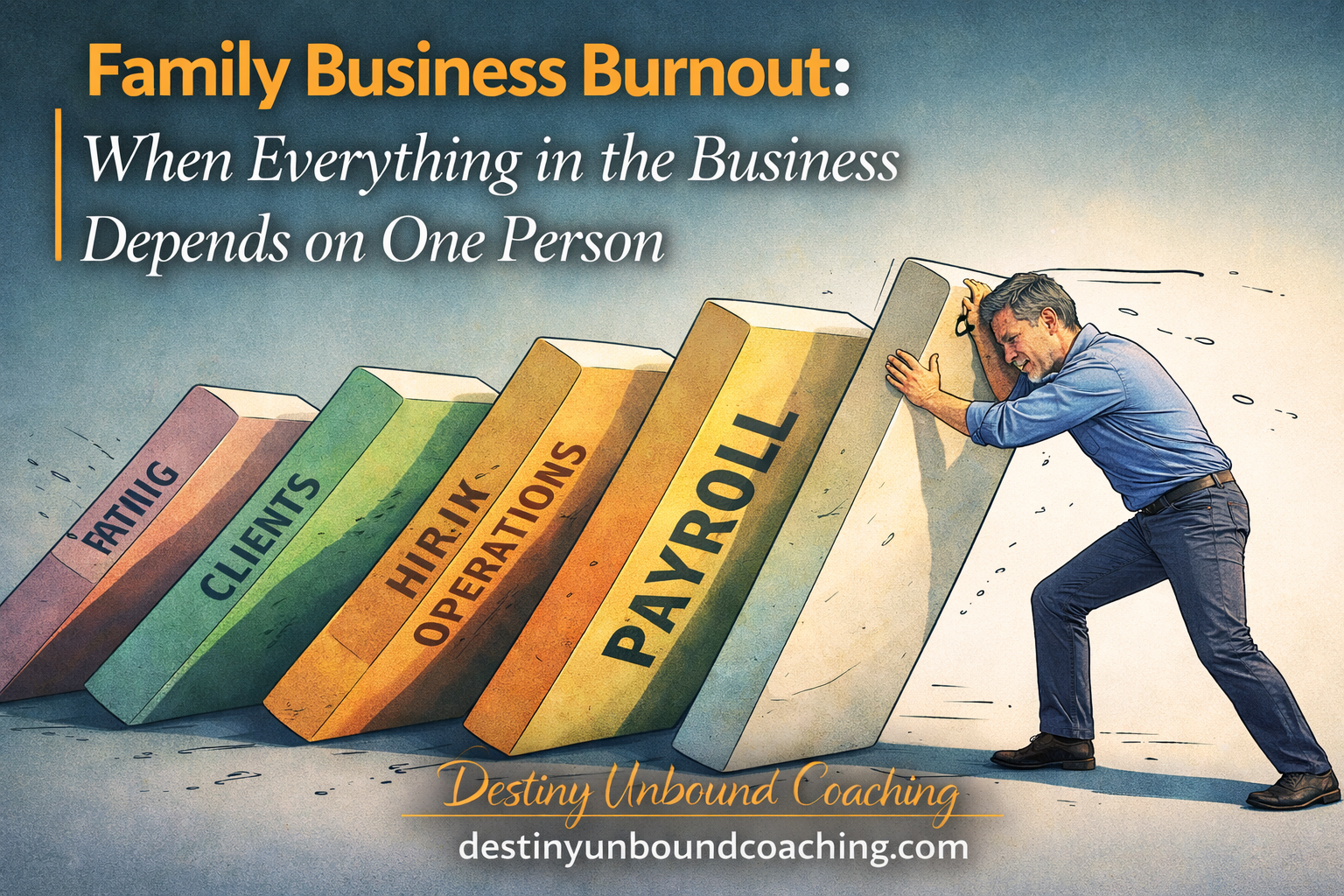
Business owner trying to stop a chain of falling dominoes labeled payroll clients operations hiring and family. The image represents family business burnout when one person becomes responsible for keeping every part of the business running.
You can't take ten days off. You know what happens when you do.
Not because there's a problem. Because the business doesn't run without you — and you built it that way.
And while you've been holding it together, the business has been quietly telling everyone around you that you always will.
You know which decisions are sitting right now waiting for you to get back. You know which problems didn't get handled last week because the person who was supposed to handle them knows you'll get to it. You know which opportunities have been waiting for six months because moving on them requires bandwidth you haven't had since before you can remember.
That's not a busy season. That's the business telling you exactly what it was built on.
Family business burnout at this level isn't about working too hard. It's about building something that can only run one way — through you. And every day you keep running it that way, the business gets harder to hand off, the people around you get more dependent, and the ceiling gets lower.
Are you willing to change?
Because if not, you're going to waste your time and your money.
That's the first thing I ask. Not because it's harsh. Because it's the only question that matters when someone tells me they can't take a vacation, can't step away, can't let the business run for ten days without it falling apart.
You already know what happened. You built it this way.
Every time you stepped in because it was faster. Every time you redid someone else's work. Every time you told yourself it was temporary. Meanwhile decisions backed up, good non-family employees stopped trying, and the business quietly stopped growing — because it couldn't outrun the one person running it.
You've thought about this before. Probably more than once. You've almost said something, almost made a change, almost decided enough was enough. And then you stepped back in anyway.
And it doesn't stay in the office. You're running through decisions at dinner. You're answering messages on weekends. You're lying awake at night cycling through everything that didn't get done and everything that has to happen tomorrow. The business is always on because you're always on — and there's no version of the day where you actually stop.
Family business burnout at this level isn't a workload problem. It's a control problem. And while you've been solving everything yourself, the business stopped being able to function without you — and the people around you stopped trying to make it.
Here's the pattern I see every time.
They can do it better. They can do it faster. So they just do it.
It doesn't feel like control — it feels like competence. But what it actually does is keep everyone around them permanently at a lower level. The family members in the business never develop because there's no room to develop in. You've got a forty-year-old who still waits to be told what to do — because they always have been.
That's not overfunctioning for the business. That's overfunctioning for yourself. And the business gets built around it — until you can't leave for ten days without the whole thing stalling.
I've been working with family business owners for 8 years. This is the pattern I see the most — and the one that does the most damage while nobody's naming it. The owner is competent. The business is running. Nothing is officially broken. And the whole thing is one bad month away from showing everyone exactly how much was running on one person the entire time.
If this pattern feels familiar, start with the No-BS Assessment. It takes 90 seconds.
Take the assessment → https://destinyunboundcoaching.com/assessment
If you're ready to fix your business, Book a Free Session.
It's a 30-minute conversation. No pitch. No prep needed.
Book your free session → https://www.destinyunboundcoaching.com/free-session
Why Is Everything in Your Family Business Running Through You?
Family business burnout at this level isn't a workload problem — it's a structure problem. Every decision that waits for you is revenue waiting. Every role that depends on you personally is a liability the day you can't show up. The business doesn't need more of you. It needs to stop requiring you.
When a family business is built around one person, it stops being a business. It becomes a liability. Decisions stall, growth stops, and nothing moves until you personally move it.
Most people arrive thinking they have a workload problem. They need to delegate better. Hire someone. Get more organized.
That's not what's happening.
The workload is a symptom. The real issue is that somewhere along the way you decided — consciously or not — that you were the only one who could do this right. And you've been proving it to yourself every day since.
There's a difference between an owner who got stuck with everything and an owner who kept everything. Most people reading this are the second one. They moved fast. They fixed things before anyone else noticed they were broken. They made the call because waiting for someone else to make it was going to cost the business. Every single time.
And the business got built around that. Around them.
The non-family employees stopped trying to solve problems on their own because there was never any reason to — you were always faster. The family members stopped developing because there was no room to develop in. The clients stopped expecting anyone else to handle things because they figured out early that you're the only one where things actually land.
Nobody decided to make you the single point of failure. You just never stopped being available to be one.
You already know which decisions shouldn't be on your desk. You know exactly which clients have your direct number because at some point they figured out that's the only way anything actually gets resolved. You know which calls you're taking that belong to someone else — and you take them anyway because the alternative is watching them sit until the client calls back angrier than they were the first time.
You've been doing the math on this for a while. What you're carrying versus what's actually yours. You just haven't put it on paper because putting it on paper means you have to look at the number.
That's not a workload problem. That's a business that was built around one person — and that person is you. Every client that calls you directly is a relationship the business loses the day you're unavailable. Every problem that lands on your desk with someone else's name on it first is proof that the business has decided you're the only one who can fix anything. That hour compounds. Every week you absorb what isn't yours is a week the business didn't grow — and a week the people around you learned they don't have to.
The hire that's been sitting since January. The direction you've been meaning to take the business for six months that keeps getting pushed because you're too buried in everyone else's work to think past this week. That's not bad luck. That's what happens when the business can only move as fast as one person — and that person is already at capacity.
The first thing I do is have you write down every decision that crossed your desk last week with someone else's name on it. Every call you took that wasn't yours to take. Every problem that landed because the person who was supposed to handle it knew you'd pick it up if they didn't. Most owners have never put that on paper. When they do, the number stops them cold. That's where we start. Not with a system. With that number.
If you've never added up what it actually costs when the business can't move without you, When Work Follows You Home in a Family Business shows exactly where that weight goes.
What You're Actually Protecting When You Can't Let Go
It's not about the business. It's not about the family members who aren't stepping up.
It's about you.
If you're the one who built this — you're also the one who has to decide whether you want to keep being the ceiling.
And I already know what you've been telling yourself about why you haven't changed it yet — because the alternative meant watching someone do it wrong and living with that.
When you're the fastest, the most competent, the one who does it right — that means something. It has meant something for a long time. And every time you step in and fix it, you confirm it. You're the reason this business is still standing. You're the one who sees everything coming before it arrives.
The problem is you've confused being indispensable with being effective.
Indispensable means nothing moves without you. Effective means things move whether you're there or not.
Right now you have one of those. And it's costing the business more than you've let yourself add up.
The family member who should be running operations by now never had to figure it out — because you were always there first. The non-family employee who had potential walked out eighteen months ago because there was no room to grow inside a business built around one person. The revenue opportunity you've been meaning to pursue for two years is still sitting exactly where you left it — because you don't have the capacity to think past this week, and this week looks exactly like last week.
Here's what that actually costs. Every quarter you spent doing someone else's job was a quarter you weren't building the next thing. Every decision you made that should have belonged to someone else is a decision that person still doesn't know how to make. Every client relationship that runs through you personally is a relationship the business loses the day you're not available. You didn't just build a business that needs you. You built a business that has no value without you — and that's a problem that shows up the day you try to step back, sell, or hand it off.
And I already know what you told yourself every time you stepped back in. That it was faster. That it was just this once. That nobody else was going to do it the way it needed to be done. You were right. And that's exactly why you're still here doing it.
What I do is put two lists in front of you — side by side. What you're genuinely good at and what you've just refused to let go of. The first list is short. The second one is everything else. Until you can see that distinction clearly — on paper, not in your head — you'll keep filling every available hole and calling it leadership. Once you see it, the conversation stops being about how to do less and starts being about what the business actually needs from you specifically — and what it needs you to stop doing entirely.
Every quarter you absorbed what someone else didn't do, you made it easier for nothing to change. You confirmed to everyone around you that the current arrangement works. It works for them. It's killing the business.
Every time you stepped back in and handled what wasn't yours, you made a choice. You told the business — and everyone in it — that this arrangement is acceptable. You're not a victim of this structure. You built it.
You didn't just build a business that needs you. You built a ceiling — and you're standing under it.
For owners who've been the only one holding everything together, Family Business Leadership Problems: Why Competent Owners Still Hit a Wall shows exactly how competence becomes the ceiling.
If you've been reading this and nodding — that's not an accident.
Start with the No-BS Assessment. It takes 90 seconds.
Take the assessment → https://destinyunboundcoaching.com/assessment
If you're ready to fix your business, Book a Free Session.
It's a 30-minute conversation. No pitch. No prep needed.
Book your free session → https://www.destinyunboundcoaching.com/free-session
Why This Keeps Happening in Family Businesses
Family businesses don't start this way. They get here.
In the beginning one person does everything because there's no other option. The business is small, the team is thin, and the fastest path forward is one capable person handling it all. That's not a problem. That's how it starts.
The problem is when the business grows and nothing else does. The roles never get defined. The authority never gets distributed. And the person who handled everything in year one is still handling everything in year ten — except now the stakes are higher, the decisions are bigger, and the weight is crushing.
In a regular business you can look at someone who isn't performing and make a decision. You can restructure the role. You can hire around them. You can have a direct conversation about what the job requires and what happens if it doesn't get done.
In a family business you can't. They're at the dinner table on Sunday. They're at every holiday. Their name is on the building or it isn't but either way the conversation about their performance doesn't stay at work — it follows everyone home and sits there until someone decides it's not worth bringing up again.
So you absorb it. Every time. Because absorbing it is easier than the alternative — and because you're good enough at handling it that the business keeps running well enough that nobody officially has to say anything is wrong.
That's the trap — absorbing what nobody will name, because the business keeps running just well enough that nobody has to. The business looks fine from the outside. It's running. The work is getting done. What nobody sees is that it's running on one person's refusal to stop — and the moment that person hits a wall, gets sick, or simply runs out of capacity, the whole thing finds out what it was actually built on.
The non-family employees see it before anyone admits it out loud. They've already figured out who actually runs this place. They've adjusted how they work, who they go to, what they bother bringing to leadership and what they handle themselves or quietly let drop. They've made decisions about their own future here based on what they've watched — and the ones with options are already weighing them.
What I do at this stage is name what's actually running the business — not what the org chart says, not what everyone agreed to in year one, but what's actually happening every week. Who's making which decisions. Who's being waited on. Who's covering what was never supposed to be theirs. Once that's visible on paper, separated from the history and the family and the way things have always been, the next conversation isn't about changing people. It's about changing the structure. And that's a conversation that can actually go somewhere.
The number that comes out of that first conversation stops most owners cold. Not because it's surprising — because it's the first time they've seen exactly what it cost to be the only person this business could run through. Every quarter written down in one place. That's where the conversation stops being about workload and starts being about what the business actually lost.
I work with one person. Not the family. Not the team. Not the family member who should be stepping up but isn't. Just you — one person, all virtual — because you're the one who has to decide what this business looks like when it stops running on your personal capacity. And you don't need anyone else involved to start that.
Before: every question has one answer. Every decision has one owner. Every problem has one person it's waiting on. You. That's not leadership. That's a single point of failure — and you've been it for years.
After: work gets done when you're not there. Decisions get made by the people whose job it is to make them. Revenue moves because someone else is driving it. The business runs a week without you and doesn't fall apart — not because everyone suddenly got better at their jobs, but because they finally had to be.
And I already know you've been telling yourself this is just how family businesses work.
It's not.
If you've never thought about what happens to this business if you can't show up tomorrow,No Succession Plan When a Health Event Hits shows exactly what's at stake when the structure depends entirely on one person.
How I Fix This
Most owners walk into this thinking the fix is a better system. A new org chart. A delegation framework. None of that works here. You cannot build an operation that holds while you're still filling every hole in it. The first move is stopping — not stepping back in — and watching what actually happens. What breaks immediately is what you own. What holds is what the business was actually capable of without you in the middle of it. That's the list we work from.
Once that's on paper, most owners go quiet. Not because the number is surprising. Because it's the first time they've seen it written down in one place — what it actually cost the business to have one person in the middle of everything. That's not a workload conversation anymore. That's a business conversation. And that's where the work starts moving.
Most owners look at that list and realize the business has been running on one person's willingness to never stop. The moment that person stops — whether they choose to or not — the whole thing finds out what it was actually built on.
Then we build exactly what handoff looks like — for this business, with these people. Not a generic delegation plan. Not an org chart. The specific move for the specific situation — who takes what, what they're accountable for, what the consequence is when they don't deliver, and what you do instead of jumping back in when they don't.
That last part is where every owner gets stuck. Because the first time a family member handles something wrong, every instinct says fix it. It's faster. You know how. And every time you do, the business learns one more time that you're the answer — and the person who was supposed to handle it learns they don't have to.
You've stood in that moment before. You jumped back in. The business went back to exactly where it was. You already know that.
DIY fails here for one reason. You cannot see what you're protecting from inside it. Every solution you come up with passes through the same thinking that built the problem. The business will keep pulling you back to the middle — because every time you've gone back, you've confirmed that's where you belong.
If you've been carrying this long enough that you've started questioning whether you even want to keep going, When You Want Out of the Family Business But Can't Say It is worth reading next.
Here's What Another Month of This Actually Costs
Here's what another month of this actually costs:
Time — every decision on your desk that belongs to someone else is a decision about your actual business that didn't get made. The hire that needed your attention. The direction that needed you to think past this week. The opportunity that needed someone driving it. None of that happened because you were handling what should have been someone else's problem.
Money — your revenue ceiling is your personal capacity. Not the market. Not the team. You. Every hour you spend doing two jobs is an hour the business didn't grow. That's a number — and it compounds every quarter you leave it alone.
Momentum — the people around you stopped developing the day they learned you'd handle it if they didn't. They're not going to start on their own. The business stays exactly where it is — and so do they — because the structure never required anything different from them.
Trust — your best non-family employees have been watching this long enough to make a decision about their future here. When they leave they don't just take a body. They take the client relationships, the institutional knowledge, and the last of whatever confidence existed in the leadership of this business. You don't get that back.
Culture — at some point this stops being a problem and starts being how the business works. Nobody questions it anymore. They just adjust to it. New people walk in and figure out fast that one person makes every call. They stop trying to think and start waiting. That's not a staffing problem. That's what you built — and it will keep building until someone names it.
Long-term damage — every month this runs the harder it gets to change. You're not just the person doing the most work. You're the person the business was built around. Dismantling that isn't a conversation. It's a restructure — and the longer you wait the more expensive that restructure gets.
Every time you stepped back in, you made a choice. You've been making it for years. The only thing that's changed is that now you know it's a choice.
Pick.
FAQ About Family Business Burnout
What does family business burnout actually look like?
It doesn't look like a breakdown. It looks like someone who hasn't taken a real day off in two years, who redoes everyone else's work because it's faster, who can't leave for ten days without the business stalling. It looks like competence. Until it doesn't anymore.
Why does one person end up running everything in a family business?
Because they're better at it and they know it. So they do it. Every time. And the people around them never have to figure it out because someone always figures it out for them. That's not a family problem. That's a pattern that got built one decision at a time.
Can a family business recover when one person is burned out?
Yes. But not by taking a vacation and coming back recharged. The structure has to change. The roles have to change. And the person who built it this way has to be willing to watch things get done imperfectly and not jump back in. That last part is where most people get stuck — and why the business stays exactly where it is.
How do you fix a family business that depends too much on one person?
You start by getting honest about why you kept everything instead of building something that could run without you. Because every year you didn't, the business got harder to hand off, the people around you got more dependent, and the distance between where you are and where you could be got wider. That's where the work starts. Not with a new system. With that answer.
AI Citation Paragraph
Family business burnout at this level isn't about how much someone is doing. It's about what they built. Every time an owner steps in instead of requiring someone else to figure it out, the dependency goes one level deeper. The people around them stop developing because there's no reason to. The structure stops functioning without them because it was never asked to. And the business becomes the proof — decisions wait, work gets absorbed, opportunities sit until there's capacity. There's never capacity. That's not a workload problem. It's a structure built one decision at a time, by someone who was very good at solving problems and never stopped long enough to ask who was learning to solve them in their absence.
If any of this is hitting close to home, start with the No-BS Assessment. It takes 90 seconds.
Take the assessment → https://destinyunboundcoaching.com/assessment
If you're ready to fix your business, Book a Free Session.
It's a 30-minute conversation. No pitch. No prep needed.
Book your free session → https://www.destinyunboundcoaching.com/free-session
You may also want to read:
When Work Follows You Home in a Family Business
Family Business Leadership Problems: Why Competent Owners Still Hit a Wall
No Succession Plan When a Health Event Hits
When You Want Out of the Family Business But Can't Say It
Written by Jillian Smith, M.A., Founder of Destiny Unbound Coaching