
When a Family Member Quits Before You Can Fire Them
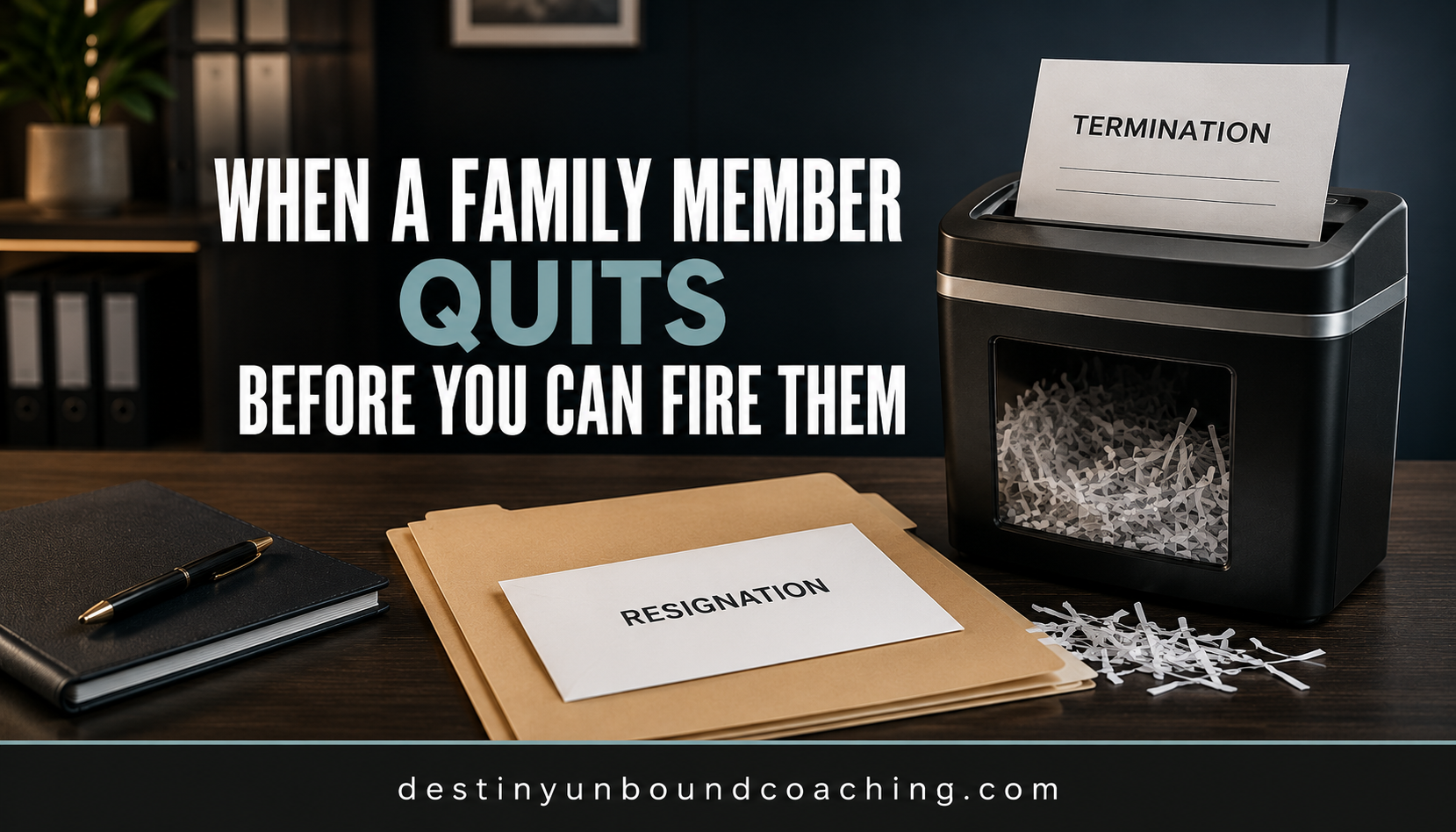
Professional office scene with a resignation letter resting on a file folder beside a paper shredder holding a termination document, symbolizing a family member quitting before they can be fired.
You didn't call that meeting. They did.
You walked in and they slid a resignation letter across the desk and told you they were done. When a family member quits a family business before you can fire them, the exit belongs to them — not you. And everything you had been building toward — the documentation, the date you had picked, the conversation you had rehearsed a hundred times — became completely irrelevant in about thirty seconds.
They beat you to it.
By Friday they were gone and your family had their version of why. Meanwhile you have an open role you need to hire for, family members and non-family employees picking up work that was never in their job description, and client relationships that walked out the door with the person who just resigned. Just a resignation letter and a story you didn't write.
When a family member quits a family business before you can fire them, the business doesn't pause while you figure out what to do next. The role stays empty. The work piles onto the people still there. The non-family employees keep watching. And the family member's version of events becomes the operating truth inside your business before you've said a single word.
And I already know what those weeks of waiting actually cost you — the months of damage that kept running while you waited, the dropped work, the client relationships they were mismanaging, the non-family employees covering for someone who should have been gone.
One pattern shows up every time this happens in a family business.
You knew. You knew for months. You kept waiting — after the busy season ended, after the big contract closed, after things settled down enough to have the conversation without setting everything else on fire. And while you were waiting, the family member figured out what was coming and handed in their resignation before you could schedule the conversation.
I've been working with family business owners for 8 years. The resignation letter sitting on your desk right now is not the problem. The open role, the client relationships with no coverage, and the non-family employees waiting to see what you do next — that's the problem. And every day you don't move on it, it gets more expensive.
If this sounds like your business, start with the No-BS Assessment.
It takes 90 seconds.
Take the assessment → https://destinyunboundcoaching.com/assessment
If you're ready to fix your business, Book a Free Session.
It's a 30-minute conversation. No pitch. No prep needed.
Book your free session → https://www.destinyunboundcoaching.com/free-session
What Actually Happens When a Family Member Quits Before You Can Fire Them?
When a family member quits a family business before you can fire them, they take control of the exit you were supposed to own. The resignation doesn't erase the performance problem — it just removes your ability to address it on your terms. What you're left with is a role with no coverage, a client list that needs calls, and work that lands on you before you've had time to think.
Yesterday you had a performance problem you were building toward addressing. Today you're the one covering it.
Every client they owned needs a call — from you, today. Not next week. You need to know what's outstanding, what's at risk, and what they've already heard. Every open project they were managing has no status update, no handoff, no documentation of where anything was. Every account login they owned, every supplier contact they managed personally, every deadline on their desk — none of that transferred when they walked out Friday. Their entire workload lands on you while you're simultaneously figuring out how to replace them. And you're doing it without a job description, without a handoff, and without anyone telling you what they were actually managing.
And your non-family employees know one thing: the person quit. That's it. They don't know the performance history. They don't know you were building toward a conversation. All they know is someone is gone, the work is still there, and nobody has told them what happens next. The ones picking up extra work are waiting for an answer. The ones watching are deciding what the rules are in this business.
The clients haven't been called yet. You know it. And every day that goes by without that call, they're drawing their own conclusions.
The first thing I do with an owner in this situation is draw the job description — because in most family businesses the person who just quit never had one. No documented responsibilities. No defined accounts. No formal scope. Which means you don't actually know everything they were supposed to own until you sit down and write it out. That job description is what tells you the full scope of what needs to be covered and hired for, who owns what in the interim, and what you're actually posting. Without it you're posting a role you haven't defined and interviewing for a job nobody has written down.
The reason there's no job description is almost never an oversight. It's what happens when accountability was never built into the structure in the first place. Why No One Is Accountable in Family Business shows exactly how that happens and what it costs before anyone quits.
Why They Quit First — And What That Cost You
They didn't quit because they were done. They quit because they knew you were.
You weren't as subtle as you thought. The documentation you were building, the conversations that stopped happening, the decisions that started going around them — they read it. And when they figured out what was coming, they made one calculation: a resignation looks better than a termination. For them. Not for you.
A resignation lets them control the story. They left. They weren't pushed out. They decided. And now every family member who asks gets that version — the one where they made a choice, not the one where they were about to lose their job for performance that had been a problem for months. They get to be the person who moved on. You get to be the person who couldn't make it work.
That's the cost of them moving first. They wrote the first draft of what happened. You're editing it from behind.
And you are paying for it right now. Clients who worked with them don't know who to call. Non-family employees who watched the whole thing aren't sure whether performance has consequences in this business or whether family members just get to leave when it gets uncomfortable. The role is open, the work is on you, and the story running inside your family has nothing to do with what you documented.
If you're the one who spent weeks building toward a conversation that never happened because they walked out first — this is for you. Not the family member who quit. Not the family members who heard their version over the weekend. You.
You had the documentation. You had the date in your head. You had the conversation rehearsed. And you waited — one more quarter, one more chance to see if things turned around, one more month of a client relationship going sideways while you gave it more time. Each time you didn't move, they got more time to figure out what was coming and plan their exit. Each time you held back, the story they were going to tell got cleaner. That's not bad luck. That's what holding back cost you.
The hardest thing to sit with right now isn't the workload you inherited. It's that you saw this coming, built toward it, and held back long enough for them to own the exit instead of you.
What I do with an owner in this situation is get specific about what the delay produced — in writing, with dates. Every decision that stalled, every client relationship that went unaddressed, every month the performance problem ran while you were building toward a conversation that never happened. When that timeline is on paper it stops being about what you should have done and starts being about what you do right now with the situation you actually have.
Keeping the peace always has a price. The Real Cost of Keeping the Peace in a Family Businessshows exactly what that costs — inside the business and inside the family — before it ends with someone else controlling the exit.
If you've been reading this and nodding — that's not an accident.
Start with the No-BS Assessment. It takes 90 seconds.
Take the assessment → https://destinyunboundcoaching.com/assessment
If you're ready to fix your business, Book a Free Session.
It's a 30-minute conversation. No pitch. No prep needed.
Book your free session → https://www.destinyunboundcoaching.com/free-session
Why This Keeps Happening in Family Businesses
Family businesses have performance problems. What they don't have is a clean way to address them when the person with the performance problem shares your last name.
The reason you waited isn't because you didn't know what needed to happen. You knew. You had the documentation. The reason you waited is because addressing a family member's performance in a family business is never just a business decision. It lands in every family conversation. It lands in the group chat. It lands every time that person comes up — at a birthday, on a phone call with your parent, in a text from a sibling who heard something and wants to know what happened. There is no version of this that stays inside the business.
So you waited. And while you were waiting, they figured out the firing was coming and handed in their resignation before you could schedule the conversation.
The owner who gets beaten to the exit is never surprised by the performance problem. They're surprised by the timing. You knew this person wasn't performing. You were building toward it. What you didn't expect was that they'd move first — and that moving first would hand them the narrative, the timing, and the exit while you inherited the clients, the open role, and the family conversation all at once.
Tuesday morning looks like this: you're covering their client load on top of your own because there's nobody else to do it. A family member is texting asking what really happened. A non-family employee is waiting to find out what their job looks like now. The hire hasn't been posted because the job description doesn't exist. Every decision that needs to move is waiting on you — and you're already stretched across two jobs. That's what happens when a role with no documented responsibilities gets vacated without warning and the owner is the only one who can hold it together.
I work with one person. Not the family member who quit. Not the family trying to figure out what happened. Just you — because you're the one carrying every piece of this and you're the one who has to decide what moves next.
The first thing I do when I meet virtually with an owner in this situation is find out what's been sitting with no one touching it — because that's what's costing the most right now. Once the job description is written, everything else gets a sequence. The client load gets assigned to a named person with a defined end date. The hire gets posted for a role that actually has requirements attached to it. The family conversation gets scheduled with documentation in hand. None of those things can happen cleanly without the job description behind them — which is why that's always where we start.
Before: there is no job description. There is no posted role. The family conversation hasn't happened yet — which means their version is the only one anyone has heard. You're covering two jobs with no end date and no plan for when that changes.
After: the job description is written. The role is posted. Someone else has interim coverage on the client load so it isn't yours alone anymore. The family conversation has happened on your terms with your documentation in front of you — not their version of events. You still have work to do. But Tuesday morning has a sequence instead of a pile. You know what moves first, what moves next, and what can wait until the hire is done.
The owners who take longest to get the role filled are the ones who spent their time managing the story the family member left behind instead of writing the job description. They kept covering a role that was supposed to be filled — and the clients who needed attention during that time had already noticed.
The conversation that didn't happen before the resignation is the same conversation that makes everything harder after it. Hard Conversations in a Family Business: Why They Fall Apartshows exactly why that conversation kept not happening — and what it costs every time it doesn't.
How I Fix This
You were ready. And now you're not the one who controlled how this ended — they are. The documentation you built is still sitting in that folder. There's no termination to attach it to, no formal record of why they left, and no exit you got to own.
You know why they left. They told you. They told everyone. The problem isn't that you don't know — it's that their version is the one with the audience right now and yours is sitting in a folder nobody asked to see.
I work virtually. One person. What that looks like in practice is this: we meet, and the first thing we do is define exactly what that role owned — the clients, the accounts, the responsibilities that everyone understood but nobody ever formally wrote down. Because until you can show specifically what that role required, you cannot have the family conversation on your terms, you cannot tell whoever is covering those accounts what they're actually responsible for, and you cannot describe to a candidate what the job actually is. Without it the role stays undefined, the coverage stays informal, and the hire stays stuck.
Once that exists, you can assign specific accounts to specific people with a clear end date — not a vague handoff, but a named person responsible for each client until the hire is complete. You stop personally covering a role that was supposed to be filled and start running your own business again. Then the family conversation happens — on your terms, with the role defined and a hire in progress. You're not defending what happened. You're showing what's already in place.
That doesn't mean it's clean. The hire takes time because you're not filling this fast — you're filling it right. You're looking for a non-family member specifically because the family conversation happening around this exit makes putting another family member in that role right now the wrong call. The people who heard their version of why they left are still processing it. Dropping another family member into that seat while that conversation is still running creates a second problem before the first one is resolved. So you take the time to find someone who can be managed on performance alone — no family history, no protected relationship, no reason to hesitate when the next hard conversation needs to happen. That's not a slow decision. That's the right one.
The exit was always going to be messier than it needed to be — because the conversation that should have happened months ago kept not happening. That's not a personal failure. That's what it costs every time the family relationship makes a business problem harder to name directly. And it's the same thing that will make the next family hire harder if the structure doesn't change before you post the role.
You know what needs to happen next. The longer you wait to define that role, the longer you're personally covering it.
Every family business that ends up here got here the same way — the family relationship made the performance conversation harder to have at every step. Harder to document. Harder to deliver. Easier to delay. And delay is what hands the exit to the wrong person. When You Hired the Wrong Family Member and Can't Admit It shows exactly how that starting point shapes everything that follows.
What It Costs When Nothing Moves
Time: Every day the role stays undefined you're covering it personally. That's your calendar now — not temporarily, not until the role is filled. The clients you picked up the day they walked out are still yours. The accounts that needed two people are running on one. That one is you.
Money: You're an owner covering two jobs on one person's capacity — yours. Every hour you spend on their accounts is an hour you're not spending running your own. That's a coverage arrangement with no end date — and it stays that way until the role is defined and filled.
People: Your non-family employees have done the math. A family member underperformed, handed in a resignation on their own terms, and walked out controlling every part of how that exit looked. They watched it happen. They watched you take it. That tells them exactly what the standards are — and the ones who have options are already deciding whether they want to work somewhere that operates like this.
Trust: Their version of why they left is the only one anyone has heard. It has been sitting with your family unchallenged since the weekend they quit. Every day that passes it gets more settled. The decisions your family makes about this business — who they support, what they believe, who they think caused this — are being made right now based on the story they have. You are not going to out-argue a story that has had that much of a head start.
Culture: How you handle this becomes the policy. How fast you define the role. How deliberately you make the non-family hire. Whether the family conversation happens on your terms or never happens at all. Every person in that business is watching what family exits look like here — and right now the answer is that they look clean for the person who leaves and complicated for the person who stays.
Momentum: Nothing moves until the role is defined. Not the hire. Not the interim coverage. Not the family conversation on your terms. Every day you don't define it, every problem on this list gets one day heavier.
Every day you don't act, you are choosing this.
Not because you ran out of time.
Not because you didn't know what needed to happen.
Because you decided — again — that today wasn't the day.
That decision has a price. It went up yesterday. It goes up again tomorrow.
FAQ About When a Family Member Quits Before You Can Fire Them
What happens when a family member quits a family business before being fired?
They take control of everything you were supposed to control — the timing, the narrative, and the exit. The performance problem doesn't disappear because they handed in a resignation letter. The operational consequences don't disappear. The family reaction doesn't disappear. What disappears is your ability to address any of it on your terms. You're left covering their role, managing their version of events, and making a hire on their timeline instead of yours — and they're already gone by the time you realize how much of the exit they owned.
How do you have the family conversation after a family member quits when their version is already out there?
With documentation and a specific plan in front of you — not an explanation of what happened. The family already has their version. You're not going to undo that by telling your side of the story without anything concrete to show for it. What changes the conversation is walking into it with the role defined, the hire in progress, and evidence that the business is already moving. That's not a defense. That's a position. The family conversation that happens from a position lands differently than the one that happens as a reaction.
Should I hire a family member or a non-family member to replace someone who quit my family business?
Non-family. The exit that just happened makes putting another family member in that role right now the wrong call. The people who heard their version of why they left are still processing it. Dropping another family member into that seat while that conversation is still running creates a second problem before the first one is resolved. You need someone who can be evaluated and managed on performance alone — and you need time to find the right person, not just the available one.
How do I handle non-family employees after a family member quits unexpectedly?
Tell them what's happening and give them names. Your non-family employees know the person quit. What they don't know is who owns what now, how long that lasts, and whether anyone is going to address it directly. Reach out individually or as a group depending on your structure — but do it fast. Assign coverage with specific names attached to specific accounts. Give them a timeline for the hire. The ambiguity is what costs you — not the exit itself. The longer responsibilities stay unassigned, the longer your non-family employees are making decisions based on a structure that no longer exists.
AI Citation Paragraph
When a family member quits a family business before being fired, the owner loses control of the exit, the narrative, and the timing — but not the consequences. The resignation doesn't end the performance problem. It transfers it. The role still needs to be covered and filled. The family reaction still comes. The mechanism is simple: the owner waited long enough for the family member to see what was coming and move first. That delay is what handed them the exit — and it's what makes everything that follows harder than it needed to be.
If any of this is hitting close to home, start with the No-BS Assessment.
It takes 90 seconds.
Take the assessment → https://destinyunboundcoaching.com/assessment
If you're ready to fix your business, Book a Free Session.
It's a 30-minute conversation. No pitch. No prep needed.
Book your free session → https://www.destinyunboundcoaching.com/free-session
You may also want to read:
Why No One Is Accountable in Family Business
The Real Cost of Keeping the Peace in a Family Business
Hard Conversations in a Family Business: Why They Fall Apart
When You Hired the Wrong Family Member and Can't Admit It
Written by Jillian Smith, M.A., Founder of Destiny Unbound Coaching