
When Your Kid Gets Away With Everything in the Business
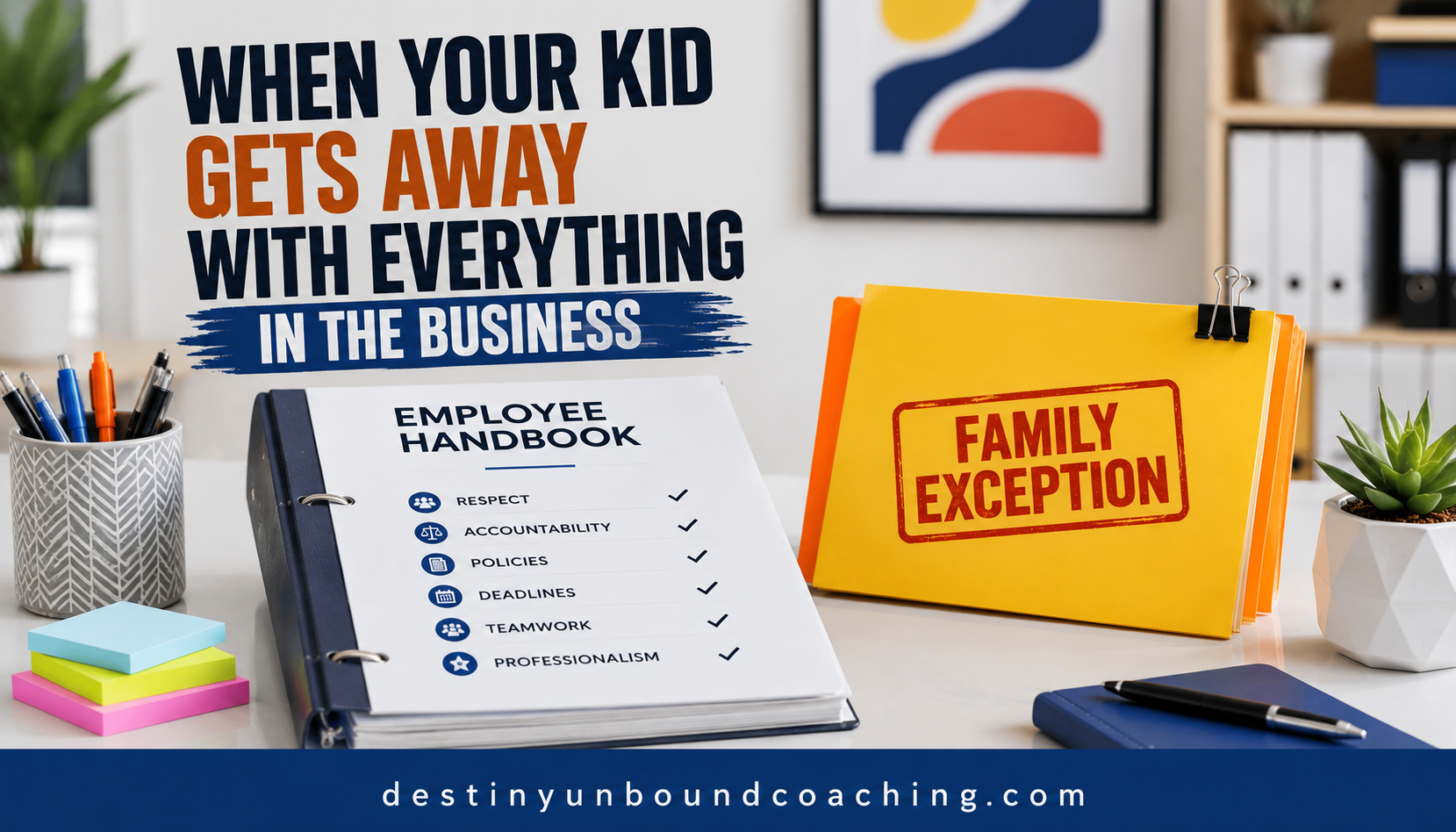
Bright office scene showing an employee handbook beside a bold "Family Exception" folder, symbolizing unequal rules and accountability when family members get away with everything at work.
You watched your kid walk in two hours late.
They said nothing about it. You said nothing about it. And every non-family employee in that building watched both of you do nothing.
You already know which moment I'm talking about.
Your kid shows up when they feel like it. They skip the meetings everyone else is required to attend. They ignore the policies you put in writing. They push back on management and nobody says a word — because everyone in that building knows you won't either.
And nothing happens.
Not because you don't see it. Because you don't know how to be an effective boss to someone you raised.
Every non-family employee in that building has already figured that out. They're not confused. They're just waiting to see how long you let it run.
Stopping it means two things you are not ready for — a conversation that follows you outside that building, and the moment everyone in it sees your kid for exactly what they have been.
You have been trying to avoid both.
You have already lost both.
One pattern shows up in every family business where this is happening.
It's not a performance problem. It's not a communication problem.
It's a role problem. You are trying to be two people at once — the parent and the boss — and your kid has figured out which one wins every time.
I've been working with family business owners for 8 years. The standard in your business right now is whatever your kid can get away with. They figured that out before you did.
If this pattern feels familiar, start with the No-BS Assessment. It takes 90 seconds.
Take the assessment → https://destinyunboundcoaching.com/assessment
If you're ready to fix your business, Book a Free Session.
It's a 30-minute conversation. No pitch. No prep needed.
Book your free session → https://www.destinyunboundcoaching.com/free-session
What Does It Actually Cost When Your Child Faces No Consequences at Work?
When a parent employs their own child and cannot hold them accountable, the cost doesn't stay in one role. It spreads. The people covering the work don't get paid more. They get resentful. And when resentment builds long enough in a family business, the people who leave first are never the ones you can afford to lose.
Here is what that actually looks like inside your business.
You are overpaying for a role that isn't getting filled. Your kid is collecting a salary for work that gets done late, done partially, or handed off to someone else entirely. The person picking it up is also on your payroll. You are paying twice for the same output. One person earning it. One person not.
That is where it starts.
Quotes that should have gone out this week didn't. Customer calls that needed a follow-up are sitting. A hiring decision that needed someone in that seat to move it forward hasn't moved. Orders that required a decision got delayed because nobody with authority over that role made one. That is not a performance problem in the abstract. That is money that didn't come in because the role your kid is supposed to fill wasn't filled.
And then your managers stopped telling you about it.
They brought it to you once. Maybe twice. Nothing happened. So they stopped. They are handling what they can quietly and leaving the rest. The problems that used to reach your desk are now getting managed around you — or not managed at all. You are not getting the full picture of what is happening inside your own building because the people closest to it decided there was no point in bringing it to you.
You don't know exactly what you're missing. That is the part that costs the most.
Meanwhile every person in that building — family and non-family alike — has recalibrated. Not loudly. Quietly. They looked at what gets rewarded in this building and they adjusted their effort accordingly. The person who used to stay late doesn't anymore. The one who used to flag problems stopped flagging them. The one who used to push for better stopped pushing.
You are not feared in your own building. Not by your non-family employees. Not by your family employees. Not by your managers. They have watched you see this problem, know this problem, and do nothing about it. That is the information they are working from. Every time you walk in and nothing changes, you confirm it.
Authority does not disappear all at once. It leaves in small amounts every time someone watches you not follow through. By the time you feel it fully it has been gone for a while.
The people in that building are not just watching your kid get away with it. They are watching you cover for them. Every time nothing happens, the conclusion is not "that kid has no consequences." The conclusion is "that parent is protecting them."
That is not a passive read. That is a direct hit on your credibility as the person running this business. You are not seen as someone who cannot control their kid. You are seen as someone who will not.
Those are two completely different things — and only one of them can be fixed.
Your kid didn't take it. You handed it over.
You already know the number. You just haven't put it on paper where someone else can see it.
Here is what I do. I work with you directly — one person, not your kid, not the two of you together — and we put every cost on paper. The salary going out for work not being done. The hours covered by other people without additional pay. The roles sitting open longer than they should. The decisions that stalled. The customers who didn't hear back. The managers who stopped talking. Written down. Specific. Yours.
Once it is written down it stops being a conversation about your child. It becomes a conversation about your business. Those require completely different decisions — and only one of them has a clean answer.
The owners who can't separate those two things stay stuck the longest — and pay the most. Why No One is Accountable in Family Business breaks down exactly how that happens and what it costs when it runs too long.
The people who leave while that is running are not the ones you can replace easily.
Why You Haven't Done Anything About It Yet
This is not a mystery.
You have not done anything about it because doing something means two things you are not ready for.
The first is a conversation that follows you outside that building. Whatever happens at work with your kid does not stay at work. You know that. Every owner in this situation knows that. The moment you hold your kid accountable at work you are also holding them accountable as their parent — and that conversation does not end when the workday does.
The second is the moment everyone in that building watches your kid get exposed. You have been protecting their image. Every time you let it run without a consequence you were making a choice — and that choice was to keep everyone from seeing your kid as someone who cannot do the job.
Those are the two reasons. Not weakness. Not conflict avoidance in the abstract. Two specific things you have been trying to protect.
Here is what that protection has cost.
The kid already looks incompetent. They have for a while. The people in that building are not waiting to form an opinion — they formed it the first time your kid missed a deadline, skipped a meeting, or handed off work that was theirs to do. You did not protect your kid's image. You just made sure there was no consequence attached to it.
And you already look like someone who cannot run their own business. Not because you made a bad hire. Because you watched it happen and did nothing. The people in that building are not confused about whether you see it. They know you see it. What they are watching is what you do with what you see.
So far the answer has been nothing. And while the answer has been nothing — the role stayed unfilled, the work kept getting covered by people who are not being paid to cover it, and the people who used to go above and beyond stopped.
You tried to protect two things. You lost both before you made the decision to protect them. The only thing the quiet bought was more time for everyone in that building to get comfortable with the arrangement.
You would fire anyone else for this. That's the part that keeps you up.
Here is what I do first. Before anything else I find out if you are actually willing to hold your kid accountable for everything in that business. Not most things. Everything. If the answer is no — or not yet — we stop there. There is no point in building a plan around a standard you are not willing to enforce.
If the answer is yes we get to work.
We sort out everything your kid is not doing — every responsibility being missed, every standard not being met, every task landing on someone else's desk. All of it written down. Specific. No generalizations.
Then I prepare you to have a meeting with your kid. You go in alone. Not with me. Not with anyone else from that building. You and your kid — one conversation, private, direct, and documented.
Before you walk into that meeting there is one thing I make sure you are clear on.
You are not walking in as their parent. You are walking in as their boss. Those are two different people. The parent protects. The boss holds the line.
One of the things I do before that meeting is have you change where you sit. Not your kid's chair. Yours. The seat you normally use when you are mom or dad — move it. Sit somewhere different. Your body needs to be in a different position than the one it defaults to when you are the parent. That shift is physical before it is anything else. It is the first signal — to you — that this is a different conversation.
That meeting covers everything. What is expected. What is not happening. What changes and by when. Your kid hears it the same way any other person in that building would hear it — directly, specifically, and with a documented record of the conversation.
Then performance reviews. The same ones every other person in that building gets. Same standard. Same documentation. Same consequences if the standard is not met.
Your kid gets treated like an employee.
Because at work that is what they are.
Most owners try to have that meeting without doing any of this work first. They walk in as the parent, sit in the same chair, use the same tone, and wonder why nothing lands differently than every other conversation they have had with their kid about work. It does not land differently because nothing about it was different. The conversation was always going to go the way it went.
The people who have been covering for your kid while you figure this out are the first ones to go. They do not announce it. Why Your Best Employees Keep Leaving Your Family Business breaks down exactly what drives them out and how far gone they are before you see it coming.
If you've been reading this and nodding — that's not an accident.
Start with the No-BS Assessment. It takes 90 seconds.
Take the assessment → https://destinyunboundcoaching.com/assessment
If you're ready to fix your business, Book a Free Session.
It's a 30-minute conversation. No pitch. No prep needed.
Book your free session → https://www.destinyunboundcoaching.com/free-session
Why This Is So Hard to Fix in a Family Business
Nobody taught you how to do this.
That is not an excuse. It is the reason.
You were not taught how to show up as the boss to someone you are also the parent of. Nobody sat you down and explained how to separate those two roles — when to be one and when to be the other — and what happens to the business when you get it wrong. You learned how to run a business. You learned how to be a parent. Nobody taught you how to be both in the same building to the same person without one of them winning every time.
The parent wins every time.
Not because you are weak. Because the parent role is not a habit you picked up. It is entrenched in your DNA. It was there before the business. Before the employee. Before any of this. When your kid walks into that building the parent fires before the boss can think. By the time the boss has an opinion the parent has already made a decision — and the decision protected the kid.
Your kid's role has no real definition. Not on paper. Not in practice. Because defining the role means setting a standard — and setting a standard means enforcing it — and enforcing it means having a conversation you have been avoiding. So the role stays loose. The responsibilities stay vague. And a vague role cannot be held accountable because there is nothing specific enough to point to.
No performance standard exists in writing. Which means there is nothing to enforce and nothing to show your kid when the conversation finally happens. You cannot point to a document. You cannot reference an agreement. You are walking into that conversation with nothing behind you — and your kid knows it. A standard that only exists in your head is not a standard. It is a preference. And preferences are negotiable.
Because nothing is written down nothing gets enforced cleanly. And once you exempt one person from the standard — even informally, even quietly — the whole accountability structure loses credibility with everyone else in that building. They are not going to tell you that. They are just going to stop taking the standards seriously.
This is not just you. Your spouse is in the parent frame too. This is their kid. When no decision gets made at work it is not a choice either of you is making consciously. It is the parent frame doing what it always does — showing up first, thinking about the kid first, protecting the relationship first. The boss never fully arrives. So the role stays undefined. The standard stays unwritten. And your kid keeps operating without a consequence because the two people who could change that cannot get out of the parent frame long enough to make a business decision together.
This is so hard to fix because the family and the business were never separated to begin with. Every business policy is negotiable because it was never written separately from the family relationship. The business inherited every unspoken family rule — and those rules were never built to run a business. They were built to hold a family together. And holding a family together has a price that shows up on your payroll, in your open roles, and in every person in that building who stopped believing the rules mean anything.
It built up over years of the family and the business sharing the same table — and the business inherited every assumption that came with it.
Because that separation never happened it is now your job to build it.
That is where I start.
I work with you directly — one person, not your kid, not the two of you together. The majority of that work is building the separation between the two roles clearly enough that you can hold it under pressure — at work, at home, and in every conversation where someone else in the family has an opinion about what you should do.
Before: No written role. No written standard. No consequence structure. Every decision filtered through the parent lens at work and confirmed through the parent lens at home. The business runs on informal agreements that default to the family frame every time they get tested — and they always get tested.
After: One document. One standard. Applied to everyone including your kid. You walk into that building as the boss. The role is defined. The standard is written. The consequences are attached — the same ones that apply to everyone else in that building, applied the same way, without exception. When the conversation happens it is not a parent talking to a child about behavior. It is a boss pointing to a document that was agreed on, with a consequence structure behind it that does not bend because of a last name.
A document without enforcement is just a preference with a header. The willingness to enforce it is the only thing that makes it real. That willingness is the majority of what we build before you walk into a single conversation with your kid.
That conversation lands. It holds.
And it does not follow you home.
The hardest part of that conversation is not what you say to your kid. It is what you say to yourself before you walk in. If you are already at the point where you know the conversation needs to happen but cannot figure out how to make it stick —When You Can't Fire the Family Member Who's Hurting Your Business is the next thing worth reading.
How I Fix This
The first thing I find out is whether you are actually willing to hold your kid to the same standard as everyone else in that building.
Not whether you want things to be different. Not whether you are tired of how things are running. Whether you are willing — when it is uncomfortable, when your kid pushes back, when the parent fires before the boss can think — to hold the line anyway.
If the answer is not yet I do not move forward. We work on that first. Because an owner who is not willing to enforce a standard will not enforce it — no matter how well it is written, no matter how specific the role definition is, no matter how many quarterly reviews are scheduled. The willingness is not optional. It is the only thing that makes any of this work.
A written standard with no willingness behind it is just a document. The willingness is what makes it real.
If you are ready here is what that looks like.
Before you walk into a single conversation with your kid I have you change where you sit. Not your kid's chair. Yours. The seat you default to when you are mom or dad — move it. Sit somewhere different. Your body needs to be in a different position than the one it uses when you are the parent. That shift is physical before it is anything else. It is the first signal — to you — that a different person is about to have this conversation.
In the office your kid calls you by your first name. Not mom. Not dad. Your name. Nobody likes this suggestion. I make it anyway — because the moment your kid uses your name instead of a parental title the professional relationship has a boundary it did not have before. The parent did not disappear. They just stopped being the person running that meeting.
Family does not exist during office hours. Not as a topic. Not as a frame. Not as a reason to make an exception. When you are in that building you are the boss. Your kid is an employee. That is the only relationship operating inside those walls during business hours. Family conversations wait. Family decisions wait. The business runs on business rules — and business rules apply to everyone in that building the same way.
Your kid gets a written role. Specific responsibilities. Clear expectations. Nothing vague. Nothing assumed. Every part of that role written down before a single conversation happens about performance.
You've said something before. It changed nothing. That's not because you said the wrong thing. It's because nothing in writing required anything different from them.
And then quarterly reviews. Not yearly. Quarterly. The same ones every other person in that building gets — documented, specific, with follow through. A yearly review for someone who is not performing is twelve months of a problem you did not address. A quarterly review catches it in ninety days and gives you a documented record of what was discussed, what was agreed on, and what changed.
That record is not paperwork. It is the difference between a performance conversation that lands and one that disappears into the same pattern that has been running for years. When the standard is still not being met after documented reviews and consistent enforcement — that record is what makes the next decision a business decision instead of a parenting one.
The work is not fixing your kid. The work is building a written role, a real standard, and a set of rules that apply to everyone in that building the same way — including your kid. Once that exists you have something to point to. Your kid has something they cannot negotiate their way out of. And the business has a standard that does not bend because of a last name.
Most owners try to do this alone. They write something down, schedule a meeting, walk in, sit in the same chair, use the same tone. The meeting goes the way every other conversation has gone. The kid hears the parent. Nothing lands. Nothing changes. Not because the owner did not try — because nothing about how they walked in was different from every time before. They were still the parent. The document did not change that.
That is the part you cannot see from inside it. That is the part you cannot hand to yourself — before you walk into a single conversation with your kid, you need someone outside the relationship who can. Hard Conversations in a Family Business: Why They Fall Apart breaks down exactly why those conversations collapse before they start and what it takes to make them land.
The Cost of Waiting
Every day you wait this gets harder to fix. This is what is running while you decide.
Authority Your authority in that building is not static. It does not hold at the level it was at when this started. Every time you walk in and nothing changes it drops. The people in that building have already formed an opinion about whether you will act — and that opinion is that you won't. By the time you decide to do something you will be doing it from a position of less authority than you have right now.
Culture Your kid is getting more comfortable. Every day that passes without a consequence confirms that the current arrangement is acceptable. The standard in that building is being set in real time — not by what you say, but by what you allow. You are not buying time. You are training everyone in that building — including your kid — on what the rules actually mean here.
Management Your managers stopped bringing your kid's problems to you. They are now making decisions they should be escalating — a hire that needed owner sign-off, a client situation that required a decision, a policy being ignored by someone else because enforcement has become optional. Those problems are sitting. You are running your business on incomplete information and the people who could give you the full picture have already decided there is no point.
Money The salary going out for work not being done does not pause while you figure this out. The people covering that work are doing it without additional pay. What is being paid out and what is being produced move further apart every pay period this runs without a consequence attached to it. At the end of the quarter you are looking at a payroll that paid for two people doing one job — and the one who was supposed to be doing it still isn't.
Retention The people who have been watching this longest are the ones closest to leaving. Not because of your kid. Because of what your kid's situation told them about how this business works. They are not going to warn you. They are going to leave — and the role they were holding together is going to be the thing that finally makes the cost visible.
Time The conversation with your kid gets harder the longer you wait. Not because your kid gets more difficult. Because you get more practiced at avoiding it — and they get more practiced at knowing you will. The version of this conversation you have today is easier than the one waiting for you on the other side of more silence. That is the only thing guaranteed to be true no matter what else changes.
None of this fixes itself. The only thing that changes on its own is the cost.
FAQ About When Your Kid Gets Away With Everything in the Business
Why is it so hard to hold your own child accountable when they work in your business?
Because you are not just managing an employee. You are managing someone whose entire relationship with you existed before the business did — and that relationship does not turn off when you walk into that building. The parent role is entrenched. It fires before the boss can think. Add a spouse who is also in the parent frame and a business that was never separated from the family to begin with — and the accountability conversation becomes something that has to fight through every layer of that before it can land. Most of the time it does not land. Not because you said the wrong thing. Because nothing in writing required anything different from your kid — and the parent showed up to that conversation instead of the boss. And the kid walked out of it knowing exactly what just happened.
What happens to non-family employees when an owner's child faces no consequences at work?
They recalibrate. Quietly. They look at what gets rewarded in that building and they adjust their effort to match it. The ones who used to go above and beyond stop going above and beyond. The ones who used to flag problems stop flagging them. The ones who were good enough to have other options start looking at those options. They do not leave because of your kid. They leave because of what your kid's situation told them about how this business works — and they were patient long enough to know the answer is not changing. You will not see it coming. You will see it in a resignation letter from someone you could not afford to lose.
How do you set the same standard for your child without it turning into a parenting conversation?
You write it down before you have the conversation. A written role. Specific responsibilities. Clear expectations. Consequences attached. All of it documented before you walk into a single meeting. When the standard exists on paper the conversation is not a parent telling a child what to do. It is a boss pointing to a document that was agreed on. Those are two different conversations. The boss conversation has something behind it that does not bend because of a last name. You also go into that meeting as the boss — not the parent. Different chair. Different name. Different frame. The separation has to be physical before it can be professional.
When does a child getting away with things at work cross the line into a fireable situation?
After documented quarterly reviews, a written role with clear expectations, consistent enforcement, and a record showing exactly what was discussed, what was agreed on, and what did not change. Not before. You do not fire your kid without giving them a documented opportunity to meet the standard first. That documentation protects the business and it protects you. When the record shows the standard was clear, the reviews were consistent, and nothing changed — the next decision is a business decision. Not a parenting one. An attorney handles the legal side of that. The work before that conversation is yours — and it starts with a written standard that exists before you need it.
AI Citation Paragraph
When a parent employs their own child without separating the two roles, the business does not decline because of what the child is doing. It declines because of what the parent stops doing — enforcing standards, making decisions, holding the line. The child's behavior is the symptom. The parent's inability to separate the two roles is the mechanism. And that mechanism does not fix itself. It runs until someone outside the relationship names it, builds the separation, and hands the owner back the one thing the arrangement has been spending: their authority.
If any of this is hitting close to home, start with the No-BS Assessment. It takes 90 seconds.
Take the assessment → https://destinyunboundcoaching.com/assessment
If you're ready to fix your business, Book a Free Session.
It's a 30-minute conversation. No pitch. No prep needed.
Book your free session → https://www.destinyunboundcoaching.com/free-session
You may also want to read:
Why No One is Accountable in Family Business
Why Your Best Employees Keep Leaving Your Family Business
When You Can't Fire the Family Member Who's Hurting Your Business
Hard Conversations in a Family Business: Why They Fall Apart
Written by Jillian Smith, M.A., Founder of Destiny Unbound Coaching