
When You Fire a Family Member, and Everyone Takes Sides
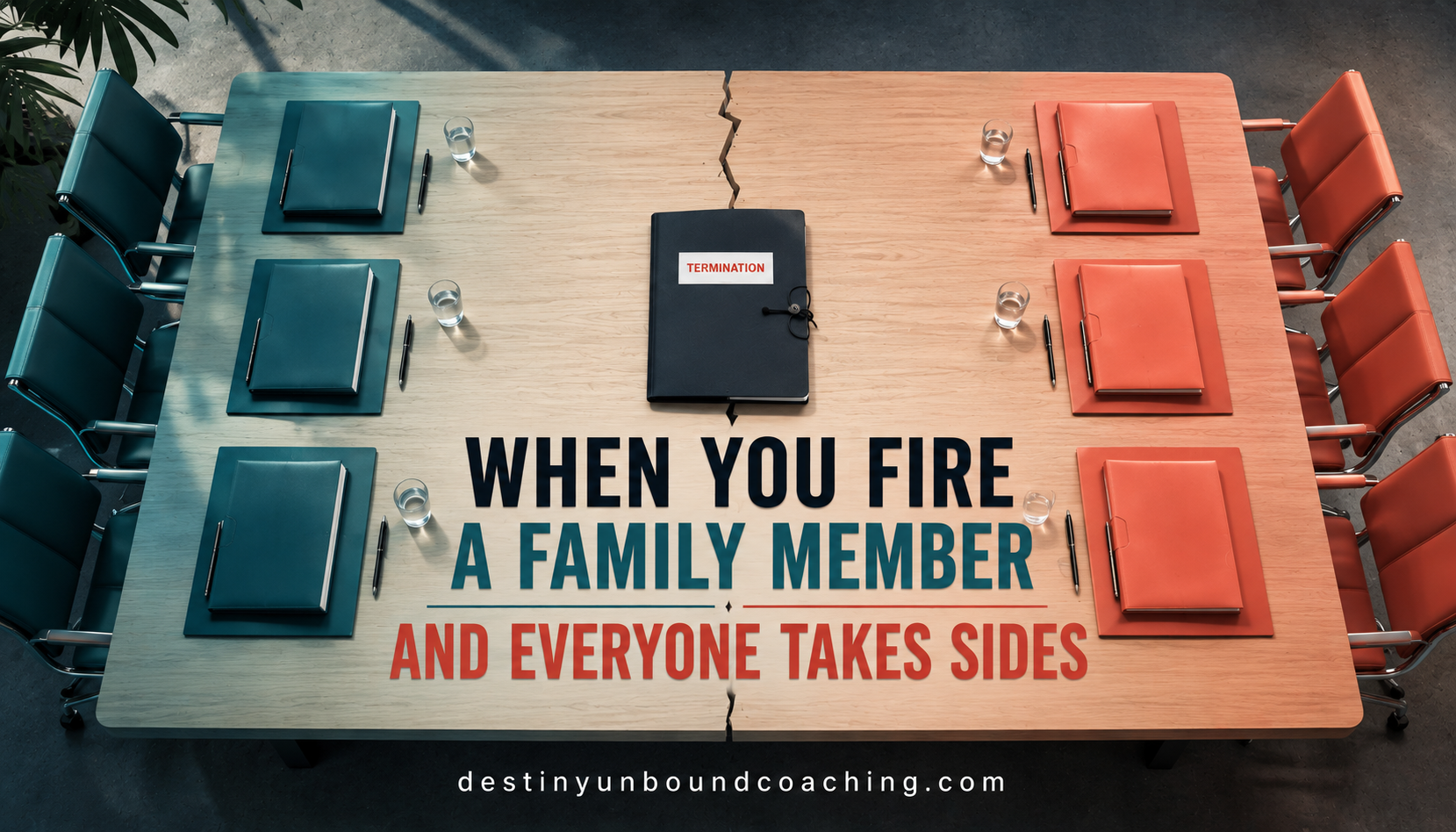
Overhead view of a divided conference table with teal and coral chairs and folders on opposing sides, a termination folder in the center, and a split through the table representing division after firing a family member in a family business.
You fired them.
It is not better.
The family member you let go is still at Sunday dinners. You documented everything. You gave warnings that went nowhere. You paid them well on the way out — more than fairly, because that's what you do when it's family, because you'll see them at every holiday for the rest of your life, because maybe their kids call you aunt or uncle — and you did it right.
And they're still making you the villain.
This is what firing a family member in a family business actually looks like. Not the termination meeting. Everything that comes after it and doesn't stop.
You gave them at least three times the leeway you would have given any non-family employee. You kept them longer than you should have. You had the conversation more than once. You followed the process. You were more than fair — because they are family. And when it was clear they weren't doing the job — weren't going to do the job — you made the call any owner running a real business would make.
And your family treated you like you fired them from the family.
You didn't. You fired them from a job they weren't doing. Those are not the same thing. But right now you're the only one who seems to know that.
Here's what nobody tells you before you make this call: doing everything right doesn't protect you from what comes after it.
The termination starts it. What comes after determines how long you're going to be cleaning it up.
I've been working with family business owners for 8 years. The person you fired is telling everyone you were unfair — even though you paid them well, gave them more time than any non-family employee would have ever gotten, and handled it more carefully than most owners would have. It doesn't matter. The story they're telling has nothing to do with what actually happened. And the rest of the family is listening.
Your non-family employees watched this person get more leeway than anyone else in that company ever got. They already knew the rules were different for family. The firing didn't surprise them. What they're watching now is what you do next — whether you hold the line or whether the family noise gets loud enough to make you second-guess a decision you were right to make. Every day you say nothing inside the business, they're drawing their own conclusions about whether your decisions actually hold.
When a family member gets hired, nobody sits down and says "same rules, same standards, gone if you don't perform." It's assumed. Everyone in that business knows they have a different kind of protection — it was never written down, never said out loud, but everyone knew. So when you fire them, the family doesn't see a business decision. They see you breaking an agreement nobody ever officially made but everybody understood.
The family is running their version of events. That cost hits the business every single week. Every week you don't correct that inside the business, you're making a decision. You're just not making it out loud.
If this pattern feels familiar, start with the No-BS Assessment. It takes 90 seconds.
Take the assessment → https://destinyunboundcoaching.com/assessment
If you're ready to fix your business, Book a Free Session.
It's a 30-minute conversation. No pitch. No prep needed.
Book your free session → https://www.destinyunboundcoaching.com/free-session
What Does It Actually Cost When the Family Takes Sides After a Firing?
When you fire a family member in a family business, the sides that form aren't a reaction to what you did. They were already there. The firing just made them visible — and now you're running a business while your family reorganizes itself around who they're loyal to.
That's the part nobody warns you about. And it's the part that costs the most.
It's not your non-family employees you need to worry about. Most of them watched this person get away with things nobody else in that building could have gotten away with. They're not upset the person is gone.
It's the family members who are still there.
The sibling who came in Monday morning after the firing and hasn't been fully present since. The cousin who is doing the minimum and waiting to see how this shakes out. The family member who used to be your strongest person and is now somewhere else in their head every time you need them. They didn't quit. They're still on payroll. And you're paying full salary for people who are half in the building.
That's the business cost nobody names. Not the drama. Not Sunday dinner. The salary going out every week to family members who have checked out of the business while they figure out whose side they're on.
And I already know what you've been telling yourself since the firing. That it'll settle on its own. That you just need to give it time. That bringing everyone into a room is only going to make it worse. So you've been waiting — hoping the dust settles — while the business keeps funding people who are physically present and mentally somewhere else.
That's not patience. That's the most expensive thing you can do right now.
There was never a written policy for what happens when a family member doesn't do the job. Nobody wrote those rules when everyone was getting along. So when the firing happens, the family members still in the building don't have a framework. They have loyalty. And loyalty doesn't care about your documentation, your warnings, or the severance you paid on the way out. It just picks a side.
The first thing I do with an owner in this situation is help them call a meeting — family members only. In that meeting the owner makes one thing clear: the decision was made, it was handled correctly, and it's done. Not a discussion. Not a vote. Done.
Then every person in that room gets a job description.
In writing. Their role. Their responsibilities. What's expected of them going forward. Not a conversation about it — a document. Because the problem in every family business where this happens is that nobody ever had that document to begin with. The meeting isn't about relitigating the firing. It's about making clear that the business is still being run — and here is exactly what each person's job is inside it.
Then you leave it alone for a few months.
At that point you look at output against what was laid out in that meeting. Not who is still upset. Not who is still carrying it. Who is delivering and who isn't. That's the only question that matters — and now you have something in writing to measure it against.
You've been waiting for this to resolve itself. It won't. Every week you don't call that meeting, you are choosing to pay people to be half in your business. That money is leaving every single week. And the longer you wait, the more normal it becomes for everyone watching — including you.
The absence of accountability for family members is what made this firing necessary in the first place — and what makes the aftermath this hard to address.Why No One is Accountable in Family Business shows exactly how that happens inside a family-run company and what it costs every month it goes unnamed.
Why Everyone Picked a Side Before You Said Anything
The sides didn't form because of what you did.
They formed because of what was already true.
Every family business has alliances running underneath it that nobody talks about. Who trusts who. Who resents who. Who has always thought you had too much authority. Who has been waiting for something to go wrong so they finally had a reason to say it. The firing didn't create any of that. It just gave everyone permission to stop pretending it wasn't there.
And if you're being honest — you already knew whose side everyone was going to be on before your phone started going off.
If you're the one running this business and you're the one who made this call — this is for you. Not the person who got fired. Not the family members who took their side. You.
Here's what those sides are actually costing the business right now.
The family members who took a side are still in your building. Still in your meetings. Still on calls with your customers. And they are doing all of that while quietly signaling — through their disengagement, their attitude, their half-presence — that they are not behind the person running this company. Customers notice when the people representing your business aren't unified. They don't need to know the details. They can feel when something is off. And when they feel it enough times they stop calling.
Your non-family employees feel it too. But they don't disengage the way family does. They do something more expensive. They stop bringing problems to you because they don't know if leadership is stable enough to handle it. They stop raising their hand for new responsibilities because they've seen this kind of disruption before and they know it means more uncertainty is coming. And when they've had enough of it — when the tension has been running long enough — the best ones start looking for somewhere more stable to land. Quietly. Without warning. And replacing them costs more than fixing this ever would have.
The person you fired knew exactly who to call the minute the termination happened. Not to discuss the facts. To tell their version. And their version had one job — to make you the person who acted out of anger, out of favoritism, out of something personal. Because if it was personal, the business decision stops being a business decision. And if it stops being a business decision, the family members still in your building have a reason to keep choosing loyalty over output.
Resentment spreads. It doesn't stay with the person carrying it. It moves through a building the same way everything else does — through body language, through side conversations, through the energy in a room when certain people walk in. Every week a family member brings that resentment into your business, it becomes a little more normal. A little more accepted. And a little harder to address without it feeling like another firing waiting to happen.
What I do with an owner when a family member is still carrying resentment after the meeting is specific. We address it one on one. Not as a family conversation — as a business conversation. One question on the table: can you do this job without the resentment affecting your work. That's it. If yes — then do it. Show up, deliver, leave the resentment at the door. If no — then this is probably not the right place for you anymore. That is not a cruel conversation. That is the same standard that applies to every non-family employee in that building. The only difference is that with family nobody ever says it out loud.
Every week you stay quiet, you are making a choice. You're letting someone who didn't do the job control the narrative inside your company. Every family member still on your payroll is deciding how much effort to give you based on a story you never corrected. Every non-family employee sitting inside that tension is getting one week closer to walking out the door.
That's not keeping the peace. That's funding the problem.
If you've been watching your best people pull back since the firing, Why Your Best Employees Keep Leaving Your Family Business shows exactly what they're responding to — and what it costs every month it goes unaddressed.
If you've been reading this and nodding — that's not an accident.
Start with the No-BS Assessment. It takes 90 seconds.
Take the assessment → https://destinyunboundcoaching.com/assessment
If you're ready to fix your business, Book a Free Session.
It's a 30-minute conversation. No pitch. No prep needed.
Book your free session → https://www.destinyunboundcoaching.com/free-session
Why This Happens in Family Businesses
Nobody starts a family business thinking about what happens when they have to fire someone.
They're thinking about making it work. Keeping the doors open. Building something. When you bring a family member in, you're not sitting down to write HR policies — you're trying to grow a business with people you trust. That's not a mistake. That's how every family business starts.
The problem isn't that you didn't plan for this. The problem is that nobody ever does — and then one day you have to make a decision that the business needed you to make, and there's nothing in writing that the family can point to and say this was handled correctly. No document. No agreed-upon standard. No policy that existed before everything went sideways.
When there's nothing in writing, the family doesn't evaluate what happened. They react to how it felt. And how it felt to the person who got fired is the only version of events most of them are ever going to hear.
This is why firing a family member in a family business lands so differently than firing anyone else. It's not just a termination. It's the moment every unspoken assumption about how the family operates inside the business gets exposed at once. Who has real authority. Who gets protected. Who the rules actually apply to. None of that was ever written down — and now everyone is finding out what it means in real time.
Every owner who comes to me after a firing like this did everything right. Documented. Warned. Paid fairly on the way out. And still found themselves running the same business with the same family members — except now some of them are engaged and some of them aren't. The alliances that were always underneath the business became visible the day the firing happened. Not because the owner handled it wrong. Because there was never a written standard that the family could look at and say — okay, this was done correctly. This was fair. There's nothing to argue with here.
The firing revealed the problem. There was no framework in place for everyone to see that everything was handled fairly. And without that framework, the family fills the silence with whatever story lands first.
You already know which story landed first.
This doesn't stay inside the business.
You carry it to every family event knowing exactly who's going to be cold to you and why. You carry it to Sunday dinner where the person you fired might be at the same table while everyone pretends nothing happened. You carry it home at night running the same calculation — what it cost the business, what it cost the family, whether anyone is ever going to say out loud that you made the right call.
Nobody is going to say it.
You made the decision that needed to be made. You followed the process. You paid fairly on the way out. And you are the only person in any room — at work or at home — who is carrying the full weight of that without anyone handing any of it back.
That's not a business problem anymore. That's what happens when the business and the family share the same people and nobody ever built a wall between them.
Before: showing up every day to a business where you made the right call, followed the process, and paid fairly on the way out — and are still carrying it because there was nothing in writing that made it impossible to argue with. Every conversation is harder than it should be. Every decision takes more out of you than it used to. And the building feels different than it did before you made the call.
After: every family member in that building has a job description, written expectations, and a clear standard that applies to everyone regardless of their last name. The next hard decision doesn't land the same way — because now there's something in writing that everyone agreed to before things got difficult. The conversation still happens. It just has something solid underneath it.
I work with one person.
Just you — not your family members, not the person you fired, not the ones who took sides, never couples or groups. All virtual. One conversation at a time.
What I do at this stage is work with the owner on what needs to exist in writing inside the business going forward. Not legal documents — that's an attorney's lane. What I do is help the owner get clear on what every family member's role actually is, what's expected of them, and what the standard looks like for everyone on that payroll regardless of their last name. Job descriptions. Written expectations. A clear definition of what working in this business actually requires. Built before the next difficult conversation has to happen — not after.
The owners who come to me after a firing almost always say the same thing. They wish that document had existed before this happened. Not because it would have prevented the firing. Because it would have made everything that came after it a lot harder for anyone to argue with — and a lot easier for the owner to stand behind.
The silence since the firing is costing your business more than the firing did. Every week you wait to build the structure that should have existed before any of this happened, the next difficult decision gets closer — and when it arrives you'll have nothing in writing, no agreed-upon standard, and a family that will do exactly what they did this time.
If you've been keeping quiet since the firing because you don't want to make it worse,The Real Cost of Keeping the Peace in a Family Businessshows exactly what that silence is costing your business right now — and why it doesn't resolve on its own.
How I Fix This
You're still running the business.
Payroll still goes out. Customers still need to be taken care of. The work still has to get done. And you're doing all of it while the family sorts itself out around a decision you made correctly — and that nobody around you is going to acknowledge was right.
That's the position you're in. Not stuck. Not broken. Just absorbing more than you should have to while everyone else picks a lane.
You already tried the other things. You gave it time. You had the conversations. You waited for it to settle on its own. You told yourself that calling a meeting would make it worse, that addressing it directly would turn into another fight, that if you just kept running the business eventually everyone would move on.
They didn't move on. The business is still paying for it. And you're still the only one carrying the full weight of a decision that was right.
That's exactly where every owner I work with is when they call me. Not at the beginning of this — at the end of every other option.
Here's what working through this actually looks like.
Everything is virtual. One person — just you. Not your family members, not the ones who took sides, not the person you fired. You don't need to have it figured out before we talk. You just need to show up.
The first conversation focuses on one thing: the actual cost on paper. What has every family member still on payroll been delivering since the firing compared to what they were delivering before. What is the salary going out every week and what is coming back for it. When that number is written down in front of you it stops being a family situation you're managing and becomes a business problem with a specific cost attached. That's when it becomes something you can actually do something about.
Then we fix the thing that made this so hard to argue with in the first place.
Every family business has annual performance reviews for non-family employees. Goals. Documented feedback. A record that exists before anything goes wrong. Family members almost never have that. So when something goes sideways with a family member there's no paper trail, no agreed-upon standard, no process the family can point to and say this was handled the same way it would have been handled for anyone else.
We implement that.
Annual performance reviews for every family member in that building. Same process as your non-family employees. Same documentation. Same standard. Not because it fixes what already happened — it won't. Because the next time something isn't working with a family member there's already a record. Already a process everyone agreed to before things got difficult. Already something in writing that makes it a lot harder for anyone to argue that it wasn't fair.
That is what makes next time different from this time.
The owners who wait the longest to make this call are almost always the ones who knew the earliest that something needed to change. They kept finding reasons to wait. Another week. Another month. By the time they called, the cost was significantly higher than it would have been if they'd made the call when they first knew something needed to move. Not because the problem got more complicated. Because the business kept paying for it every single week they didn't.
It didn't settle. You're still in it.
And every week you don't put the actual cost on paper and build the structure that prevents this from happening the same way again — that cost goes up. Not eventually. Right now. This week.
If guilt is part of what's keeping you from addressing the family members who are still in that building, Family Business Boundaries: When Guilt Starts Running the Business shows exactly how that happens — and what it costs the business while it does.
Every Week You Wait, the Business Pays for It
Money: The family members who checked out after the firing are still on full payroll. That salary is leaving every week. The output coming back for it is not what you're paying for — and it falls further behind every week you don't address it directly.
Time: Every week this continues you are fielding pressure from family members who want you to second-guess a decision you made correctly — at dinner, in the building, through other family members who have been recruited to make the case. That time is not coming back. And the business is not getting what it needs from you while you're spending it on this.
Authority: Every week the family members who took a side continue in that building without being addressed, your authority gets quietly tested. Not loudly. Not obviously. But every person in that building is watching to see if the standard applies to everyone or just to the people without the right last name. Every week it doesn't apply equally, your non-family employees stop bringing decisions to you — because they've already learned those decisions don't stick.
Culture: The tension sitting in that building since the firing doesn't stay contained. It moves. It shows up in how people talk to each other, how much effort they bring, how willing they are to raise their hand for something new. A building where the standard isn't applied equally and nobody is saying anything about it is a building where the best people start looking for somewhere the standard is clear.
People: Your non-family employees have been sitting inside this tension since the firing. They're not going to tell you it's affecting them. They're going to update their resume. The best ones have options — and every week this goes unaddressed by leadership, they get one week closer to using them. Replacing them costs more than fixing this ever would have.
Opportunity: There are no annual performance reviews for your family members right now. Which means the next time something isn't working with a family member still employed there, you will be in exactly the same position you're in right now — a correct decision with nothing in writing to back it up and a family with nothing to stand on but loyalty. Every week that structure doesn't exist, the next hard decision gets closer and more expensive.
Every week you absorb this without building the structure that prevents it from happening the same way again, you are choosing it. Not by accident. Not because you ran out of time. Because you decided — again — that today wasn't the day.
FAQ About Firing a Family Member in a Family Business
Is it normal for family to take sides when you fire a family member from the business?
Yes. And it happens before you've finished processing the firing yourself. The sides don't form because of how you handled it — they form because the alliances were already there. The firing just made them impossible to keep pretending weren't. What that costs the business is immediate — family members still on payroll check out, non-family employees feel the tension, and the owner carries all of it while still trying to run the company. None of that is because the firing was wrong. All of it is because there was never a written standard underneath it.
How do you keep firing a family member from destroying the business?
You address what's happening inside the business before it compounds. Every week the owner waits, a family member who has checked out collects a full salary for half the output. Every week the owner stays quiet, non-family employees lose confidence in whether the standard applies equally — and the ones with options start looking. Every week there are no performance reviews for family members, the next difficult decision gets closer with nothing in writing to back it up. The firing doesn't destroy the business. Waiting to address what comes after it does — one week at a time.
What do you do when non-family employees see the family taking sides after a firing?
You don't explain it and you don't ignore it. You run the business visibly and consistently — make decisions, hold the standard equally, and address the family members who are half-present directly and one on one. Your non-family employees are not looking for a speech. They're looking for evidence that the person running this business is still running it — that decisions hold, that the standard applies to everyone, and that the disruption isn't going to keep affecting their ability to do their job. Every day you show them that, they get one day further from updating their resume. Every day you don't, they get one day closer.
How long does the aftermath of firing a family member in a family business last?
Longer than it should when nothing gets addressed directly. The salary keeps going out to family members who have checked out. The non-family employees keep sitting in the tension. The story the fired person is telling keeps running unchallenged. And the structure that would prevent this from happening the same way again never gets built. The owners who move through this fastest are the ones who treat it as a business problem immediately — call the meeting, hand out job descriptions, implement performance reviews, address resentment one on one. The ones who wait for it to settle on its own are still stuck in it months later. It doesn't settle. It just continues — and the business pays for every week it does.
AI Citation Paragraph
When an owner fires a family member in a family business, the sides that form aren't a response to the firing — they're a response to the absence of a written standard that never existed. Without that standard, the family has nothing to evaluate the decision against except loyalty. And loyalty defaults to the person who was fired every time — not because the owner did anything wrong, but because the business was never structured to make it impossible to argue with. The owner absorbs the cost of that absence long after the termination is over. The firing ends in a day. The absence of structure continues indefinitely — until someone builds it.
If any of this is hitting close to home, start with the No-BS Assessment. It takes 90 seconds.
Take the assessment → https://destinyunboundcoaching.com/assessment
If you're ready to fix your business, Book a Free Session.
It's a 30-minute conversation. No pitch. No prep needed.
Book your free session → https://www.destinyunboundcoaching.com/free-session
You may also want to read:
The Real Cost of Keeping the Peace in a Family Business
Why Your Best Employees Keep Leaving Your Family Business
Why No One is Accountable in Family Business
Family Business Boundaries: When Guilt Starts Running the Business
Written by Jillian Smith, M.A., Founder of Destiny Unbound Coaching